New to online business? Start with our free 7-day roadmap and build your foundation step by step.
Get the Free Roadmap →Marketing
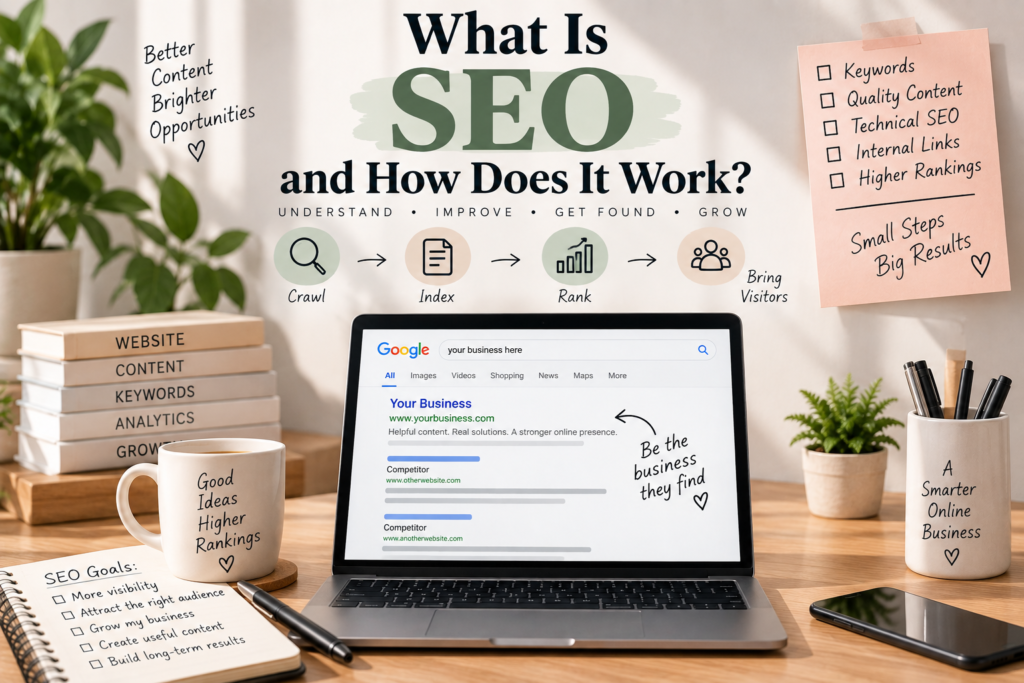
What Is SEO and How Does It Work?
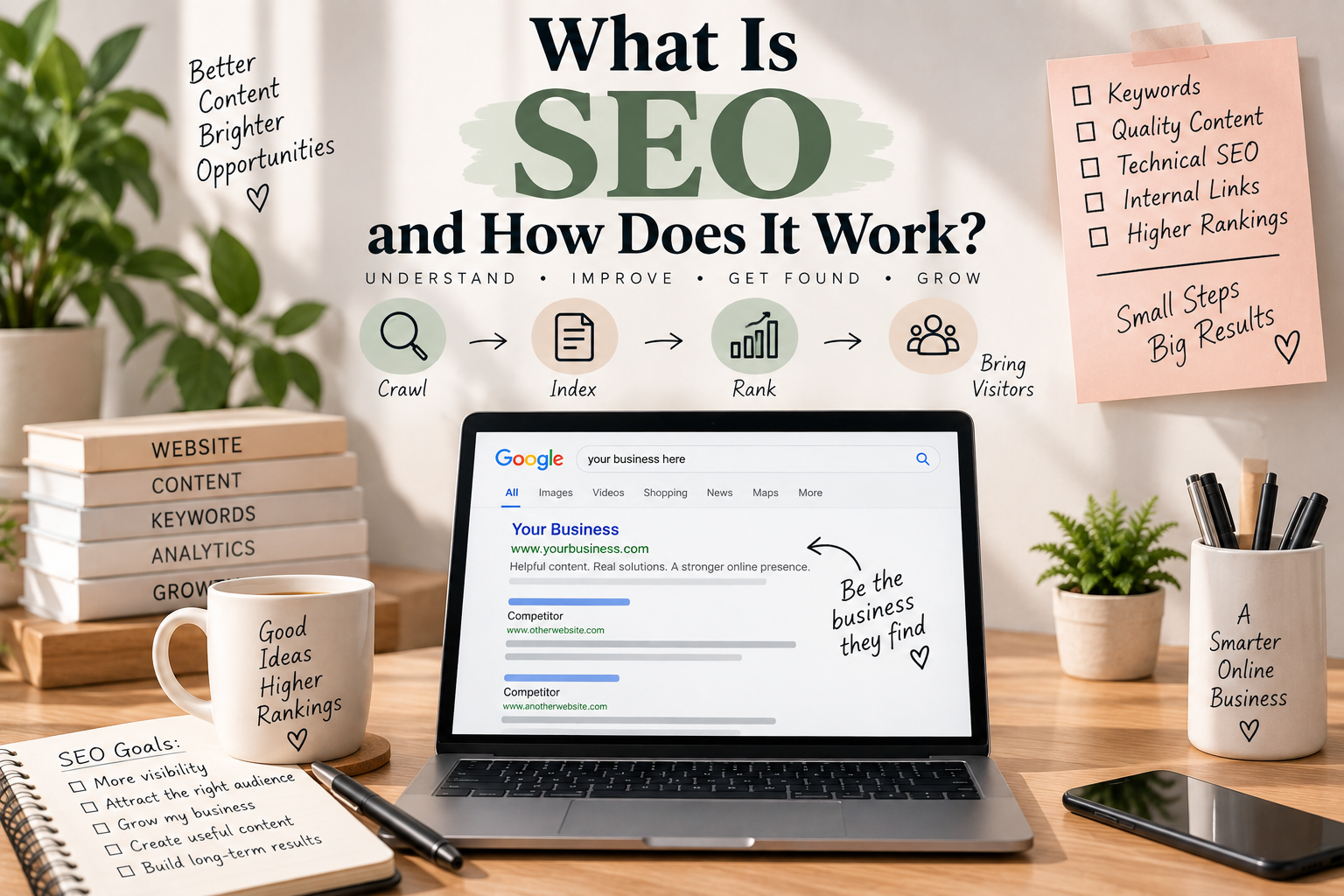
What Is SEO and How Does It Work?
If you have a website, you have probably heard the term SEO. But what does it actually mean, and how can it help people discover your website?
What Is SEO and How Does It Work? is a common question for beginners because search engine optimization can seem complicated at first. In reality, the basic idea is straightforward: you improve your website and its content so search engines can understand it and people can find useful information through search.
SEO is not about finding a secret trick that guarantees the first position on Google. Instead, it is a long-term process of creating useful content, organizing your website properly, and making it easier for both visitors and search engines to understand what your pages are about.
What Does SEO Mean?
SEO stands for search engine optimization.
It refers to the process of improving web pages so they can be discovered and understood by search engines and provide a useful experience for visitors.
Search engines use automated systems to discover pages, understand their content, and decide which results are useful for particular searches.
That means SEO involves much more than adding keywords to an article.
A well-optimized website can have:
- Useful and original content
- Clear page titles
- Descriptive headings
- Helpful internal links
- Relevant images
- A logical website structure
- Pages that work well on mobile devices
- Clear information that matches what visitors are looking for
How Does Search Engine Optimization Work?
Search engines need to discover and understand web pages before they can potentially show them to users.
Google describes Search as involving processes such as crawling, indexing, and serving search results.
When Google discovers a page, its systems can crawl the page and analyze its content. If the page is eligible to be indexed, information about it can be stored in Google’s index.
When someone performs a search, Google’s systems then determine which available results may be useful for that particular query.
This is why creating a page simply because you want to rank for a keyword is not enough. The page should actually answer the question or satisfy the need behind the search.
You can learn more about how Google Search works in the official Google Search documentation.
What Is Search Intent?
Search intent is the reason behind a person’s search.
Consider someone searching for:
- “What is dropshipping?”
- “Best laptop for online business”
- “How to start a Shopify store”
- “Shopify pricing”
Each search suggests a different reason for searching.
The first person may be looking for an explanation. The second may be comparing products. The third wants instructions, while the fourth may be looking for pricing information.
Understanding that difference helps you create content that actually matches what the searcher needs.
For example, an article explaining the basics of dropshipping would probably not be the best result for someone who is specifically looking for current Shopify pricing.
How to Use SEO and How Does It Work? A Simple Example
A simple example makes the process easier to understand.
Imagine you run a small business selling handmade bags.
You could create a page called:
“Handmade Bags for Everyday Use”
That page could explain the materials, sizes, designs, uses, shipping information, and other details customers need.
You could then create helpful articles answering related questions such as:
- How to choose the right everyday bag
- What fabric is best for tote bags?
- How to care for a canvas bag
- What size bag should you use for work?
These pages could link to one another where appropriate.
Over time, your website would contain a collection of related information rather than one isolated product page.
Why Are Keywords Important?
Keyword research helps you understand the words and phrases people use when searching for information.
Keywords can help you decide what topics to cover and how to describe your pages.
For example, if you run a website about ecommerce, you might discover that people search for topics such as:
- How to start an online store
- How to find products to sell
- How to price products
- How to manage inventory
- How to ship products
Those searches can become useful content ideas.
However, keywords should not be repeated unnaturally throughout a page. Google’s spam policies specifically warn against keyword stuffing, including repeating phrases so frequently that the writing becomes unnatural.
For more information about choosing topics and creating useful content, read How to Start Content Marketing.
What Is On-Page SEO?
On-page SEO refers to improvements you make directly to the content and structure of a webpage.
Examples include:
- Creating a clear page title
- Using useful headings
- Writing descriptive content
- Using relevant keywords naturally
- Adding descriptive image alt text
- Linking to relevant pages
- Making content easy to read
The goal is not to make a page look optimized for a search engine. The goal is to make the page genuinely useful while clearly communicating what it is about.
A page titled “Marketing” could mean almost anything. A page titled “How to Market a Small Business Online” gives visitors a much clearer idea of what they will find.
You can continue exploring this topic with How to Use SEO for a Small Business.
Why Are Internal Links Important?
Internal linking means linking from one page on your website to another page on the same website.
Internal links can help visitors discover related information without having to return to Google and search again.
For example, an article about SEO could link to a guide about getting website traffic. A marketing article could link to a social media marketing guide.
That is exactly why related articles should not exist as completely separate pieces of content.
For example, if you want to learn more about increasing visitors, you can read How to Get More Traffic to Your Website.
Good internal linking also helps create a clear structure between related pages.
How Does Google Decide Which Pages to Show?
Google does not use one simple ranking formula that website owners can follow to guarantee a position.
Search systems consider many signals when determining which results may be useful for a query.
Relevance is important. A page should provide information that matches the search.
Quality also matters. A page should provide useful information rather than simply repeating words that someone wants to rank for.
User experience can matter as well. Visitors should be able to access and use the page without unnecessary problems.
There are also technical considerations that can affect how search engines access and understand a website.
Because search systems are constantly evolving, it is better to focus on creating a useful website than trying to chase every individual ranking change.
What Is Technical SEO?
Technical SEO focuses on aspects of a website that help search engines crawl, understand, and access its pages.
Examples can include:
- Website speed
- Mobile usability
- HTTPS security
- Site structure
- XML sitemaps
- Canonical URLs
- Indexing controls
- Broken links
Beginners do not need to understand every technical concept immediately.
Start with the basics and gradually learn more as your website grows.
If you want to check how Google sees your website, Google Search Console is one of the most useful free tools available to website owners.
Does SEO Only Apply to Google?
No.
Search engine optimization can apply to different search platforms and systems.
However, Google is one of the most important search engines for many websites, which is why much SEO guidance focuses on Google Search.
The same basic principle still applies elsewhere: understand what people are searching for, provide useful information, and make your content easy to discover and understand.
Does Social Media Affect SEO?
Social media and SEO are different marketing activities, but they can support one another.
For example, you could publish a useful article on your website and then share it on Instagram, Facebook, TikTok, or another platform.
Social media can help more people discover your content, while your website can provide the complete information.
If you’re building a broader marketing strategy, you may also want to read What Is Social Media Marketing?.
How Long Does SEO Take?
There is no guaranteed amount of time before SEO produces results.
A new website may need time to build visibility, while an established website may already have pages receiving search traffic.
Results can depend on factors such as competition, the quality of your content, your website’s authority, technical issues, and the searches you are targeting.
That is why SEO should generally be treated as a long-term process rather than a quick traffic solution.
Instead of asking whether SEO will work within a specific number of days, monitor your website and look for meaningful changes over time.
Common SEO Mistakes
Beginners often make the same mistakes when they first start optimizing their websites.
Using Too Many Keywords
Repeating a keyword over and over can make your writing difficult to read and may create a poor experience for visitors.
Copying Content
Copying another website’s content does not give your audience a strong reason to visit your page.
Writing Only for Search Engines
People are the ones who will read your content, use your services, or buy your products. Their needs should remain at the center of your content strategy.
Ignoring Internal Links
A collection of useful articles becomes much more valuable when visitors can easily move between related topics.
Expecting Instant Results
SEO often requires patience. Continue improving your website instead of making major changes every few days because traffic has not increased yet.
How Can Beginners Start With SEO?
Learning SEO basics does not require you to change your entire website overnight.
Start with a simple process:
- Understand your audience.
- Find topics your customers are searching for.
- Create genuinely useful content.
- Give each page a clear title.
- Organize content with headings.
- Add relevant internal links.
- Make your website easy to use on mobile devices.
- Check your performance in Google Search Console.
- Update important content when necessary.
Learning search engine optimization becomes much easier when you practice these steps on a real website rather than trying to memorize every SEO concept at once.
How to Use SEO for a Small Business: A Practical Approach
A small business can begin with a very simple SEO system.
Choose a few topics that are closely connected to your products or services. Create useful pages around those topics, connect them with relevant internal links, and monitor what happens in search.
For example, a small online store might have one main page about its products and several helpful articles answering customer questions.
As the website grows, those articles can become a useful resource for visitors while giving search engines more context about the business.
The most important part is consistency. You do not need to publish something every day. A smaller number of genuinely useful pages can be more valuable than a large collection of repetitive articles.
Final Thoughts
The best way to approach What Is SEO and How Does It Work? is to think about the relationship between people, content, and search engines.
People search because they want an answer, solution, product, service, or explanation.
Your website should provide something useful for that need.
Search engines then need to understand what your page contains so they can determine whether it may be relevant to a particular search.
That is the foundation of SEO.
You do not need to know every advanced technique before getting started. Focus on useful content, clear organization, good website practices, and understanding your audience.
FAQ
What is SEO in simple words?
SEO is the process of improving a website and its content so search engines can understand it and people can discover relevant pages through search.
Why is SEO important for a website?
SEO can help people discover your website when they search for topics, products, services, or questions related to what you offer.
Is SEO free?
Many basic SEO activities can be done without paying for search placement. However, businesses may spend money on website hosting, content creation, SEO tools, developers, or professional services.
Do I need an SEO expert?
Not necessarily. Beginners can learn many SEO fundamentals themselves. Professional help can become useful when a website has complex technical problems or when a business needs a more advanced strategy.
Can SEO guarantee first place on Google?
No. Nobody can legitimately guarantee a specific Google ranking. SEO focuses on improving a website’s relevance, quality, accessibility, and overall usefulness.
What should I learn first?
Start with the basics: understand your audience, learn about search intent, create useful content, organize your website properly, use internal links, and monitor your results.
1 thought on “What Is SEO and How Does It Work?”
Comments are closed.
[…] example, this article can connect to What Is SEO and How Does It Work? for readers who want to understand the fundamentals […]