New to online business? Start with our free 7-day roadmap and build your foundation step by step.
Get the Free Roadmap →Marketing
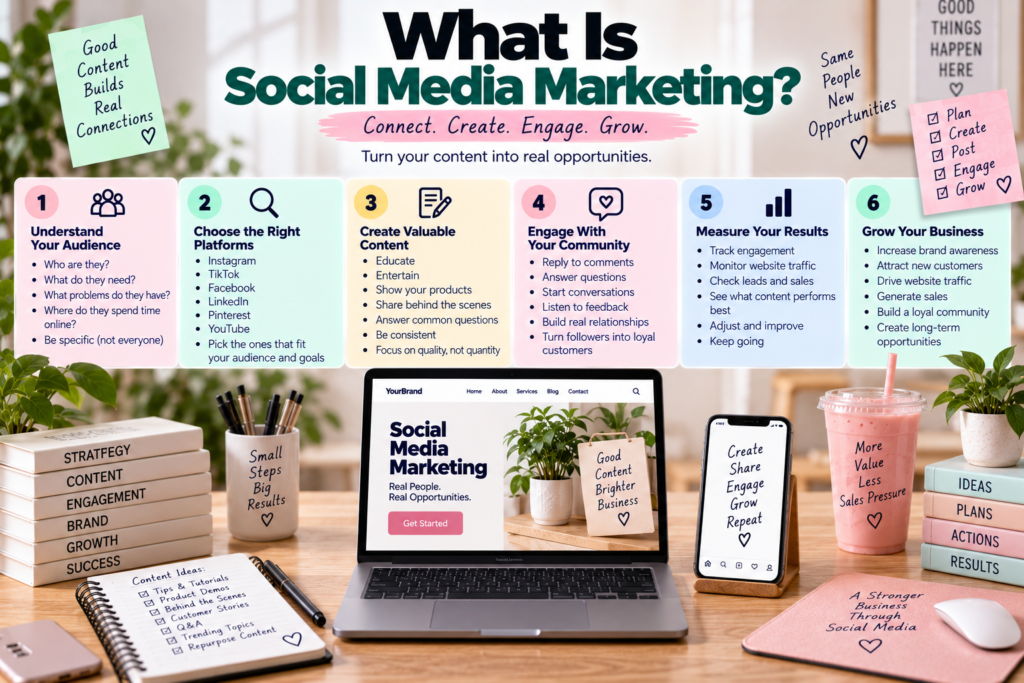
What Is Social Media Marketing?
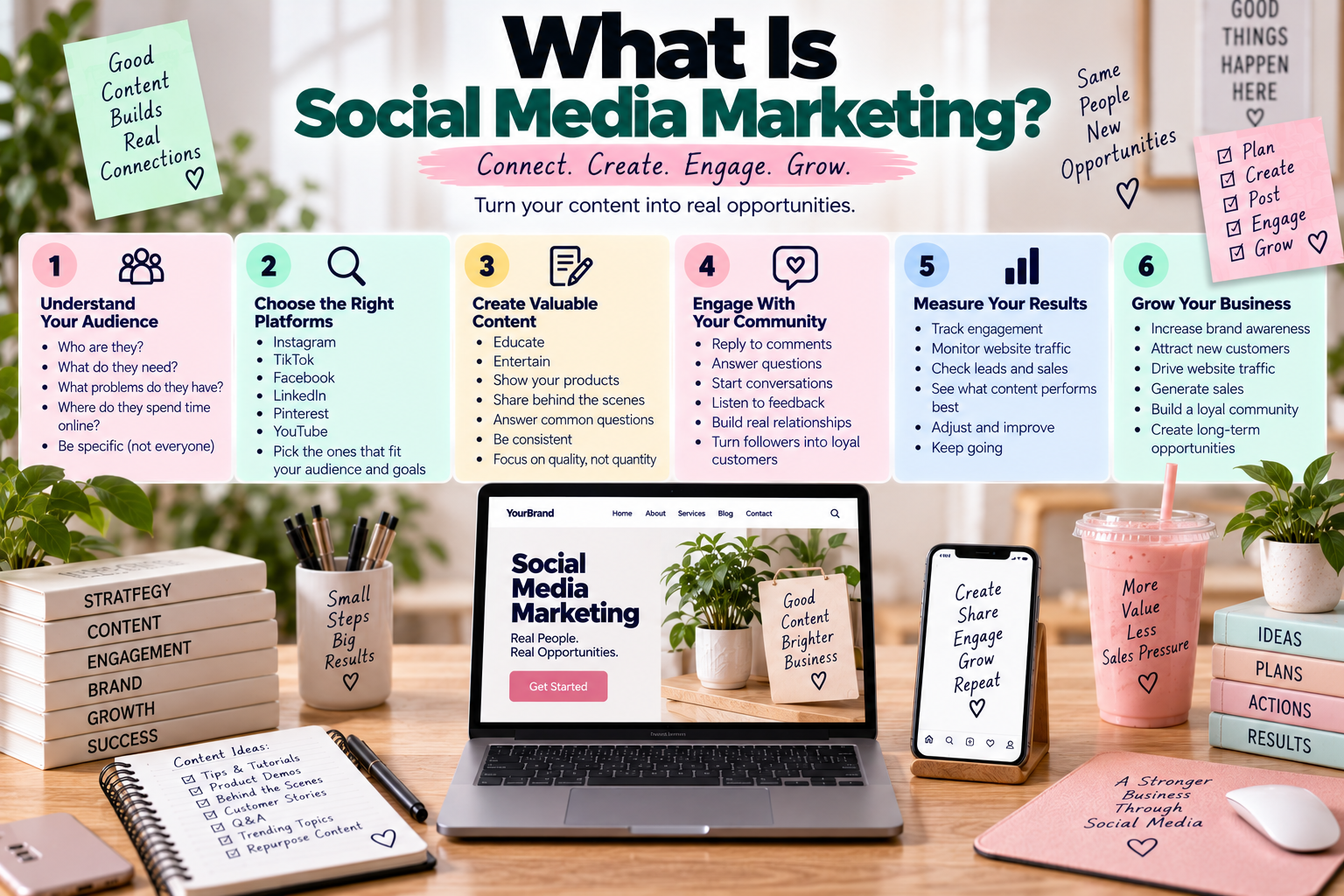
What Is Social Media Marketing?
Social media marketing is the use of platforms like Instagram, TikTok, Facebook, and LinkedIn to promote a business, build an audience, and drive sales — through both organic posting and paid advertising working together. This guide covers what social media marketing actually involves in practice, how it fits into a broader marketing strategy, and how beginners can approach it without feeling overwhelmed by the sheer number of platforms and tactics available.
The Two Sides of Social Media Marketing
Social media marketing generally breaks down into two distinct approaches:
- Organic social media marketing — regular posting, genuine engagement, and community building without paying directly for reach or visibility
- Paid social media marketing — running targeted ads to reach specific audiences beyond your existing followers, using the platform’s own advertising tools
Most small businesses start with organic social media marketing to build an initial audience and test messaging before eventually investing in paid ads once they understand what genuinely resonates with their specific audience.
Why Businesses Use Social Media Marketing
Social platforms offer direct access to billions of active users worldwide, and unlike a website that depends entirely on people actively finding it through search or referral, social media marketing puts your content directly in front of an audience that’s already actively browsing and engaged. It’s also one of the more measurable forms of marketing available — most platforms provide detailed, built-in analytics showing exactly how content performs, down to specific engagement metrics that would be far harder to track through traditional advertising channels.
How Social Media Marketing Actually Works
Understanding the mechanics helps clarify why some content performs well and other content doesn’t. When you post, the platform’s algorithm initially shows it to a small subset of your followers (or, on algorithm-driven platforms like TikTok, a small test audience regardless of follower count). Based on engagement signals — likes, comments, shares, watch time — the algorithm decides whether to expand distribution further. This means social media marketing success depends heavily on creating content that genuinely earns engagement in those crucial early moments after posting, not just content that’s technically well-made or on-brand.
Choosing the Right Platform for Social Media Marketing
Not every platform suits every business equally. A few general patterns tend to hold across most niches:
- Instagram — strong for visual products, lifestyle brands, and behind-the-scenes content that benefits from polished imagery
- TikTok — strong for reaching younger audiences with short, engaging, native-feeling video content
- LinkedIn — strong for B2B businesses, professional services, and thought-leadership content
- Facebook — strong for local businesses and community-based engagement, particularly with an older demographic
For specific platform guidance, our guides on how to market your business on Instagram and how to market your business on TikTok go deeper into each platform’s specific dynamics and best practices.
The Role of Content Strategy Within Social Media Marketing
Effective social media marketing rarely happens through random, unplanned posting. A genuine content strategy — recurring themes, a consistent posting schedule, and a clear sense of what value each post provides to the viewer — tends to significantly outperform sporadic, reactive posting with no underlying plan. This doesn’t mean every post needs to be rigidly scripted months in advance, but having a general framework guiding what you post and why makes the whole effort considerably more sustainable and consistent over time.
Building a Social Media Marketing Routine
Effective social media marketing depends more on consistency than on posting frequency alone. A sustainable routine — even three to four posts a week done consistently over months — tends to outperform sporadic bursts of intense activity followed by long gaps of inactivity, which most algorithms interpret as a signal of an unreliable, inactive account not worth prioritizing in distribution.
Engagement Is a Two-Way Street
A common misconception is that social media marketing is purely about broadcasting content outward. In reality, actively engaging with your audience’s comments, participating in relevant conversations, and interacting with other accounts in your niche all contribute meaningfully to how algorithms perceive and distribute your content, beyond just the posts you publish yourself. Accounts that treat the platform as a one-way announcement channel tend to see slower, shallower growth than those that engage as an active participant in the broader community.
Measuring Social Media Marketing Success
Rather than tracking follower count alone — which is often described as a vanity metric with limited direct business value — pay closer attention to engagement rate, click-throughs to your website, and actual conversions that result from social traffic. Platforms like Meta Business Suite provide free, detailed analytics that show which specific content is genuinely resonating with your audience, going well beyond surface-level metrics like raw follower growth. Pairing this with Google Analytics on your own website lets you see the full journey from a social post through to an actual conversion, rather than just the engagement that happens within the platform itself.
How Social Media Marketing Fits Into a Broader Strategy
Social media marketing rarely works best as a completely isolated effort disconnected from everything else you’re doing. It tends to perform strongest when integrated with content marketing (repurposing blog content into social posts), email marketing (using social platforms to grow an email list you fully own), and your broader brand identity across every channel. Treating social media as one interconnected piece of a larger strategy, rather than a standalone silo, tends to produce considerably better cumulative results than managing it in complete isolation from your other marketing efforts.
Organic vs. Paid: When to Introduce Advertising
While organic social media marketing is genuinely free beyond the time invested, paid social media marketing requires an actual ad budget — though this can start as small as a few dollars per day when testing initial campaigns. Many businesses find it more effective to test messaging and content organically first, then put paid budget behind whatever’s already proven to resonate, rather than guessing blindly with ad spend before understanding what genuinely works for their specific audience and niche.
Balancing Brand Consistency With Platform-Specific Content
While each platform rewards slightly different content styles, it’s worth maintaining a recognizable thread of brand identity across all of them — consistent visual elements, a similar tone of voice, the same core messaging adapted rather than completely reinvented for each platform. Viewers who encounter your business across multiple platforms should be able to recognize it as the same brand, even as the specific format and presentation adapts to fit each platform’s particular norms and audience expectations.
Social Media Marketing for Different Business Stages
A brand-new business with zero existing audience approaches social media marketing differently than an established one with years of accumulated followers and content history. Early on, the priority tends to be pure audience-building — reaching new people who’ve never heard of the business at all. As an account matures, the focus often shifts toward deepening relationships with an existing audience, launching products directly to warm followers, and using social proof from established credibility to convert viewers who are already somewhat familiar with the brand. Recognizing which stage your business is actually in helps calibrate realistic expectations and appropriate tactics, rather than applying advice meant for an established account to a brand-new one with no existing following to leverage yet.
Common Social Media Marketing Mistakes to Avoid
Posting without a clear strategy. Random, unplanned content tends to underperform compared to posts guided by a consistent theme and genuine purpose behind each piece.
Focusing purely on follower count. Vanity metrics can be misleading — a smaller, genuinely engaged audience often produces better business results than a larger but passive, disengaged one.
Ignoring platform-specific norms. Content that works well on one platform often needs meaningful adaptation for another — directly cross-posting identical content everywhere tends to underperform compared to content tailored to each specific platform’s format and audience expectations.
Being inconsistent. Sporadic bursts of activity followed by long silences make it considerably harder for both algorithms and human audiences to build a reliable, ongoing relationship with your content over time.
Never engaging back. Treating the platform purely as a broadcast channel, without genuinely participating in conversations, limits the community-building benefits that make social media marketing genuinely effective in the first place.
The Growing Role of Video Across Social Platforms
Across nearly every major platform, video content — particularly short-form video — has increasingly become favored by algorithms over static images or text posts. This shift affects how businesses should think about social media marketing holistically: even platforms historically associated with photos, like Instagram, now heavily prioritize video formats like Reels in their distribution. Businesses that adapt to this shift, rather than continuing to rely primarily on static content, tend to see meaningfully better organic reach across most platforms as algorithms continue favoring this format.
Building a Simple Starting Framework
If you’re just getting started with social media marketing, a reasonable initial framework includes: choosing one primary platform where your specific audience is most active, defining three to four recurring content themes, committing to a realistic, sustainable posting frequency, and setting aside time each week specifically for engagement rather than only content creation. This structure gives you enough guidance to stay consistent without becoming so rigid that it prevents genuine experimentation and learning along the way.
Frequently Asked Questions
Is social media marketing free? Organic social media marketing is free aside from your time investment; paid social media marketing requires an ad budget, which can be as small as a few dollars a day when starting out and testing initial campaigns.
How many platforms should a beginner use for social media marketing? Most beginners see considerably better results focusing on one or two platforms where their specific audience is most active, rather than spreading thin across every available platform simultaneously with minimal effort in each.
How often should you post for social media marketing to work? Consistency matters more than exact frequency — a sustainable schedule of three to five posts per week, maintained over several months, tends to outperform inconsistent daily posting that fades out quickly after an initial burst of enthusiasm.
What’s the difference between social media marketing and social media management? Social media marketing focuses specifically on using these platforms to drive business results — awareness, engagement, sales. Social media management is the broader, ongoing operational work of maintaining accounts, which includes marketing but also customer service, community moderation, and day-to-day administrative tasks that keep an account running smoothly beyond just the promotional content itself.