New to online business? Start with our free 7-day roadmap and build your foundation step by step.
Get the Free Roadmap →Dropshipping
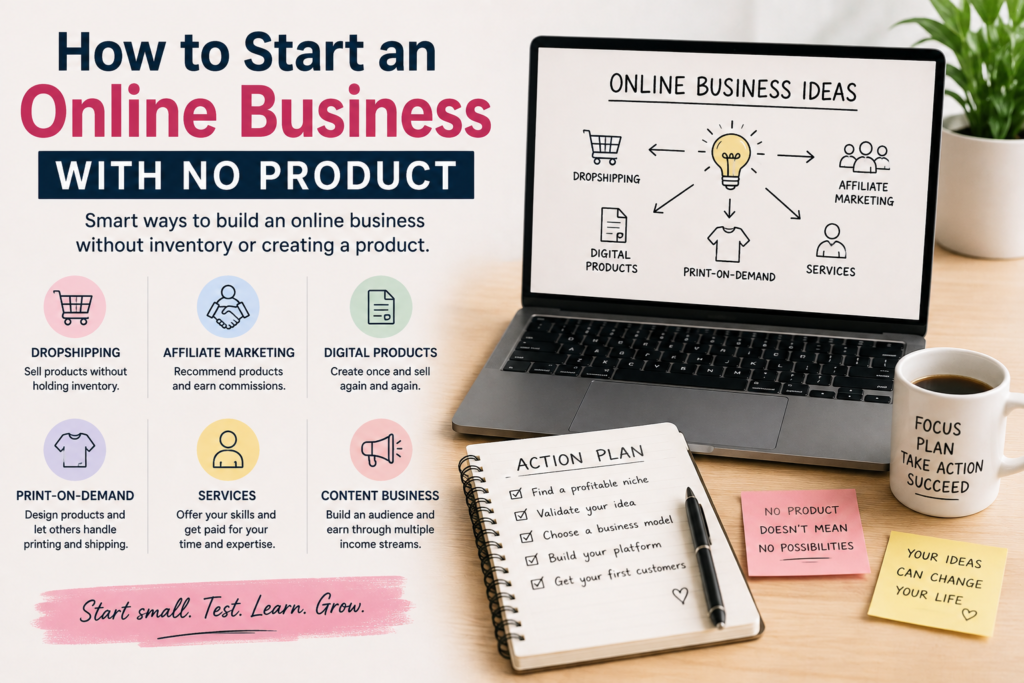
How to Start an Online Business With No Product
How to Start an Online Business With No Product
Not having a product idea yet doesn’t mean you’re not ready to start. It’s genuinely possible — and common — to start an online business with no product at all, building around a skill, a service, or an audience instead of physical inventory. This guide covers exactly how to start an online business with no product, walking through the realistic models that let you begin without manufacturing or sourcing anything.
Why “No Product” Doesn’t Mean “No Business”
There’s a common assumption that a real business needs something tangible to sell. In practice, plenty of profitable online businesses are built entirely around expertise, time, or an audience — no inventory, no manufacturing, no supplier relationships required. Understanding how to start an online business with no product opens up options that are often faster and cheaper to launch than a traditional product-based store.
Option 1: Freelancing
If you already have a marketable skill — writing, design, development, marketing, virtual assistance — freelancing lets you start an online business with no product by selling your time and expertise directly to clients. There’s no inventory to manage, and you can begin with platforms like Upwork or Fiverr, or through direct outreach to potential clients in your network.
Option 2: Affiliate Marketing
Affiliate marketing means recommending other companies’ products through content — a blog, YouTube channel, or social media — and earning a commission on resulting sales. This is one of the clearest ways to start an online business with no product of your own, since you never touch inventory or handle fulfillment at all. Our guide on can you start affiliate marketing with no money covers the practical starting steps in more depth.
Option 3: Content Creation
Building an audience through blogging, YouTube, or social media can become a business in its own right, monetized through advertising, sponsorships, or affiliate commissions — again, without ever needing your own product. This path tends to take longer to become profitable than freelancing, since it requires building an audience first, but it can scale beyond the direct time-for-money trade-off that freelancing involves.
Option 4: Consulting or Coaching
If you have deep expertise in a specific area, consulting or coaching lets you sell knowledge and guidance directly, without any physical or digital product changing hands. This works particularly well for people with professional experience in a field others are actively trying to break into or improve within.
Option 5: Digital Services
Beyond one-off freelance projects, ongoing digital services — social media management, bookkeeping, virtual assistance, email marketing management — let you start an online business with no product while building more predictable, recurring revenue than project-based freelance work typically offers.
Option 6: Dropshipping (A Middle Ground)
Dropshipping technically involves selling a product, but you never manufacture, hold, or ship it yourself — a supplier handles that entirely. It sits in an interesting middle ground: you’re selling something tangible, but you can start an online business with no product actually in your possession at any point, and often no upfront inventory investment either.
Building Credibility Without a Portfolio of Past Clients
One of the more common obstacles for anyone trying to start an online business with no product — especially through freelancing or consulting — is the lack of a track record to point to. A few practical ways around this: create sample work specifically to demonstrate your skill, offer a discounted first project in exchange for a genuine testimonial, or reframe relevant past experience (even from outside freelancing) as evidence of your capability. The goal is giving a potential client or audience tangible proof you can deliver, not fabricating experience you don’t actually have.
Comparing These Paths by Startup Cost and Effort
| Model | Startup Cost | Time to First Income |
|---|---|---|
| Freelancing | Very low | Fast (weeks) |
| Affiliate marketing | Very low | Slower (months) |
| Content creation | Low | Slower (months) |
| Consulting/coaching | Low | Fast (weeks) |
| Digital services | Low | Moderate |
| Dropshipping | Low-moderate | Moderate |
None of these require significant upfront capital, but they differ considerably in how quickly you can realistically expect income, which is worth weighing honestly against your own financial runway before committing.
Choosing Which Path Fits You
The right option to start an online business with no product depends heavily on what you already have going for you:
- Have a marketable skill right now? Freelancing offers the fastest realistic path to first income.
- Enjoy creating content and can be patient? Content creation or affiliate marketing build toward longer-term, more scalable income.
- Have deep expertise in a specific field? Consulting or coaching lets you monetize that knowledge directly.
- Want to test ecommerce without inventory risk? Dropshipping offers a lower-risk entry into product-based selling.
There’s no universally “best” option — the right fit depends on your existing skills, how quickly you need income, and how much patience you have for a slower-building model.
What You Actually Need to Get Started
Regardless of which path you choose, a few things remain constant when you start an online business with no product:
- A clear understanding of who you’re serving and what problem you solve for them
- A way to be found — a website, social profile, or platform presence
- A way to get paid — whether that’s an invoicing system, a platform’s built-in payment processing, or a simple payment link
- A plan for actually reaching your first clients or audience members, since none of these paths succeed purely through passive discovery
Setting Realistic Income Expectations Early On
Regardless of which path you choose to start an online business with no product, it’s worth setting realistic expectations about timeline from the outset. Freelancing and consulting can produce income within weeks, but rarely full-time-replacing income immediately — building a full client roster takes sustained effort over months. Content and affiliate-based paths take even longer to become meaningfully profitable, often six months to a year of consistent publishing before real momentum builds. Going in with these realistic timelines in mind makes it considerably easier to stay consistent through the inevitable slow early period, rather than abandoning a genuinely viable path too soon simply because results didn’t arrive as quickly as hoped.
Common Mistakes When Starting Without a Product
Being too vague about what you offer. “I do marketing” is a weaker starting point than “I help small ecommerce stores improve their email open rates” — specificity makes you easier to hire or follow.
Underpricing services out of inexperience. New freelancers and consultants often undercharge significantly, which can make the business difficult to sustain even with a full client roster.
Expecting content or affiliate income too quickly. These paths generally take longer to become profitable than service-based options, and abandoning them too early is a common reason beginners don’t see them through to the point where they start working.
Skipping the marketing step entirely. Even without a physical product, you still need a plan to reach potential clients or an audience — expertise alone doesn’t generate income without visibility.
How These Paths Can Combine or Evolve Over Time
Many successful entrepreneurs don’t stay in just one of these lanes forever. It’s common to start an online business with no product through freelancing or consulting, then gradually build a content platform or audience alongside that service work, and eventually launch a digital product — a course, a template, an ebook — once you understand your audience’s needs deeply enough to build something they’ll actually pay for. Our guide on how to start an online business: a beginner’s guide covers this broader progression in more detail if you’re thinking beyond just the immediate starting point.
Frequently Asked Questions
Can you really start a business with no product or money? Yes, to a significant degree. Freelancing, affiliate marketing, and consulting all require minimal to no upfront capital, since they’re built around your time, skills, or existing knowledge rather than inventory.
Which no-product business model makes money fastest? Freelancing and consulting typically generate income fastest, since you’re directly selling your time and expertise rather than waiting to build an audience first, as content creation and affiliate marketing generally require.
Do I need a website to start an online business with no product? Not necessarily at first — many freelancers and consultants start with just a social media profile or a listing on a freelance platform, adding a dedicated website later as the business grows.
Can a no-product business eventually become a product-based one? Yes, and this is a common progression. Many entrepreneurs use a service or content-based business to build an audience and understand their market before eventually launching their own digital or physical product, using the direct customer insight gathered along the way rather than guessing at what to build from scratch.