New to online business? Start with our free 7-day roadmap and build your foundation step by step.
Get the Free Roadmap →Marketing
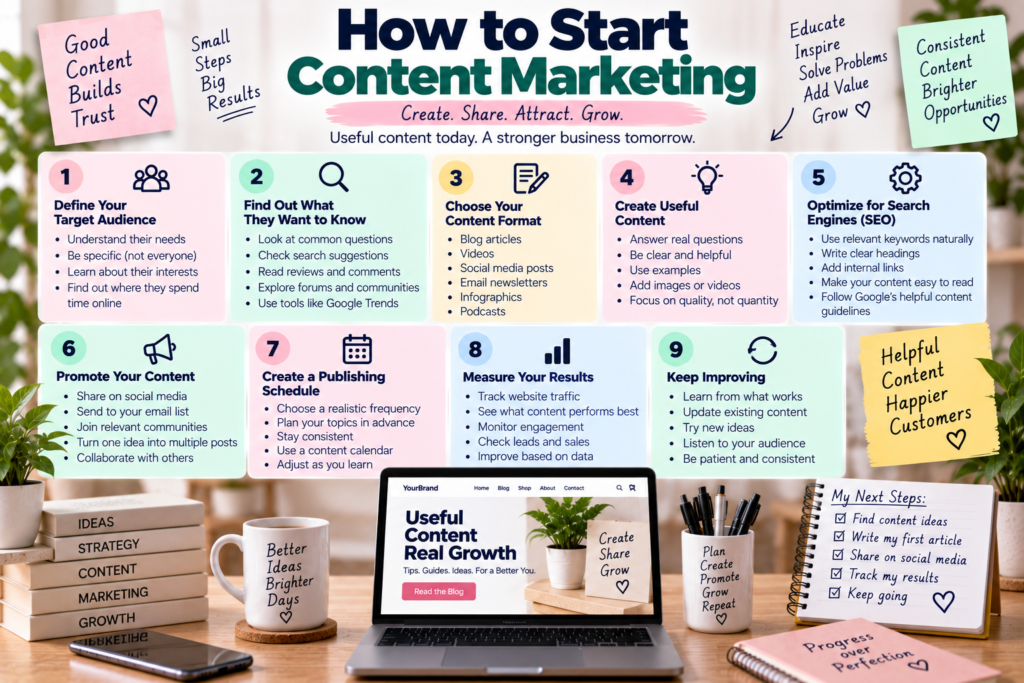
How to Start Content Marketing
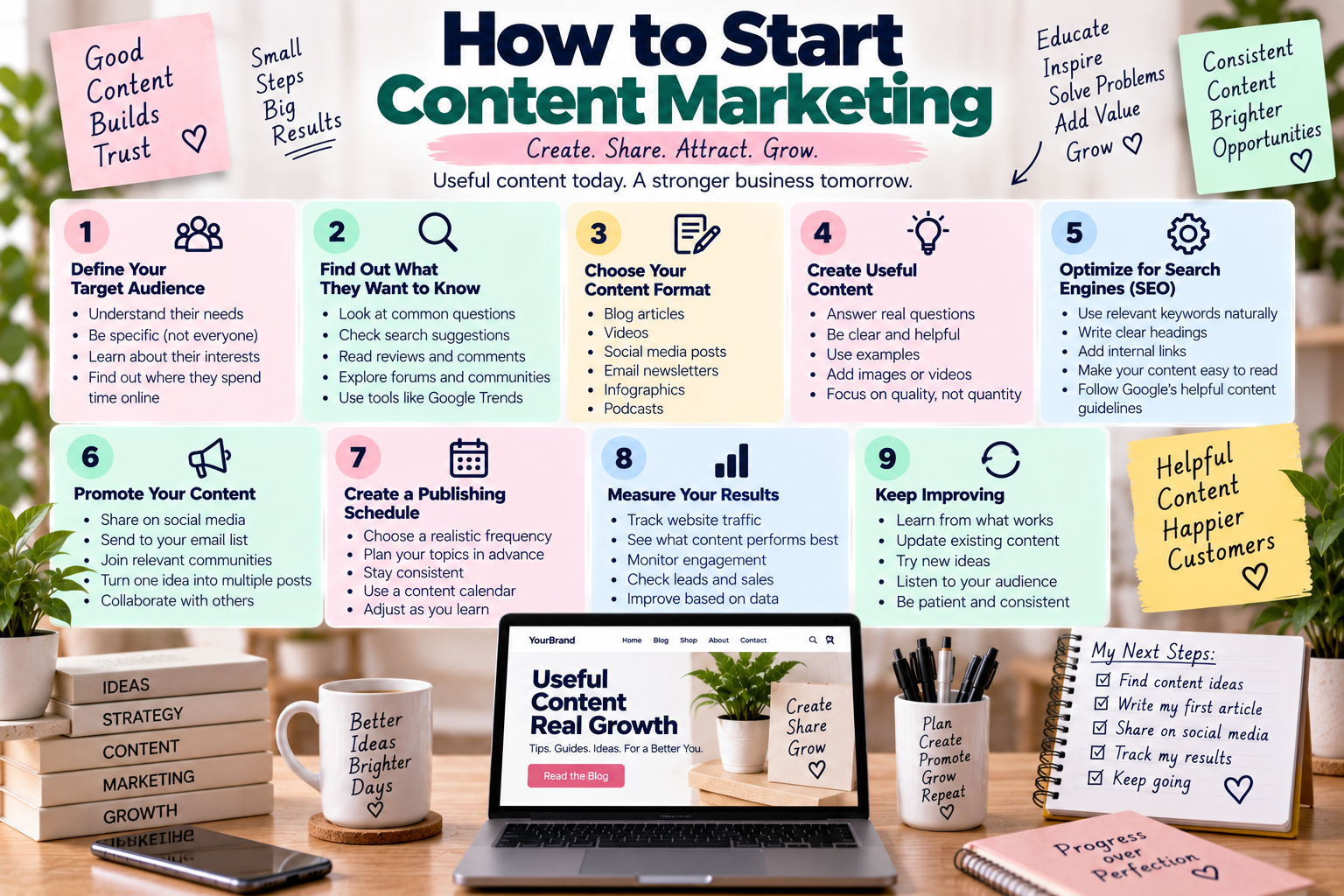
How to Start Content Marketing
Once you understand the basic idea, the next real question becomes how to start content marketing without wasting weeks producing content nobody ends up reading. This guide walks through a realistic, step-by-step process to start content marketing as a genuine beginner, even with no prior writing or content creation experience to draw on.
If you’re not yet sure what content marketing involves at a conceptual level, our what is content marketing guide covers those fundamentals first, before diving into this more practical, action-oriented walkthrough
Step 1: Get Genuinely Specific About Your Audience
Before you start content marketing, know exactly who you’re creating content for, in real, specific terms. “Small business owners” is far too broad to be useful; “small business owners in their first year who don’t have any marketing background or team” is specific enough to genuinely shape your actual content decisions, from topic selection to tone and complexity level.
Step 2: Research What Your Audience Is Already Asking
Look at forums, comment sections, and communities where your specific audience already spends time to identify recurring questions they’re genuinely asking. Tools like Google Trends can also help you gauge whether interest in a particular topic is growing before you invest significant time creating content built around it, rather than guessing at relevance.
Step 3: Choose One Primary Format and Channel
To start content marketing effectively, resist the natural urge to simultaneously tackle blog posts, videos, and social content all at once. Pick the single format that best matches both your specific audience’s habits and your own genuine strengths — whether that’s writing, speaking comfortably on camera, or creating punchy short-form content.
Step 4: Create a Simple, Realistic Content Calendar
Even a basic weekly plan — covering what topic, what format, and what day — makes it considerably easier to start content marketing consistently, rather than creating content reactively only when you happen to find spare time, which tends to produce sporadic, inconsistent output that struggles to build any real momentum.
Step 5: Focus on Genuine Usefulness Over Self-Promotion
The content that performs best when you start content marketing usually leads with genuine usefulness, not an immediate sales pitch. Save direct promotional messaging for a smaller portion of your overall content, and let the clear majority build trust and demonstrate real expertise first, before ever asking for anything in return from the reader or viewer.
Step 6: Publish Consistently Before Judging Any Results
Many beginners give up on content marketing after just a handful of posts with modest, unimpressive early results. In reality, most content marketing requires sustained, consistent publishing over several months before it builds any real traction — particularly for search-driven formats like blog posts, which depend on search engines gradually building trust in your site’s authority and relevance over time.
Step 7: Distribute, Don’t Just Publish
Publishing content is only half the actual work — without genuine distribution, even great content can sit almost entirely undiscovered. Share new content directly with your existing network, in relevant communities where it genuinely adds value, and across whatever social channels you’re already using, rather than assuming people will simply find it organically on their own.
Step 8: Track and Refine Based on Real Data
Use free analytics tools to see which pieces of content actually attract traffic or genuine engagement once you start content marketing, and deliberately create more content similar to what’s already demonstrably working rather than continuing to guess at entirely new topics each time you sit down to write or create.
Connecting Content Marketing to Your Broader Traffic Goals
Content created through this process doesn’t just build audience trust in isolation — it also directly feeds your broader efforts to bring more visitors to your site over time. Our guide on how to get more traffic to your website covers how consistent content publishing fits into that larger traffic-building picture, once you’ve got a foundational content marketing routine genuinely established and running consistently.
Involving Your Audience in Content Direction
As you start content marketing and begin accumulating a small audience, pay attention to the questions and comments they leave — these often reveal exactly what to create next, removing much of the guesswork involved in choosing future topics. Directly asking your audience what they’d find useful, through a simple poll or an open question in a newsletter, can also surface content ideas you might not have considered on your own, while simultaneously deepening the sense of engagement and investment your audience feels in your content overall.
Choosing Your First Few Topics
Rather than trying to cover everything your audience might ever want to know right away, start with a small handful of foundational topics that address the most common, entry-level questions in your niche. These tend to attract the broadest initial audience and often become your most durable, consistently-performing pieces of content over time, precisely because they address questions that remain relevant and commonly searched regardless of when someone discovers them.
Setting a Realistic Publishing Schedule
Beginners often either overcommit to an unsustainable daily publishing schedule that quickly leads to burnout, or publish so infrequently that momentum never actually builds in the first place. A more realistic starting cadence — one solid piece of content per week for a blog, for example — tends to be considerably more sustainable long-term than an ambitious schedule you can’t realistically maintain once the initial enthusiasm inevitably wears off after the first few weeks.
Repurposing Your First Pieces of Content
Once you’ve created a solid piece of content, don’t let it exist in only one format. A single blog post can become several social media posts, a short video script, or an email newsletter with relatively modest additional effort. This repurposing habit is one of the more efficient ways to start content marketing without needing an entirely new idea for every single piece of content across every channel you’re using.
Balancing Quality and Quantity as You Get Started
A common early tension when you start content marketing is deciding whether to prioritize publishing frequently or investing more time into fewer, deeper pieces. There’s no universally correct answer, but a reasonable guideline is favoring genuine depth and usefulness over sheer volume, especially in the beginning — a handful of genuinely excellent, thorough pieces tend to build more credibility and search authority than a larger volume of thin, rushed content that doesn’t fully satisfy what a reader or viewer actually needed when they arrived. Once you’ve built a sustainable process, frequency can gradually increase without sacrificing the quality that made your early content genuinely effective in the first place.
Building an Editorial Process That Actually Sticks
As you start content marketing, it helps to establish a simple, repeatable process rather than reinventing your approach from scratch with every new piece: researching a topic, outlining key points, drafting, editing, and publishing. Having this process defined in advance — even informally — reduces the friction and decision fatigue that often causes inconsistent publishing, since you’re following a known path rather than figuring out your approach anew each time.
Common Early Mistakes to Avoid
A handful of avoidable missteps account for a large share of struggles when beginners first start content marketing. Chasing every possible topic instead of focusing on what your specific audience genuinely needs often produces scattered, unfocused content that doesn’t build a coherent sense of expertise in any particular area. Comparing your early results to established creators or businesses who’ve been publishing consistently for years sets an unrealistic benchmark that ignores the years of accumulated effort behind that comparison. And neglecting basic optimization — clear titles, genuine keyword relevance, reasonable structure — can mean genuinely good content underperforms simply because it’s harder for people to discover in the first place.
Overcoming the Fear of Publishing Imperfect Content
A common obstacle for beginners is waiting for content to feel “perfect” before publishing it, which often means never actually publishing anything at all. In practice, genuinely useful, clearly written content that’s slightly imperfect tends to perform considerably better than perfectly polished content that never actually gets published because the bar was set impossibly high. Learning to publish at “good enough and genuinely useful” rather than waiting for an unattainable standard of perfection is one of the more important mindset shifts required to actually start content marketing and keep going consistently.
How Long Before You’ll See Real Results?
Setting realistic expectations upfront helps prevent premature abandonment of a genuinely viable strategy. Content marketing, especially content built around SEO, typically takes three to six months of consistent publishing before meaningful, reliable traffic starts to materialize. Content shared more directly through social media or email can show faster initial engagement, but even that tends to require sustained effort over weeks, not days, before a genuine pattern of what’s working becomes clear.
Learning From Your Early Content’s Performance
Once you have a handful of pieces published, pay close attention to which ones perform noticeably better than others — more traffic, more engagement, more shares. This data becomes genuinely useful over time: content marketing improves considerably once you understand your specific audience’s actual preferences, rather than continuing to guess based on assumptions that may not accurately reflect what they genuinely respond to.
Frequently Asked Questions
How much time does it take to start content marketing? This depends heavily on format — a solid blog post might take a few hours to research and write, while a polished video could take a full day or more from planning through editing. Starting with a simpler, faster format is often the most realistic entry point for genuine beginners.
Do I need to be a naturally good writer or speaker to start content marketing? No. Clarity and genuine usefulness matter considerably more than polish, especially in the early stages — both writing and speaking skills tend to improve meaningfully with consistent practice over time.
How soon will content marketing actually bring in customers? This varies, but most beginners see meaningful, reliable results after several months of consistent publishing rather than immediately after their first few pieces go live.
Should I hire a professional to help me start content marketing? Not necessarily at the beginning. Many successful content marketing efforts start with the business owner creating content directly, bringing in additional help later once the strategy is validated and the workload genuinely exceeds what one person can sustainably manage alone — starting solo also gives you firsthand insight into what actually works before delegating that decision-making to someone else.
5 thoughts on “How to Start Content Marketing”
Comments are closed.
[…] If you want to develop a consistent approach to creating useful content, read How to Start Content Marketing. […]
[…] For more information about choosing topics and creating useful content, read How to Start Content Marketing. […]
[…] you’re working on content for your own site, How to Start Content Marketing can help you build a more consistent […]
[…] For more information about building a content strategy, read How to Start Content Marketing. […]
[…] a deeper breakdown of this getting-started process, our guide on how to start content marketing walks through each step with more specific […]