New to online business? Start with our free 7-day roadmap and build your foundation step by step.
Get the Free Roadmap →Marketing
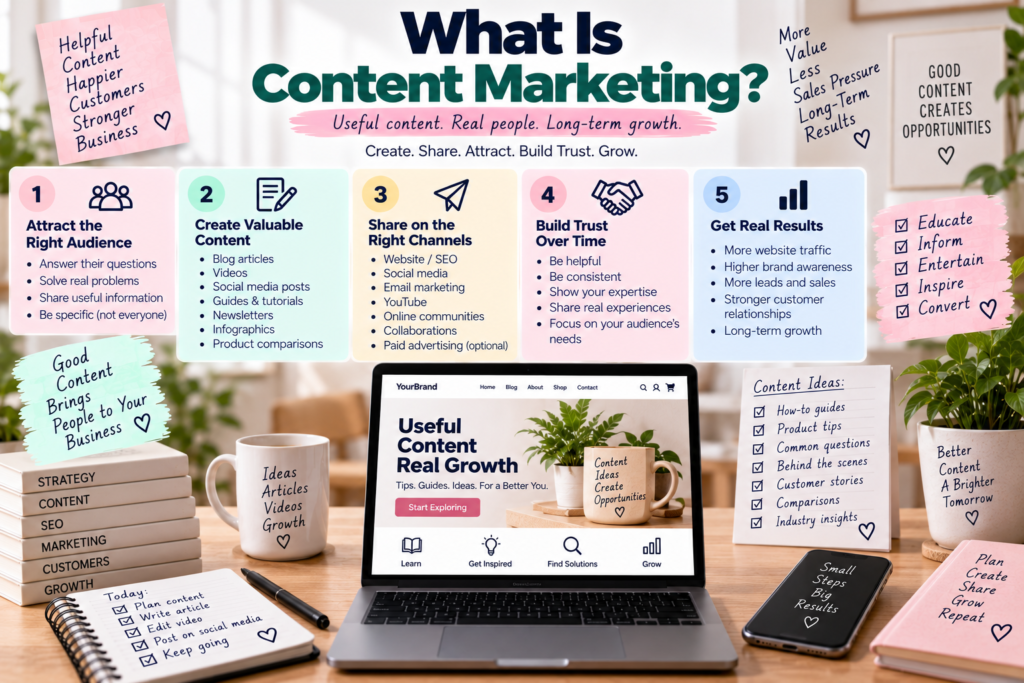
What Is Content Marketing?
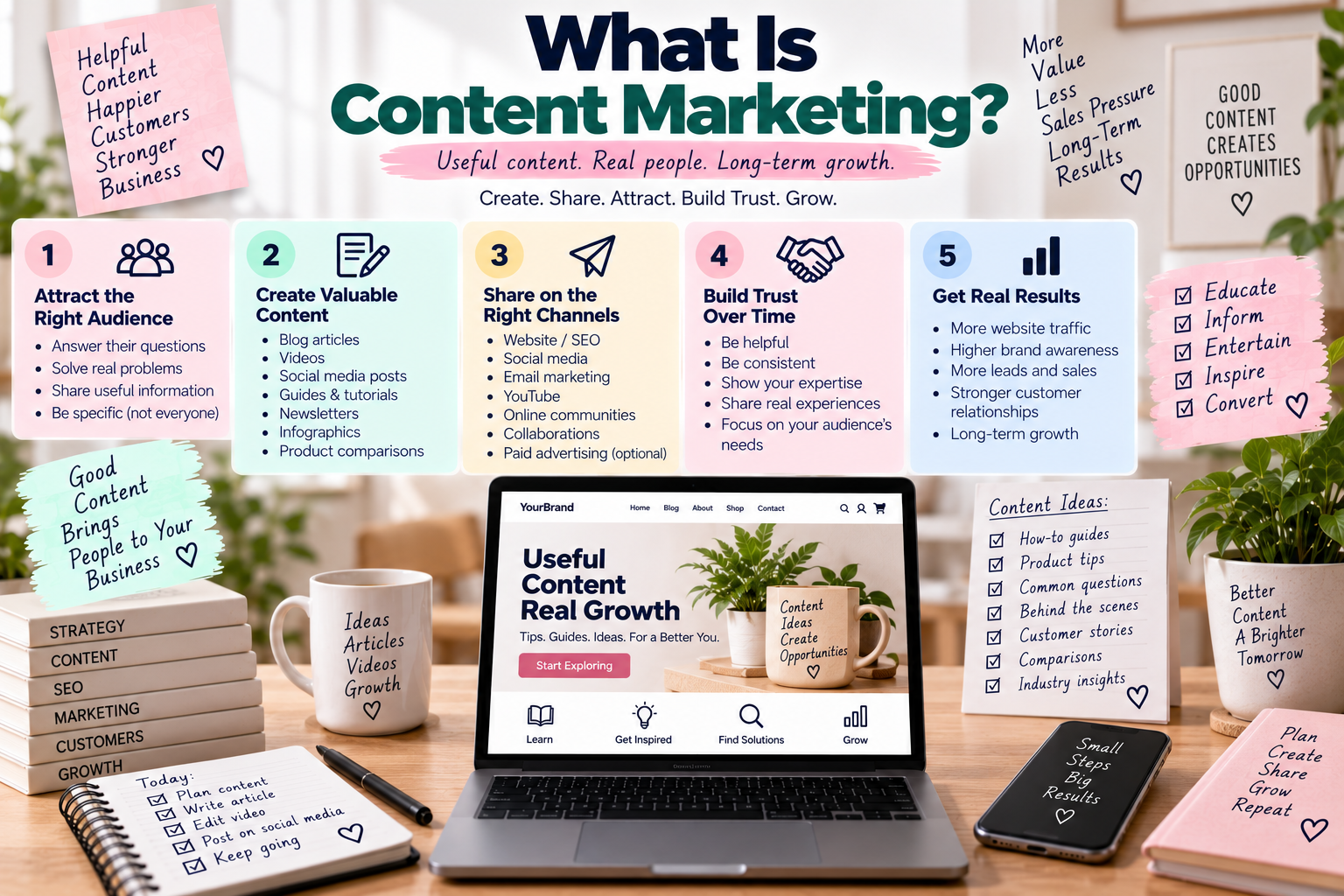
What Is Content Marketing?
If you’ve spent any time researching online business, you’ve likely asked yourself: what is content marketing, and is it actually worth the effort compared to just running ads? Content marketing is the practice of creating and sharing valuable content — blog posts, videos, guides, social posts — to attract, engage, and eventually convert an audience, rather than advertising directly at them from the very first interaction.
This guide breaks down exactly what is content marketing, how it actually works, and why so many businesses treat it as a foundational part of their overall strategy rather than a side project.
How Content Marketing Differs From Advertising
Traditional advertising interrupts people with a direct sales message, whether they’re interested in the moment or not. Content marketing instead earns attention by being genuinely useful, entertaining, or informative first. The sale, if it happens, tends to come later — often after someone has consumed several pieces of your content and built real trust in your expertise, rather than being asked to buy on first contact.
The Main Formats of Content Marketing
Content marketing isn’t limited to blog posts, even though that’s often the first format people picture. Common formats include:
- Blog articles — in-depth, search-optimized written content that keeps working long after publishing
- Videos — tutorials, reviews, or behind-the-scenes content, particularly effective on platforms like YouTube
- Social media posts — shorter-form content built for specific platforms and their particular audience habits
- Email newsletters — content delivered directly to subscribers who’ve already opted in
- Podcasts — audio content that tends to build a more personal, ongoing connection with listeners
Most successful content marketing strategies focus deeply on one or two formats rather than spreading thin across all of them simultaneously.
Why Content Marketing Actually Works
The core mechanism behind content marketing is trust-building through demonstrated value. When someone finds a genuinely helpful piece of content — one that actually solves their problem rather than just teasing a solution behind a paywall — they associate that usefulness with your brand. Over repeated interactions, that accumulated trust makes the eventual sale feel less like being sold to and more like a natural next step.
There’s also a compounding effect unique to certain content formats. Unlike a paid ad that stops the moment you stop paying, a well-optimized blog post can keep attracting organic search traffic for years with minimal ongoing effort — each new piece of content becomes another small, permanent asset rather than a one-time expense.
Content Marketing vs. Content Creation as a Business
It’s worth distinguishing content marketing — creating content to support a separate business or product — from building a content creation business itself, where the content and its audience essentially are the business, monetized through ads, sponsorships, or its own products. Many entrepreneurs actually blend both approaches, using content marketing to grow an existing business while the content itself also builds an audience with its own separate value.
Content Marketing and SEO Are Closely Linked
A large share of content marketing’s long-term value comes specifically through search engine visibility. Publishing content that directly answers what people are searching for gives search engines a reason to rank your pages, which in turn brings in visitors actively looking for exactly what you offer — a fundamentally different, often higher-intent audience than one reached through interruptive advertising. Our guide on what is SEO and how does it work covers the mechanics behind how this actually plays out in search rankings.
Getting Started With Content Marketing
A practical starting approach looks like this:
- Identify the specific questions your target audience is already asking
- Create content that directly and honestly answers those questions, without excessive self-promotion
- Publish consistently on one primary channel before expanding to others
- Track which pieces actually drive traffic or engagement, and create more content along those same lines
For a deeper breakdown of this getting-started process, our guide on how to start content marketing walks through each step with more specific tactics.
Common Content Marketing Formats by Business Stage
Different stages of a business often call for different content approaches. Early on, foundational, evergreen content (answering the most basic, common questions in your niche) tends to build the strongest base of organic traffic. Later, as you better understand your specific audience, more advanced or niche-specific content can layer on top, deepening the relationship with an audience that’s already engaged rather than purely trying to attract new visitors.
Measuring Whether Content Marketing Is Actually Working
Unlike a direct sales pitch, content marketing’s impact isn’t always immediately obvious in a single metric. Useful signals to track include organic search traffic growth over time, how long visitors spend engaging with content, email signups generated from content, and — eventually — how many customers can trace their first interaction with your brand back to a specific piece of content. Tools like Google Analytics and Google Search Console make most of this tracking accessible without requiring specialized software or a dedicated analytics team.
The Investment Required Versus Traditional Advertising
Content marketing tends to require more patience but generally costs less in direct spend compared to sustained advertising. A single well-researched, genuinely useful article can continue attracting readers for years, while an ad budget stops producing results the moment spending stops. This doesn’t make content marketing free — time invested in research, writing, and editing carries real cost — but the cost structure differs meaningfully from paid channels, front-loading effort rather than requiring continuous spend to maintain visibility.
Is Content Marketing Right for Every Business?
Not every business benefits equally from content marketing. It tends to work best for businesses where customers research before buying — since content builds trust during that research phase — and less immediately for businesses driven primarily by impulse purchases or highly localized, time-sensitive needs. That said, even businesses in the latter category often find some value in content marketing for building general brand credibility and search visibility over time.
Repurposing Content Across Formats
A single piece of content rarely needs to stay in just one format. A thorough blog post can become a short video script, a handful of social posts, or an email newsletter — multiplying the return on the original research and writing effort without starting from scratch each time. This repurposing habit is one of the more efficient ways smaller teams keep up a consistent content marketing pace without needing to generate entirely new ideas for every single piece.
Common Mistakes With Content Marketing
Treating it as purely promotional. Content that’s constantly pitching rather than genuinely helping tends to be ignored or actively distrusted by readers who can tell the difference.
Expecting immediate results. Content marketing typically takes months to build real momentum, especially for SEO-driven formats like blog posts — expecting week-one results leads to premature abandonment.
Inconsistent publishing. Sporadic bursts of content followed by long silences make it harder to build the audience trust and search authority that content marketing depends on.
Ignoring distribution. Publishing great content without any plan to actually get it in front of people wastes the effort that went into creating it in the first place.
Frequently Asked Questions
Is content marketing free? Content marketing costs time rather than direct ad spend in most cases, though tools, freelance writers, or paid content promotion can add cost if you choose to invest in them beyond the basics.
How long does content marketing take to show results? Content marketing is typically a slower-building strategy than paid ads, often taking a few months of consistent publishing before meaningful traffic or leads develop, particularly for SEO-driven content.
Do small businesses really need content marketing? Not every business needs it equally, but content marketing is especially effective for businesses where customers research before buying, since it builds trust ahead of the purchase decision rather than only at the moment of sale.
What’s the difference between content marketing and social media marketing? Content marketing is the broader strategy of creating valuable content across any format or channel; social media marketing is specifically about distributing and engaging with content on social platforms. The two overlap significantly but aren’t identical — content marketing can also live entirely on your own website through a blog, independent of any social platform at all.
1 thought on “What Is Content Marketing?”
Comments are closed.
[…] you’re not yet sure what content marketing involves at a conceptual level, our what is content marketing guide covers those fundamentals first, before diving into this more practical, action-oriented […]