New to online business? Start with our free 7-day roadmap and build your foundation step by step.
Get the Free Roadmap →Marketing
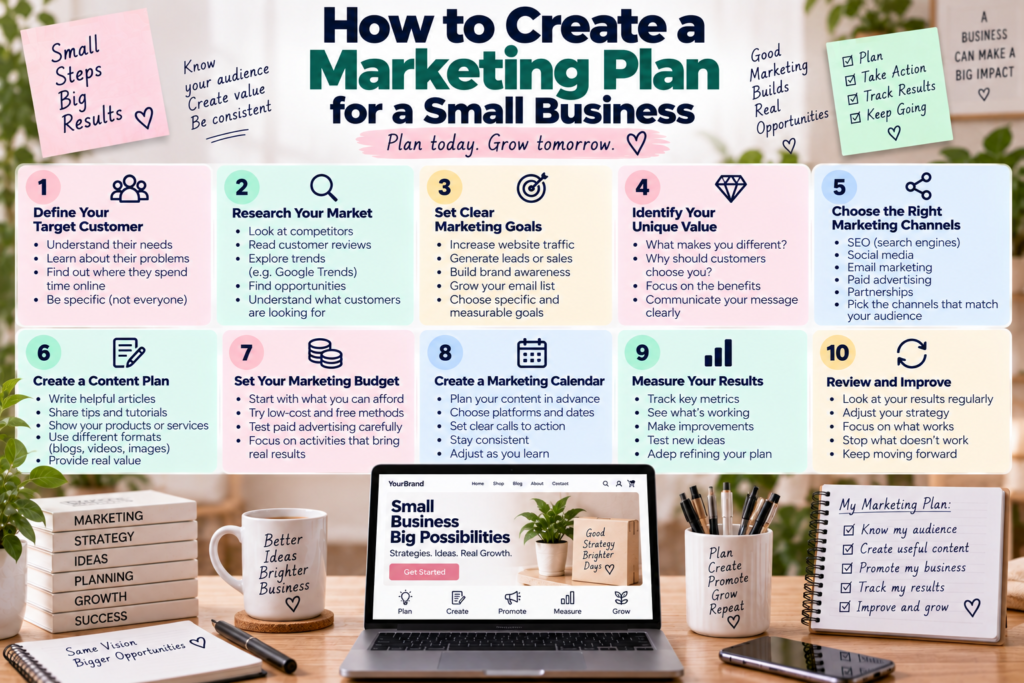
How to Create a Marketing Plan for a Small Business
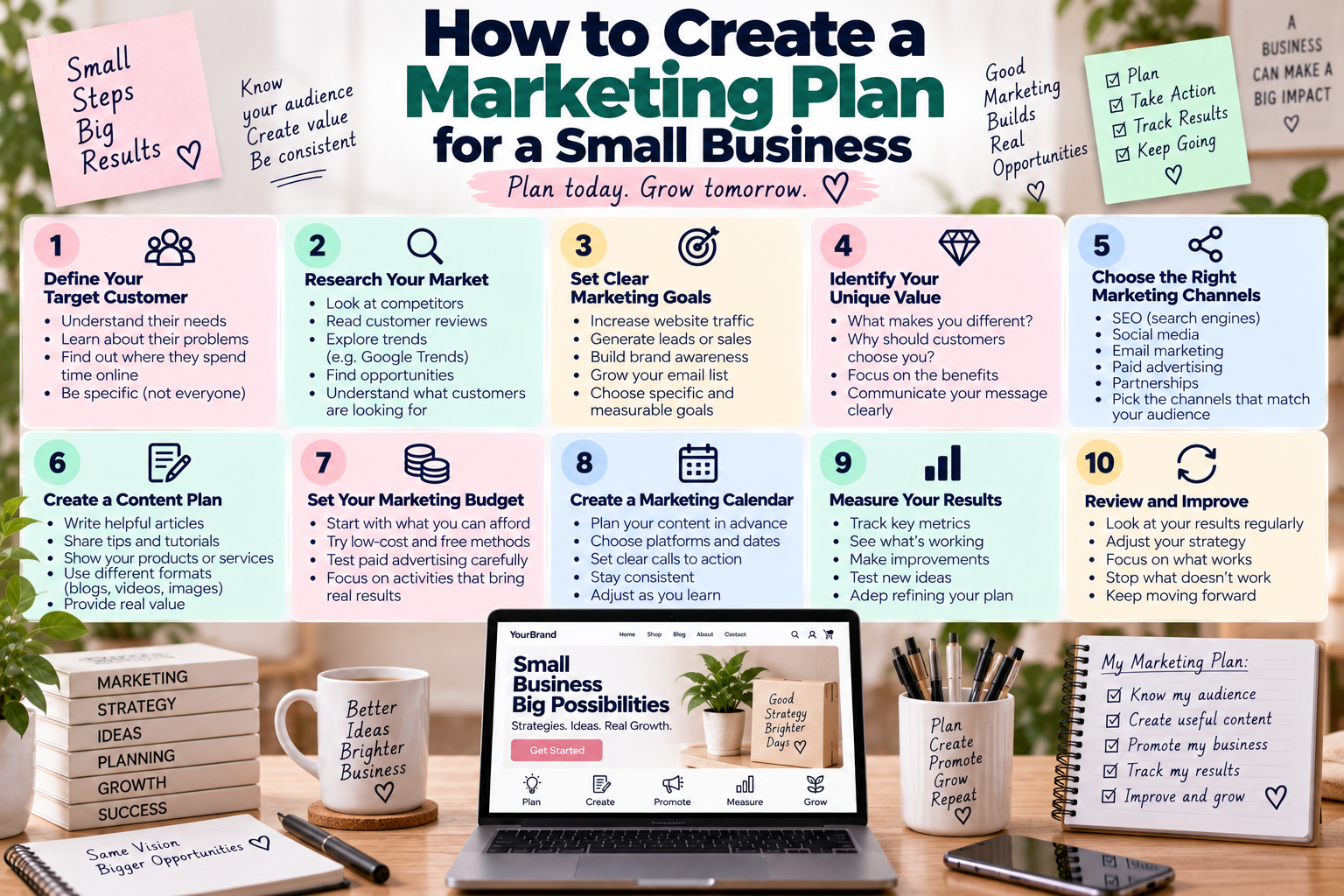
How to Create a Marketing Plan for a Small Business
A marketing strategy tells you why you’re doing something. A marketing plan for a small business tells you what to actually do, and when — which is exactly why so many small business owners have a rough sense of direction but no concrete plan they actually follow week to week. This guide covers how to create a marketing plan for a small business that you’ll genuinely use, not one that looks impressive but sits unopened after the first week.
If you haven’t defined your broader direction yet, our guide on how to create a marketing strategy is worth working through first — the plan below builds directly on top of that foundation.
Marketing Plan vs. Marketing Strategy
These two terms get used interchangeably, but they’re genuinely different things. A marketing strategy defines your overall direction — your audience, positioning, and general channel focus. A marketing plan for a small business turns that direction into specific, scheduled actions: what content to publish, which channels to use, and on what actual timeline. Think of the strategy as the compass and the plan as the turn-by-turn directions.
Step 1: Set Clear, Specific Goals
A useful marketing plan for a small business starts with specific, measurable goals — not “get more customers” but “generate 20 qualified leads per month through the website” or “grow email subscribers to 500 within 90 days.” Vague goals are nearly impossible to act on or measure progress against; specific ones give you something concrete to check yourself against each week.
Step 2: List Your Available Resources Honestly
Before building out tactics, be honest about what you actually have available — time, budget, and existing skills. A marketing plan for a small business run by one person with no budget looks fundamentally different from one with a small team and dedicated ad spend, and pretending otherwise sets you up for a plan you can’t realistically execute.
Step 3: Choose Specific Channels and Tactics
Based on your audience and available resources, select specific tactics rather than trying to cover everything at once:
- Content — blog posts, videos, or guides that answer real audience questions
- Social media — consistent posting on the one or two platforms your audience actually uses
- Email — a welcome sequence plus regular updates to nurture leads over time
- Paid ads — a small, deliberate test budget, ideally once your offer is already validated organically
Trying to execute all four simultaneously as a beginner tends to produce mediocre results across the board rather than strong results anywhere. Our guide on marketing for beginners: how to get your first customers covers how to prioritize when you’re just getting started.
Step 4: Build a Simple Content and Posting Calendar
A marketing plan for a small business works considerably better with an actual calendar — even a basic spreadsheet listing what to publish and when. This single tool turns vague intentions into a repeatable, trackable process, and it’s often the difference between a plan that gets followed and one that quietly gets forgotten within two weeks.
Step 5: Define How You’ll Measure Success
Decide upfront what you’ll actually track — website traffic, email signups, sales, or engagement — using accessible free tools like Google Analytics. Reviewing this data monthly keeps your marketing plan for a small business grounded in real results rather than gut feeling about what seems to be working.
Step 6: Assign Realistic Timelines
Every tactic in your plan needs a realistic timeline attached — not just “post on social media” but “post three times per week starting Monday, review results after 30 days.” Open-ended tactics with no timeline tend to drift indefinitely without ever actually getting evaluated or adjusted.
Step 7: Build In Regular Review Points
A marketing plan for a small business isn’t a document you write once and follow blindly forever. Build in specific checkpoints — monthly or quarterly — to review what’s actually working, what isn’t, and adjust accordingly. Treating the plan as a living document rather than a fixed script is what makes it genuinely useful over time rather than quickly outdated.
Aligning Your Marketing Plan With Your Sales Process
A marketing plan for a small business works best when it’s connected to what actually happens after someone shows interest — not just generating traffic or leads in isolation. If your plan drives inquiries but there’s no clear next step for converting them into customers, a lot of that effort gets wasted at the handoff point. Mapping out what happens from first contact through to a completed sale, and making sure your marketing tactics feed naturally into that process, closes a gap that’s easy to overlook when focused purely on top-of-funnel activity like traffic and awareness.
Budgeting Realistically Within Your Plan
Even a modest marketing plan for a small business benefits from an honest budget line, even if that budget is mostly your own time rather than cash. Free channels like content and organic social media still cost real hours, and accounting for that time investment — not just cash spend — gives a more accurate picture of what you’re actually committing to. This also helps set realistic expectations: a plan built entirely around free channels will likely move slower than one with some paid support, and knowing that upfront prevents disappointment down the line.
A Sample Simple Structure
If you want a concrete starting template, a workable marketing plan for a small business might include:
- Goal — one primary, measurable objective for the next 90 days
- Audience — a brief, specific description of who you’re targeting
- Primary channel — the single channel you’ll focus most effort on
- Secondary channel — one supporting channel, if resources allow
- Content calendar — a simple weekly or monthly posting schedule
- Budget — what you’re spending, and where
- Metrics — the specific numbers you’ll check monthly to gauge progress
- Review date — when you’ll formally revisit and adjust the plan
This structure is deliberately simple — the value comes from actually following it, not from how sophisticated it looks on paper.
Common Pitfalls When Building a Marketing Plan
Making it too complicated to actually follow. An elaborate 20-page document often gets abandoned faster than a simple one-page plan that’s easy to reference weekly.
Setting goals with no way to measure them. If you can’t check whether you hit a goal, it’s not actually a useful goal — it’s just a hope.
Never revisiting the plan. Markets, costs, and what’s working all shift over time; a plan that’s never updated eventually stops reflecting reality.
Trying to do everything at once. Spreading limited time and budget across too many tactics simultaneously usually produces weaker results than focusing deeply on fewer channels.
Copying someone else’s plan wholesale. A marketing plan for a small business needs to reflect your specific audience, resources, and goals — a generic template rarely fits perfectly without real customization.
How Often Should You Update Your Plan?
Most small businesses benefit from a light monthly check-in (are we on track for this month’s numbers?) combined with a more thorough quarterly review (is the overall approach still working, or does something need to change?). This cadence catches problems early without requiring constant, disruptive re-planning that never lets any single tactic run long enough to actually show results.
Frequently Asked Questions
How detailed should a marketing plan for a small business be? Detailed enough to actually follow week to week, but simple enough that you’ll realistically keep using it — a one or two page plan is often more useful in practice than an elaborate document that ends up ignored after the first week.
How often should a small business update its marketing plan? Most small businesses benefit from reviewing and adjusting their marketing plan monthly or quarterly based on actual results, rather than sticking rigidly to an initial plan regardless of what the data shows.
Can one person handle a marketing plan for a small business alone? Yes, especially in the early stages. Many small businesses start with the owner executing the entire plan directly before bringing in additional help as the business grows and the workload becomes unsustainable for one person.
What’s the biggest mistake small businesses make with their marketing plan? Building a plan that’s too complicated or ambitious to realistically execute given actual available time and budget, which leads to inconsistent follow-through and eventual abandonment of the plan altogether — a simpler plan that’s actually followed consistently tends to outperform an elaborate one that gets partially executed for a few weeks and then quietly dropped.