New to online business? Start with our free 7-day roadmap and build your foundation step by step.
Get the Free Roadmap →Ecommerce
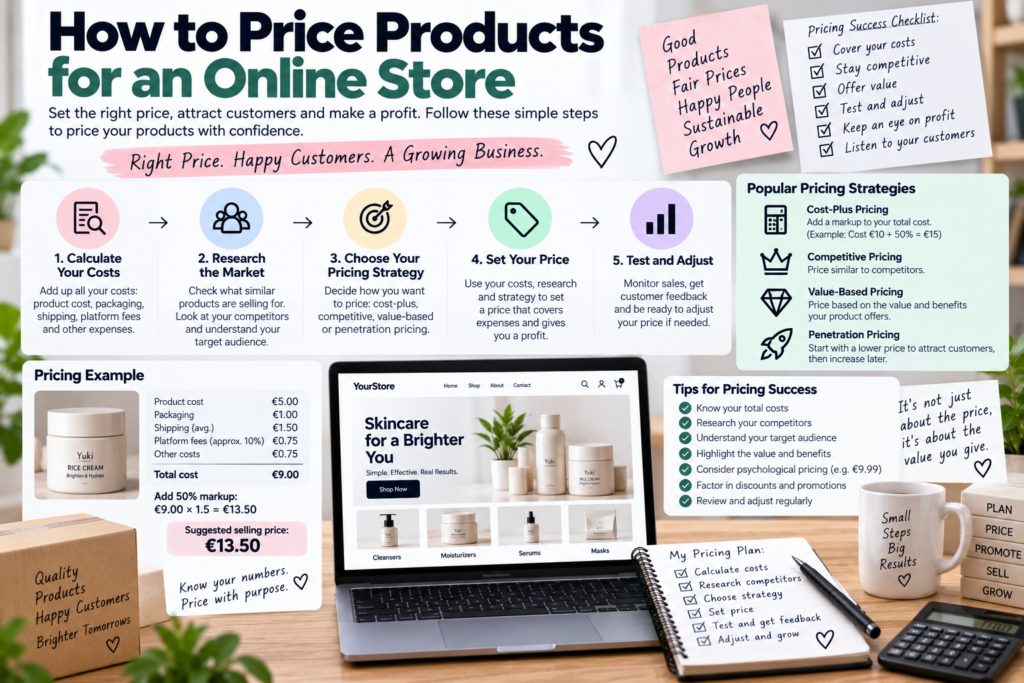
How to Price Products for an Online Store
How to Price Products for an Online Store
Pricing is one of those decisions that feels like it should be simple — just pick a number, right? — but it’s actually one of the more consequential choices you’ll make as a store owner. Price too high without justification and you’ll struggle to convert visitors into buyers. Price too low and you might sell plenty, while quietly working yourself into a corner with margins too thin to actually sustain the business. Learning how to price products for an online store properly means moving past guesswork into an actual method.
This guide walks through exactly how to price products for an online store in a way that covers your costs, stays competitive, and still leaves room for the business to actually grow — because the number on the price tag affects far more than just this month’s sales.
Why Pricing Deserves Real Thought
A lot of beginners either copy a competitor’s price or pick a number that “feels right.” Both approaches skip the actual math that determines whether a price is sustainable. Getting pricing right affects everything downstream — your marketing budget, your ability to run promotions, and ultimately whether the business survives past the first few months.
Step 1: Calculate Your True Cost Per Unit
Before you can price anything intelligently, you need to know exactly what each unit actually costs you. This goes beyond just the product cost itself:
- Product or manufacturing cost — what you pay your supplier or the raw materials
- Shipping costs — both inbound (getting inventory to you) and outbound (getting it to customers, if you’re covering that)
- Payment processing fees — typically a small percentage per transaction
- Platform or marketplace fees — subscription costs or referral fees, depending on where you sell
- Packaging materials — boxes, tape, inserts, anything involved in getting the product ready to ship
Skipping any of these in your calculation is one of the most common reasons a seemingly profitable product turns out to barely break even once every real cost is accounted for.
Step 2: Decide on Your Target Margin
Once you know your true cost, decide what margin you actually need. A common approach when learning how to price products for an online store is working backward from a target profit percentage — for example, if your true cost per unit is $12 and you want a 50% margin, your price would need to be at least $24.
There’s no universal “correct” margin — it depends on your industry, how much marketing spend you’ll need to acquire customers, and how much room you want for future promotions or discounts without eating into profitability.
Step 3: Research What Competitors Are Actually Charging
Understanding the competitive landscape helps you position your pricing realistically. This doesn’t mean copying competitors exactly — it means understanding where you sit relative to them, and why.
- Priced significantly higher? You’ll need a clear reason — better quality, unique features, stronger branding — or customers will simply buy the cheaper option instead.
- Priced significantly lower? This can work as a strategy, but make sure your margins still support the business; competing purely on price is a race that’s hard to win long-term against larger competitors.
- Priced similarly? Differentiation then needs to come from elsewhere — service, presentation, brand trust, or the overall shopping experience.
Step 4: Consider Psychological Pricing
Small pricing details can meaningfully influence buying behavior. A few common, well-tested approaches:
- Charm pricing — $19.99 instead of $20, which tends to feel meaningfully cheaper despite the tiny actual difference
- Price anchoring — showing a higher “original” price alongside a discounted one, which frames the current price as a deal
- Bundle pricing — pricing a set of products slightly below the sum of buying them individually, encouraging larger purchases
These tactics don’t replace solid margin math — they work best layered on top of pricing you’ve already confirmed is sustainable.
Step 5: Factor In Perceived Value, Not Just Cost
Price isn’t purely a math problem — it’s also a signal. A price set too low can actually undermine trust, making a product seem lower quality than it is. This is particularly relevant if you’re selling something premium or handmade, where an unexpectedly low price can create suspicion rather than excitement. Understanding how to price products for an online store well means balancing the hard numbers with how that number will actually be perceived by your specific audience.
Step 6: Test and Adjust Over Time
Pricing isn’t a one-time decision you set and forget. Once live, pay attention to conversion rate at your current price point, and don’t be afraid to test adjustments — a small price increase that doesn’t meaningfully hurt conversion is pure margin improvement, while a price that’s clearly suppressing sales is worth revisiting.
Tools like Google Analytics can help you track how pricing changes correlate with actual conversion behavior over time, rather than relying on gut feeling alone.
Common Pricing Mistakes to Avoid
Ignoring hidden costs. Payment processing fees, packaging, and platform fees are easy to forget but add up quickly across volume.
Racing to the bottom on price. Competing purely on being the cheapest is a difficult, often unsustainable long-term strategy, especially against larger competitors with better economies of scale.
Never revisiting prices. Costs change, competitors shift, and a price that made sense at launch may no longer reflect current reality months later.
Underpricing out of fear. A lack of confidence in the product’s value often shows up as underpricing — which then makes the business harder to sustain, not easier.
Overcomplicating the math. While cost and margin matter, don’t let pricing analysis paralysis delay actually launching and testing in the real market.
Pricing Differently Across Sales Channels
If you’re selling in more than one place — your own store plus a marketplace like Amazon or Etsy — pricing sometimes needs to account for different fee structures on each platform. A marketplace’s referral fees can be substantially different from your independent store’s payment processing costs, which means the same margin target might require different sticker prices depending on where the sale happens. Our guide on how to choose the right selling platform for your business touches on how fee structures vary across different types of platforms, which directly feeds into this pricing math.
Discounts and Promotions Without Destroying Your Margin
Running sales and discounts is a normal, healthy part of ecommerce — but only when planned around your actual margin rather than reactively. A useful approach is building a small promotional buffer into your baseline pricing from the start, so an occasional 15-20% discount doesn’t push you below break-even. Flash sales, seasonal promotions, and bundle discounts all work best when they’re planned in advance against known numbers, not improvised in the moment because sales feel slow.
A Simple Pricing Formula to Start With
If you want a straightforward starting point:
Price = (Product Cost + Shipping + Fees) ÷ (1 − Desired Margin as a decimal)
For example, if your total cost per unit is $15 and you want a 40% margin: $15 ÷ (1 − 0.40) = $15 ÷ 0.60 = $25.
This gives you a baseline number to adjust from based on competitor research and psychological pricing considerations, rather than starting from zero.
How Pricing Connects to Your Broader Business Strategy
Pricing doesn’t exist in isolation — it’s tied directly to your marketing budget, your fulfillment costs, and how you plan to grow. If you’re still working through the earlier stages of setting up your store, our guide on how to start an online storecovers how pricing fits into the broader launch process alongside product selection and platform setup.
Frequently Asked Questions
What’s a good profit margin for an online store? This varies significantly by industry, but many ecommerce businesses target somewhere between 20-50% margin after accounting for all costs, adjusting based on competition and marketing needs.
Should I price my products the same as competitors? Not necessarily. Matching competitor pricing only makes sense if your costs and value proposition are similar — differentiating through quality, branding, or service can justify a different price point entirely.
How often should I revisit my pricing? Reviewing pricing periodically — especially after cost changes, seasonal shifts, or new competitor activity — helps ensure your prices stay both competitive and profitable over time.
Is it bad to price products too low? Yes, in two ways: it directly reduces your margin and sustainability, and it can also undermine perceived quality, making customers suspicious of a price that seems too good to be true.
Can I change my prices after launching my store? Yes, and you should expect to. Learning how to price products for an online store is an ongoing process — reviewing and adjusting prices based on real sales data, cost changes, and competitor movement is normal and healthy, not a sign something went wrong initially.
7 thoughts on “How to Price Products for an Online Store”
Comments are closed.
[…] to be wildly off. If you haven’t worked through your specific pricing yet, our guide on how to price products for an online store walks through the actual math in more […]
[…] marketing costs, it’s worth reconsidering before investing further time. Our guide on how to price products for an online store covers this calculation in more depth once you’ve narrowed down a specific […]
[…] after your first sale reveals the math didn’t actually work in your favor. Our guide on how to price products for an online storewalks through this calculation in more […]
[…] factored in, it’s worth reconsidering before investing further time and effort. Our guide on how to price products for an online store covers this specific calculation in much more depth once you’ve narrowed down a product […]
[…] fees, and a business that can’t afford to grow can’t actually grow. Our guide on how to price products for an online store walks through the proper calculation to avoid this […]
[…] erodes margin before fees, shipping, and returns are even factored in. Our guide on how to price products for an online store breaks down a more reliable approach than simply matching whatever competitors […]
[…] are one of the most common reasons customers abandon a purchase at the last step. Our guide on how to price products for an online store covers how to factor shipping costs into your pricing without eating into your […]