New to online business? Start with our free 7-day roadmap and build your foundation step by step.
Get the Free Roadmap →Ecommerce
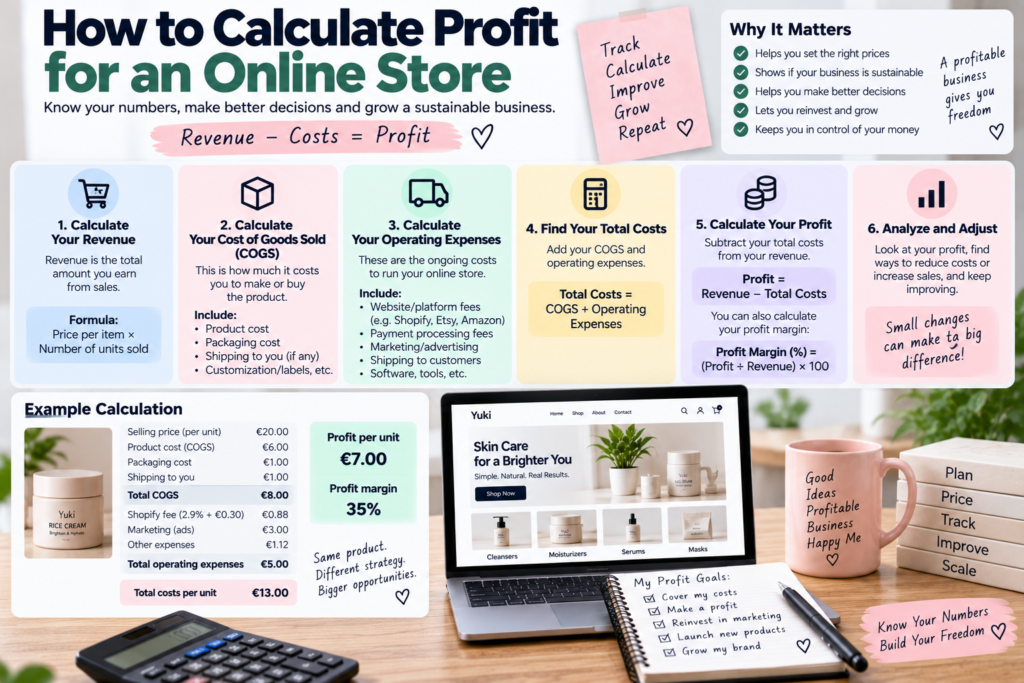
How to Calculate Profit for an Online Store
How to Calculate Profit for an Online Store
Knowing how much your online store sells is important, but revenue is not the same as profit.
A store can generate €5,000 in sales and still have much less money left after paying for products, shipping, advertising, platform fees, payment processing, returns, and other expenses.
That’s why learning how to calculate profit for an online store is essential before deciding whether a product or business is financially worthwhile.
If you’re still working on your pricing, read How to Price Products for an Online Store.
What Is Profit?
Profit is the money remaining after you subtract your business expenses from your revenue.
A simple formula is:
Revenue − Expenses = Profit
For an online store, however, there can be many different expenses to consider.
These may include:
- Product costs
- Packaging
- Shipping
- Payment processing
- Platform fees
- Advertising
- Software
- Returns and refunds
- Storage
- Other operating expenses
The more complete your calculations are, the better picture you’ll have of your business.
1. Start With Your Revenue
Revenue is the total amount your customers pay for your products before you subtract expenses.
For example:
100 orders × €25 average order value = €2,500 revenue
That €2,500 is not your profit.
You still need to subtract the costs associated with generating those sales.
This distinction is one of the most important things to understand when running an online store.
2. Calculate Your Product Costs
The first major expense is usually the cost of obtaining or producing your products.
Suppose you sell 100 units and each one costs you €8.
Your product cost would be:
100 × €8 = €800
If you make the products yourself, you may need to calculate materials, production supplies, and other direct costs instead.
Keep your calculations as accurate as possible.
3. Add Packaging Costs
Packaging is another expense that can affect your online store profit.
For example, if packaging costs €1 per order and you have 100 orders:
100 × €1 = €100
Your packaging expenses would therefore be €100.
Depending on the products you sell, packaging could include:
- Boxes
- Mailers
- Labels
- Tape
- Protective materials
- Custom packaging
- Inserts
Don’t forget these costs simply because they’re relatively small per order.
Small expenses can add up as sales increase.
4. Include Shipping Costs
Shipping is particularly important for physical products.
Suppose you pay €4 to ship each order and have 100 orders:
100 × €4 = €400
Your shipping cost would be €400.
If customers pay the full shipping cost separately, the calculation can be different because the shipping charge becomes part of your revenue while the shipping expense remains a business cost.
The important thing is to account for both sides.
5. Account for Payment Processing
Payment providers can charge transaction or processing fees.
The exact fee depends on the provider, country, payment method, and agreement.
For example, if your total payment processing fees for the month are €75, that €75 needs to be included among your expenses.
Don’t use an old fee example from another business.
Check your payment provider’s current pricing when calculating your own numbers.
6. Include Platform Fees
Your ecommerce platform may also create expenses.
Depending on your setup, you could have:
- Monthly subscription fees
- Transaction fees
- Marketplace commissions
- App subscriptions
- Paid extensions
For example, Shopify provides different plans and pricing structures. You can check the official Shopify pricing page for current information.
If you use WooCommerce, the core software is free, but hosting, payment processing, and extensions can still create expenses. WooCommerce explains these considerations in its official documentation.
7. Don’t Forget Advertising Costs
If you use paid advertising, include it in your calculations.
Imagine you spend €300 on advertising during a month and generate €2,500 in sales.
That €300 is a business expense.
You can also calculate the relationship between advertising spend and the revenue it generates, but don’t assume that every sale from a campaign represents profit.
The products, fulfillment, payment, and other costs still need to be deducted.
If you’re trying to build your business without a large advertising budget, our Marketing for Beginners guide covers organic and paid marketing approaches.
8. Include Returns and Refunds
Returns can affect your numbers in several ways.
You might have to deal with:
- Refunded revenue
- Return shipping
- Replacement products
- Damaged inventory
- Restocking
- Customer service
If you sell physical products, leave room in your financial planning for returns.
A month with €3,000 in gross sales doesn’t necessarily mean that the entire €3,000 remains after refunds and other adjustments.
9. Understand Gross Profit
Gross profit generally looks at revenue minus the direct costs associated with the products sold.
A simplified formula is:
Revenue − Cost of Goods Sold = Gross Profit
For example:
Revenue: €2,500
Product costs: €800
Gross profit: €1,700
Depending on your accounting method and business, the costs included in cost of goods sold can vary.
For simple ecommerce planning, the important idea is that gross profit looks at the money left after certain direct product costs.
10. Calculate Your Gross Margin
Gross margin expresses gross profit as a percentage of revenue.
The basic formula is:
Gross Profit ÷ Revenue × 100 = Gross Margin
Using the previous example:
€1,700 ÷ €2,500 × 100 = 68%
That means the gross margin in this simplified example is 68%.
Don’t assume a particular margin is automatically “good.”
Different industries, products, and business models can have very different cost structures.
11. Understand Operating Expenses
After calculating gross profit, you need to consider the other expenses involved in running the business.
These might include:
- Advertising
- Software
- Platform subscriptions
- Website hosting
- Professional services
- Office expenses
- Storage
- Salaries
- Insurance
- Other overhead
These expenses can exist even when you don’t make a sale.
That’s why looking only at product margins doesn’t give you the complete financial picture.
12. Calculate Net Profit
A simplified calculation is:
Revenue − All Business Expenses = Net Profit
For example:
Revenue: €2,500
Product costs: €800
Packaging: €100
Shipping: €400
Payment fees: €75
Advertising: €300
Other expenses: €200
Estimated remaining profit: €625
This is a simplified example rather than an accounting statement.
Taxes and other business-specific expenses can affect the final amount you actually keep.
13. Calculate Profit Per Product
You can also calculate the approximate profit contribution of an individual product.
Suppose:
Selling price: €30
Product cost: €10
Packaging: €1
Shipping contribution: €4
Payment/platform costs: €2
That gives:
€30 − €10 − €1 − €4 − €2 = €13
The €13 is the amount remaining before other expenses such as advertising, software, overhead, taxes, and returns.
This type of calculation can help you compare different products.
14. Don’t Confuse Markup With Margin
These two terms are often confused.
Markup
Markup compares the amount added to your cost with the original cost.
For example:
Product cost = €10
Selling price = €20
The markup is:
€10 ÷ €10 × 100 = 100%
Margin
Margin compares profit with the selling price.
Using the same example:
€10 profit ÷ €20 selling price × 100 = 50%
So a 100% markup is a 50% margin.
Understanding the difference helps prevent mistakes when evaluating ecommerce profit margins.
15. Calculate Your Break-Even Point
The break-even point is where your business’s revenue covers its relevant costs, meaning you’re not making a profit or a loss.
A simplified formula for break-even units is:
Fixed Costs ÷ Contribution Per Unit = Break-Even Units
For example, suppose:
Fixed costs = €500
Selling price = €25
Variable costs per order = €15
Your contribution per order is:
€25 − €15 = €10
Your break-even point would be:
€500 ÷ €10 = 50 orders
So, in this simplified example, you would need 50 orders to cover €500 in fixed costs.
Real businesses can have more complicated cost structures, but the principle is useful for planning.
16. Track Your Numbers Monthly
Don’t calculate your profit only once.
Create a simple monthly record of:
- Revenue
- Product costs
- Shipping
- Packaging
- Payment fees
- Platform fees
- Advertising
- Returns
- Other expenses
- Profit
Comparing months can help you identify changes.
Maybe revenue is increasing while profit is staying flat.
That could indicate that your costs are increasing faster than your sales.
Perhaps one product generates much more profit than another.
That information can influence your future product decisions.
17. Calculate Profit Before Scaling
Before ordering significantly more inventory or increasing advertising, check your numbers.
More sales aren’t automatically better if each sale contributes very little toward your expenses.
Imagine:
Product A: €10 contribution per sale
Product B: €3 contribution per sale
If both generate the same number of orders, Product A gives your business more room to cover overhead and generate profit.
However, don’t evaluate products only on one number.
Return rates, customer lifetime value, repeat purchases, and operational effort can also matter.
18. Use a Simple Profit Spreadsheet
You don’t need complicated accounting software to start understanding your numbers.
A basic spreadsheet could contain:
| Product | Selling Price | Product Cost | Shipping | Fees | Other Costs | Profit |
|---|---|---|---|---|---|---|
| Product A | €25 | €8 | €4 | €2 | €1 | €10 |
| Product B | €35 | €12 | €5 | €3 | €2 | €13 |
This can make it easier to compare products and identify which ones deserve more attention.
As your business grows, consider using proper accounting software or professional accounting support.
Common Profit Calculation Mistakes
Looking only at revenue
High sales don’t necessarily mean high profit.
Forgetting shipping
Shipping can significantly change the economics of a physical product.
Ignoring payment fees
Small transaction fees can add up.
Forgetting returns
Refunds and returns can reduce your actual revenue.
Treating all sales as profit
Every sale has associated costs.
Using unrealistic forecasts
Don’t assume every visitor will become a customer.
Confusing markup with margin
A percentage added to cost isn’t the same as your profit margin.
Frequently Asked Questions
How do I calculate profit for an online store?
Start with your total revenue and subtract the relevant costs of running the business. A simple formula is revenue minus total expenses equals profit. Include product costs, shipping, packaging, payment fees, platform costs, marketing, returns, and other applicable expenses.
What is the difference between revenue and profit?
Revenue is the money generated from sales before expenses. Profit is what remains after applicable business expenses have been deducted.
How do I calculate profit per product?
Subtract the product’s direct costs from its selling price. Depending on your business, these may include product cost, packaging, shipping, payment fees, and other transaction-related expenses. You can then consider additional overhead and marketing costs.
What is a good ecommerce profit margin?
There is no universal margin that is considered good for every ecommerce business. The appropriate margin depends on the products, industry, business model, operating costs, competition, and other factors.
Should shipping be included when calculating profit?
Yes. Shipping is a real business expense for physical products and should be included in your calculations. If customers pay a shipping charge, include the amount collected and the actual shipping expense in your calculations.
Can a store have high sales but low profit?
Yes. A store can generate substantial revenue while spending heavily on inventory, advertising, shipping, salaries, returns, and other expenses. That’s why revenue alone isn’t enough to evaluate business performance.
Final Thoughts
Learning how to calculate profit for an online store gives you a much clearer picture of whether your business is actually working financially.
Start with revenue, then account for the costs connected to each sale. After that, consider your wider operating expenses.
Don’t worry about making your first spreadsheet perfect.
The important thing is to start tracking the numbers consistently.
Once you understand where your money is coming from and where it’s going, you can make better decisions about pricing, products, marketing, inventory, and growth.