New to online business? Start with our free 7-day roadmap and build your foundation step by step.
Get the Free Roadmap →Ecommerce
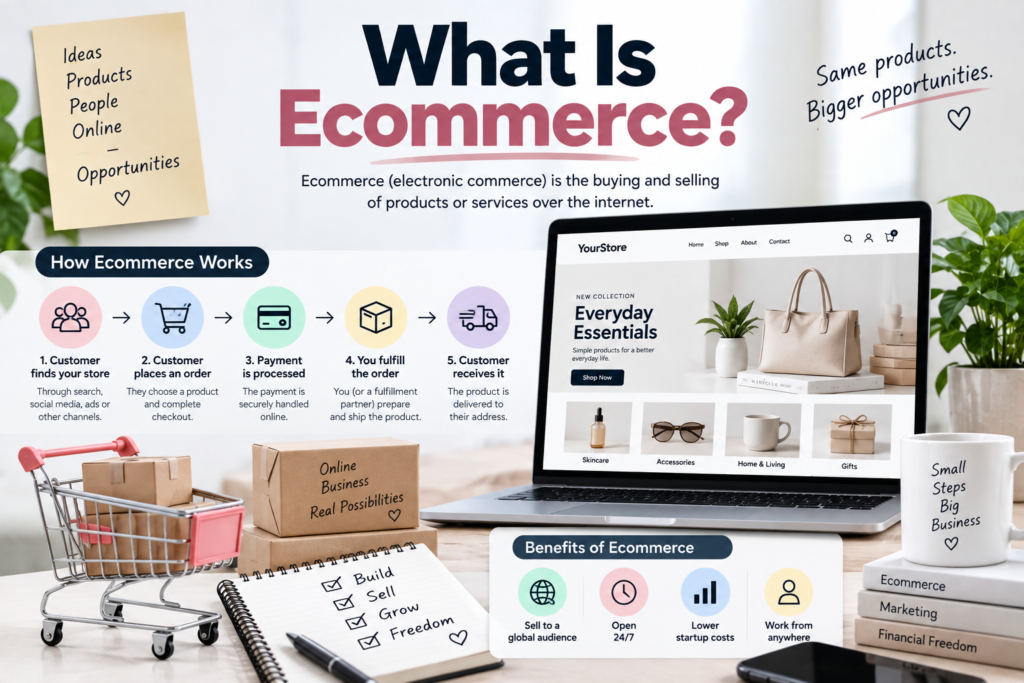
What is Ecommerce?
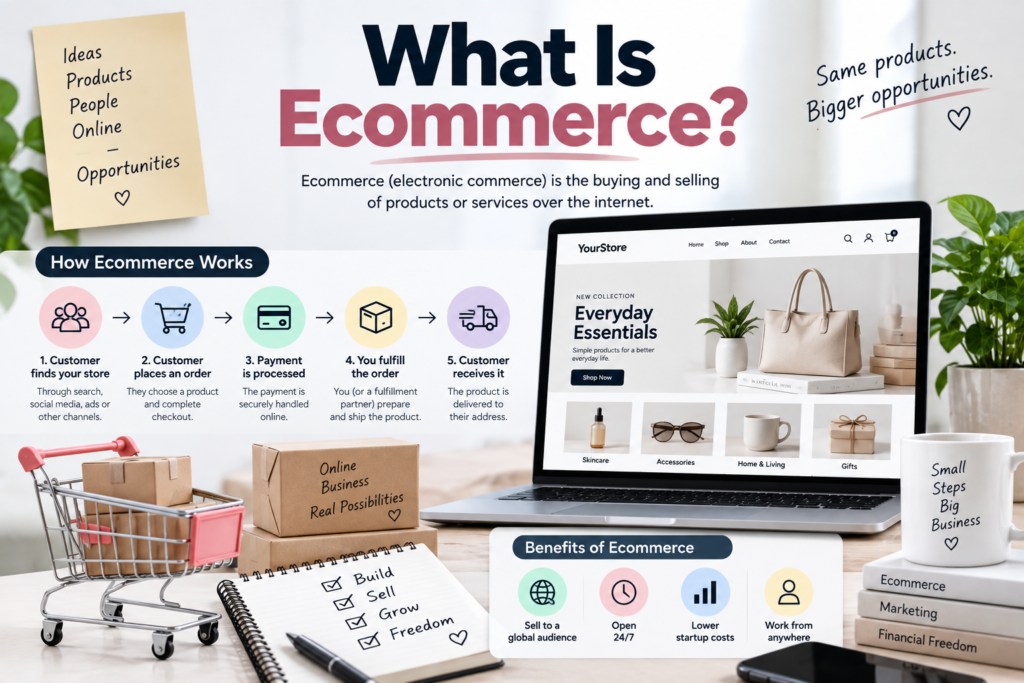
What Is Ecommerce?
Chances are you’ve bought something online in the last week without even thinking about the word behind it — ecommerce. It’s one of those terms that’s become so common it’s almost invisible, baked into how we shop without a second thought. But if you’re considering starting an online business, it’s worth actually understanding what is ecommerce beyond the surface-level definition, because the details shape almost every decision you’ll make afterward.
This guide breaks down exactly what is ecommerce, the different forms it takes, how it actually works behind the scenes, and why it’s become such an accessible way to start a business from almost anywhere.
What Is Ecommerce, In Plain Terms?
Ecommerce — short for “electronic commerce” — is simply the buying and selling of goods or services over the internet. That’s the whole definition at its core. Whether it’s a multinational company or a single person selling handmade candles from their kitchen table, if the transaction happens online, it falls under this umbrella.
What makes understanding what is ecommerce useful isn’t the definition itself, though — it’s recognizing just how many different shapes it can take, and how differently each one operates.
The Main Types of Ecommerce
Ecommerce isn’t a single business model. It splits into a few distinct categories, each with its own dynamics:
Business-to-Consumer (B2C) — the most familiar type, where a business sells directly to individual customers. Think of buying shoes from an online store or a subscription box delivered to your door.
Business-to-Business (B2B) — companies selling products or services to other companies, often in bulk or on ongoing contracts. Less visible to everyday consumers, but massive in scale.
Consumer-to-Consumer (C2C) — individuals selling directly to other individuals, typically through a marketplace that facilitates the transaction, like eBay or Facebook Marketplace.
Consumer-to-Business (C2B) — a less common but growing model where individuals sell products or services to businesses — think freelancers, influencers, or independent contractors.
Understanding which category your idea fits into shapes almost every decision that follows, from which platform to use to how you’ll market it.
How Does Ecommerce Actually Work?
Once you strip away the branding, most ecommerce transactions follow a fairly consistent sequence:
- A product or service is listed — with photos, descriptions, and pricing, either on an independent website or within a marketplace
- A customer finds and selects it — through search, browsing, social media, or direct traffic
- Payment is processed securely — through a payment gateway that handles the transaction
- The order gets fulfilled — shipped by the seller, a third-party warehouse, or a dropshipping supplier
- Post-purchase steps happen — confirmation emails, tracking updates, and eventually, hopefully, a review
If you’re comparing where to actually run this process — your own site versus an existing marketplace — our guide on what is a selling platform and how does it work breaks that decision down in more depth.
Why Ecommerce Became So Accessible
A couple of decades ago, starting a retail business meant a physical storefront, significant upfront capital, and geographic limitations on who could even become your customer. Ecommerce quietly dismantled most of those barriers. Platforms like Shopify and WooCommerce turned what used to require a developer and months of setup into something a beginner can configure themselves in a weekend.
Today, platforms exist that let you launch a functioning online store in an afternoon. Payment processing, once complex and expensive to set up, is now handled by services like Stripe or PayPal that take minutes to configure. And your potential customer base isn’t limited to foot traffic on a specific street — it’s anyone with an internet connection, anywhere.
This accessibility is a big part of why so many people ask what is ecommerce and how to get started with it — the barrier to entry has dropped dramatically compared to traditional retail.
Physical Products vs. Digital Products
Ecommerce covers more than just shipping boxes. It’s worth distinguishing between:
- Physical products — items that require inventory, packaging, and shipping logistics
- Digital products — downloadable or virtual goods like ebooks, courses, or software, delivered instantly with no shipping involved at all
Both fall firmly under the ecommerce umbrella, but they involve very different operational realities. Physical products require thinking through storage, fulfillment, and returns; digital products trade that complexity for a different set of challenges around piracy protection and delivery systems.
The Building Blocks of an Ecommerce Business
Regardless of what you’re selling, a functioning ecommerce operation typically needs:
- A storefront — whether an independent website or a listing on a marketplace
- A payment system — to securely process transactions
- A fulfillment method — how the product actually reaches the customer
- A way to attract traffic — since even the best product needs visibility to sell
- Customer support infrastructure — for questions, issues, and returns
Missing any one of these tends to create friction somewhere down the line — a great product with no traffic won’t sell, and plenty of traffic with a broken checkout process converts nobody either.
Ecommerce vs. Traditional Retail
The most obvious difference is the absence of a physical storefront, but the distinctions run deeper than that. Ecommerce typically involves lower overhead (no rent for retail space), a much larger potential customer base (not limited by geography), and detailed data on customer behavior that traditional retail simply can’t match — you can see exactly how many people viewed a product, added it to their cart, and abandoned it before purchase.
That said, ecommerce also comes with its own challenges traditional retail doesn’t face — namely, the complete absence of in-person trust signals. A customer can’t physically hold your product or speak to you face-to-face before buying, which makes things like product photography, reviews, and clear policies carry more weight than they would in a physical store.
Common Misconceptions About Ecommerce
A few myths tend to trip up people just learning what is ecommerce, and clearing them up early can save a lot of wasted effort:
“It’s passive income once it’s set up.” This one causes more disappointment than almost any other myth. Even a well-built ecommerce store requires ongoing marketing, customer service, and inventory management. It can become more efficient over time, but “set it and forget it” is rarely how it actually plays out.
“You need a huge budget to compete.” Some of the most successful ecommerce businesses started with modest budgets, focusing on a specific niche rather than trying to compete broadly against massive retailers from day one.
“More products means more sales.” A large, unfocused catalog often performs worse than a smaller, well-curated one. Depth in a specific niche tends to build trust and repeat customers faster than breadth across unrelated categories.
“Ecommerce is only for physical products.” As covered earlier, digital products, subscriptions, and services all fall under the same umbrella — ecommerce is far broader than just shipping boxes.
The Role of Customer Trust in Ecommerce
Since ecommerce removes the face-to-face interaction of traditional retail, trust becomes something you have to actively build rather than something that comes naturally from a handshake and a storefront. Clear policies, genuine reviews, responsive customer service, and a professional-looking site all contribute to whether a stranger feels comfortable entering their payment details. Our guide on how to get visitors to trust your website and buy goes deeper into the specific signals that make or break that decision for a new visitor.
Getting Started With Ecommerce
If you’re ready to move from understanding what is ecommerce to actually building one, the general path looks like:
- Decide what you’re selling — physical or digital, and within which niche
- Choose where you’ll sell — your own store, a marketplace, or both
- Set up payment processing and fulfillment
- Build out your product listings with quality photos and clear descriptions
- Start driving traffic through content, social media, ads, or SEO
Our guide on how to start an online store walks through this process in much more practical detail, covering platform choices and setup specifics once you’re ready to move past the conceptual stage.
Frequently Asked Questions
Is ecommerce the same as dropshipping? No. Dropshipping is one specific fulfillment method within ecommerce, where a supplier ships products directly to customers without the seller holding inventory. Ecommerce is the broader umbrella term covering all forms of online buying and selling.
Do I need a physical product to do ecommerce? No. Digital products — ebooks, courses, software, templates — are just as much a part of ecommerce as physical goods, without the added complexity of shipping and inventory.
How much money do I need to start an ecommerce business? This varies enormously depending on the model. Some approaches, like dropshipping or digital products, can start with very little capital, while others, like holding significant inventory upfront, require more investment.
What’s the easiest type of ecommerce for a beginner to start? There’s no single easiest option — it depends on your skills, budget, and interests. Many beginners find digital products or dropshipping more accessible starting points since they avoid the upfront cost and complexity of holding physical inventory.
Is ecommerce still a good business to start? Yes, though it’s more competitive than it was years ago. Success now depends more on genuine niche research, quality execution, and marketing skill than simply having an online store — the barrier to entry is low, but so is the barrier for everyone else too.