New to online business? Start with our free 7-day roadmap and build your foundation step by step.
Get the Free Roadmap →Ecommerce
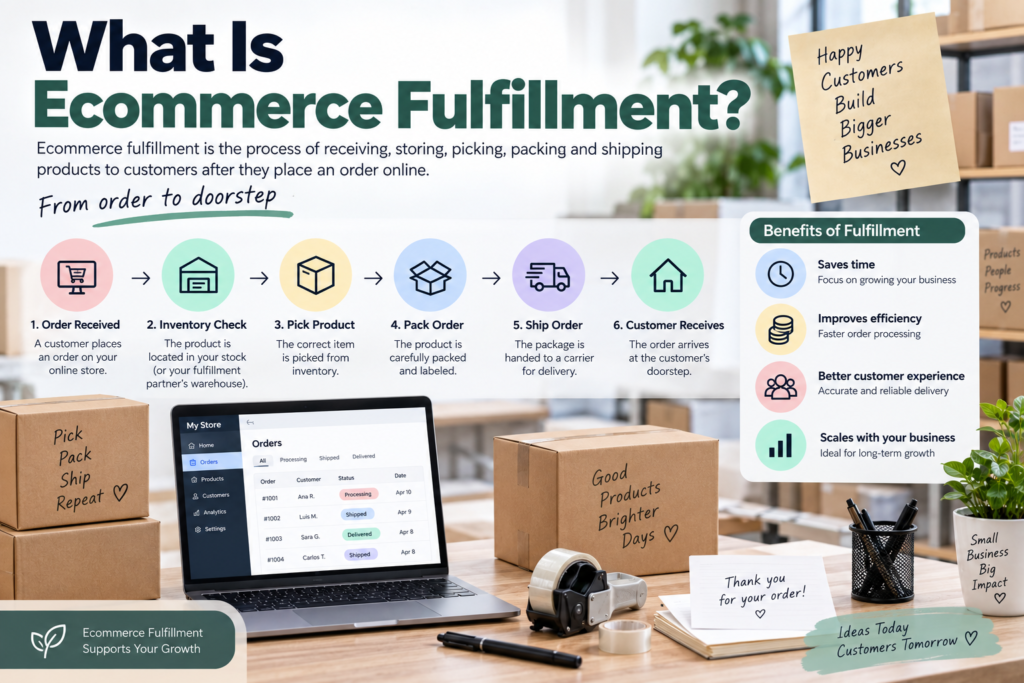
What Is Ecommerce Fulfillment?
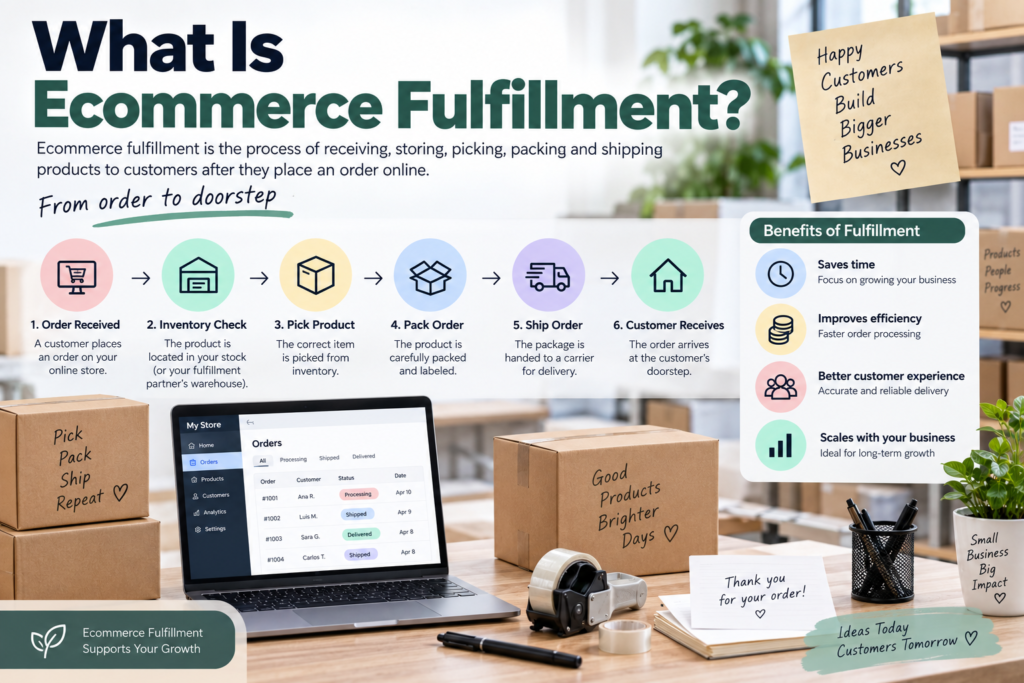
What Is Ecommerce Fulfillment?
You’ve made the sale — congratulations, genuinely, that’s the hard part. But the moment a customer clicks “buy,” a whole new process quietly kicks into gear that most beginners never think about until they’re already knee-deep in it: getting that product from wherever it currently sits into your customer’s hands. That entire process has a name — ecommerce fulfillment — and understanding it properly can be the difference between happy repeat customers and a stream of refund requests.
This guide covers exactly what ecommerce fulfillment involves, the different models available, and how to choose the right approach for where your business is right now — because the wrong choice at the wrong stage can quietly cap your growth or quietly drain your margins
What Is Ecommerce Fulfillment, Exactly?
Ecommerce fulfillment refers to the entire process of receiving, processing, and delivering an order to a customer after they’ve made a purchase. It’s not just “shipping” — it’s the whole chain: storing inventory, picking the right item, packing it securely, shipping it out, and handling anything that goes wrong afterward, like returns or exchanges.
It’s easy to underestimate how much operational weight sits inside that single word “fulfillment” until you’re the one responsible for it.
The Main Ecommerce Fulfillment Models
There isn’t just one way to handle this. Broadly, sellers choose between a few distinct approaches:
Self-fulfillment — you personally store inventory (at home, a garage, a small warehouse) and handle picking, packing, and shipping yourself. Maximum control, but it scales poorly once order volume grows.
Third-party logistics (3PL) — you send inventory to an external company like ShipBob that handles storage, packing, and shipping on your behalf, for a fee. This removes the physical burden but adds a layer of cost and reduces direct control.
Marketplace-managed fulfillment — services like Fulfillment by Amazon (FBA) handle storage, packing, and shipping for products sold through their platform, often bundled with faster shipping perks for buyers. Our guide on how to start selling on Amazon covers exactly how this option works in practice.
Dropshipping — a supplier holds inventory and ships directly to your customer once an order comes in, meaning you never physically handle the product at all. This is its own distinct approach to ecommerce fulfillment, trading control for minimal operational overhead.
How Does Ecommerce Fulfillment Actually Work, Step by Step?
Regardless of which model you choose, the underlying sequence tends to follow a similar path:
- The order comes in — through your website, a marketplace, or wherever the sale happened
- Inventory gets checked — confirming the product is actually in stock and available
- The item gets picked — located within storage, whether that’s a spare bedroom or a massive warehouse
- It gets packed — securely boxed with appropriate protective materials
- A shipping label is generated — and the package is handed off to a carrier
- Tracking information is shared — so the customer knows where their order stands
- The order arrives — hopefully in good condition and within the expected timeframe
- Post-delivery support happens — for returns, exchanges, or damaged item claims, if needed
Every step represents a place where things can go smoothly or go sideways, which is exactly why choosing the right ecommerce fulfillment approach matters more than it might initially seem.
Self-Fulfillment: Pros and Cons
Handling ecommerce fulfillment yourself gives you complete control over packaging, presentation, and timing — useful if branding and unboxing experience matter to your business. It’s also usually the cheapest option at low order volume, since you’re not paying anyone else’s fees.
The downside shows up as you grow. What’s manageable at ten orders a week becomes genuinely overwhelming at two hundred, and most sellers eventually hit a point where self-fulfillment starts eating into time that would be better spent on marketing, product development, or customer relationships.
Third-Party Logistics (3PL): Pros and Cons
Outsourcing ecommerce fulfillment to a 3PL frees up significant time and removes the physical storage burden entirely. Many 3PLs also offer better shipping rates than an individual seller could negotiate alone, thanks to their overall shipping volume.
The trade-off is cost and reduced flexibility — you’re now paying storage and per-order fees, and any special packaging or personal touches become harder (and more expensive) to implement consistently.
Marketplace-Managed Fulfillment: Pros and Cons
Services like FBA combine the benefits of outsourcing with strong platform integration — your listings often qualify for expedited shipping badges that boost visibility and buyer trust. It’s a genuinely convenient middle ground for many sellers.
The downside is cost (these services aren’t cheap) and reduced control over the unboxing experience, since your packaging follows the platform’s standardized approach rather than your own branding choices.
Dropshipping as an Ecommerce Fulfillment Model
Dropshipping represents the most hands-off version of ecommerce fulfillment — you never touch inventory at all. This dramatically lowers the operational burden and startup cost, but it also means you have the least control over quality, packaging, and shipping speed, since all of that depends entirely on your supplier’s performance.
How to Choose the Right Fulfillment Approach
The right choice depends heavily on your stage and priorities:
- Just starting out, low order volume? Self-fulfillment keeps costs low while you validate demand.
- Growing fast, need to free up time? A 3PL removes the operational burden as volume increases.
- Selling primarily on a specific marketplace? That platform’s managed fulfillment option (like FBA) often makes sense.
- Want the lowest possible startup cost and minimal operational involvement? Dropshipping trades control for simplicity.
Many businesses actually shift between these models over time — starting with self-fulfillment to validate an idea cheaply, then moving to a 3PL or marketplace-managed option once volume justifies the added cost.
Fulfillment Speed and Customer Expectations
However you handle ecommerce fulfillment, speed matters more to customers than most beginners initially expect. Modern shoppers are accustomed to fast shipping standards set by major retailers, and slow, unclear fulfillment is one of the more common sources of negative reviews — often more than product quality issues themselves. Being transparent about expected shipping times upfront, even if they’re longer than customers might prefer, tends to produce better outcomes than vague or optimistic promises that don’t hold up.
Packaging and the Unboxing Experience
Beyond just getting a product from point A to point B, packaging plays a bigger role in customer perception than many beginners initially realize. A product that arrives in a beat-up, poorly protected box creates doubt about quality before a customer has even used what they bought — regardless of how good the actual product is.
For businesses using self-fulfillment or a flexible 3PL, this is an area where you can differentiate meaningfully: branded packaging, a small thank-you note, or thoughtful presentation can turn an ordinary delivery into a moment that encourages a review or repeat purchase. This level of control is generally harder to achieve with marketplace-managed or dropshipping models, where packaging standards are largely dictated by the platform or supplier.
Common Fulfillment Mistakes That Hurt Customer Trust
A handful of avoidable mistakes tend to cause the most damage here, regardless of which model you choose:
Overpromising on shipping times. Setting expectations you can’t consistently meet leads directly to frustrated customers and negative reviews, even when the product itself is exactly as described.
Poor packaging. Items arriving damaged because of inadequate protective materials creates refund requests and erodes trust quickly, especially for a first-time customer deciding whether to buy from you again.
No tracking information. Leaving customers in the dark about where their order stands generates unnecessary support inquiries and anxiety that a simple tracking number would have prevented entirely.
Ignoring returns and exchanges. Treating this as an afterthought rather than a planned process tends to create the worst customer experiences — and returns are an inevitable part of selling online, not a rare edge case.
Frequently Asked Questions
What’s the difference between fulfillment and shipping? Shipping is just one piece of fulfillment — specifically, getting the package from your location to the customer’s. Fulfillment covers the entire process, including storage, order processing, packing, and post-delivery support.
Is dropshipping a type of ecommerce fulfillment? Yes. Dropshipping is one specific fulfillment model, distinguished by the fact that the seller never physically holds or handles the inventory themselves.
How much does ecommerce fulfillment typically cost? This varies enormously by model and volume — self-fulfillment has lower fees but higher time cost, while 3PLs and marketplace-managed options charge storage and per-order fees in exchange for handling the physical work for you.
When should a small business switch from self-fulfillment to a 3PL? There’s no universal threshold, but many sellers consider switching once order volume starts consistently eating into time needed for other parts of the business, like marketing or product development.
Can I switch fulfillment models after I’ve already launched? Yes, and many sellers do exactly that as their business grows. It’s common to start with self-fulfillment to keep costs low while validating demand, then transition to a 3PL or marketplace-managed option once order volume makes outsourcing worthwhile financially.