New to online business? Start with our free 7-day roadmap and build your foundation step by step.
Get the Free Roadmap →Ecommerce
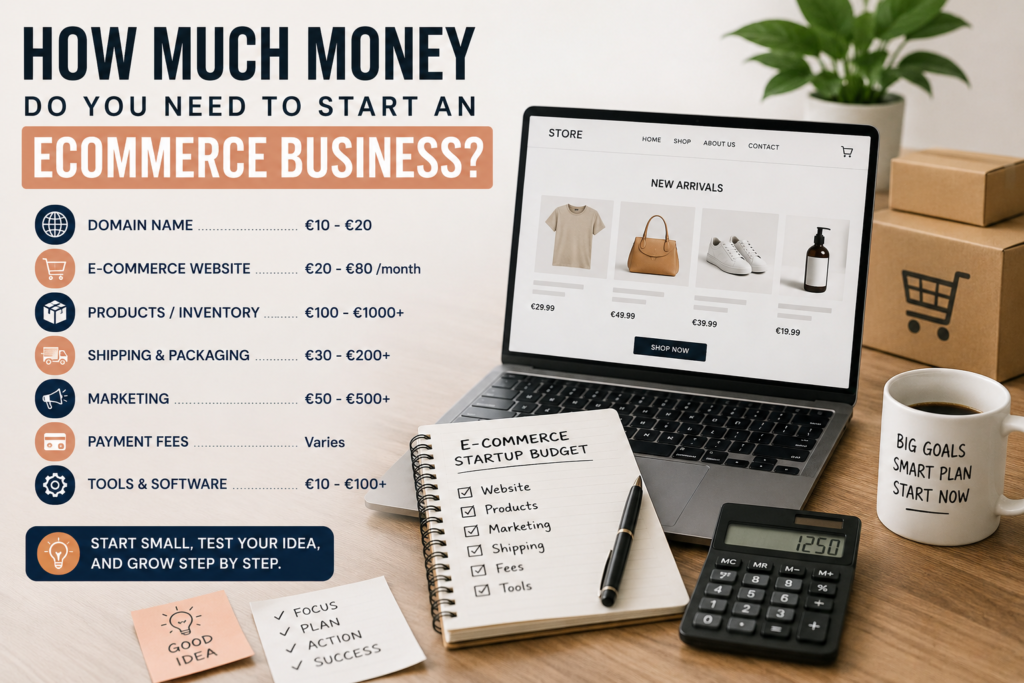
How Much Money Do You Need to Start an Ecommerce Business?
How Much Money Do You Need to Start an Ecommerce Business?
One of the first questions people ask before launching an online store is, How Much Money Do You Need to Start an Ecommerce Business?
The answer is not a single number. Your starting budget depends on what you sell, how you source products, where you sell, how much inventory you purchase, and how much of the work you do yourself.
For example, a person testing a few products through a low-inventory model may need far less upfront cash than someone developing a private-label product, ordering hundreds of units, and paying for professional branding.
Therefore, the most useful approach is not to look for one universal startup figure. Instead, build a budget around your particular business model and decide how much you can afford to risk before you have proven that customers want the product.
What Actually Determines Your Ecommerce Startup Cost?
Before calculating a budget, separate your expenses into categories.
Some costs happen before your first sale. Others appear every month. Meanwhile, certain expenses only become significant after your business starts growing.
The main categories are:
- Product or inventory costs
- Samples and testing
- Website or selling-platform costs
- Domain and software
- Packaging
- Product photography and content
- Payment processing
- Shipping and fulfillment
- Marketing
- Returns and customer service
- Business and professional expenses
- Emergency cash reserve
Not every ecommerce business needs every category immediately. However, overlooking several small expenses can make a supposedly inexpensive launch much more expensive than expected.
How Much Money Do You Need to Start an Ecommerce Business? Think in Budget Levels
Rather than choosing an arbitrary amount, think about your available budget in stages.
A lean test budget
A lean budget is designed to answer one question:
Will people actually show interest in this offer?
At this stage, you might use:
- A simple ecommerce platform or marketplace
- A basic domain
- Free or inexpensive design tools
- Small product quantities
- DIY product photography
- Organic marketing
- A very small advertising test, if necessary
The goal is not to build a perfect store.
Instead, you are buying information.
You want to discover whether customers click, ask questions, add products to their cart, and eventually purchase.
A moderate launch budget
Once you have stronger evidence that your product has potential, you can invest more.
This could include:
- More inventory
- Better packaging
- Professional-looking product photography
- Additional software
- Paid marketing
- Improved website design
- More product variations
- Better fulfillment processes
At this point, the business is moving from experimentation toward a more structured operation.
A larger brand-building budget
A larger budget might be appropriate when you already understand your market and want to build a recognizable brand.
Expenses could include:
- Larger inventory orders
- Custom packaging
- Product development
- Professional photography and video
- Custom website development
- Larger advertising campaigns
- Influencer or creator partnerships
- Warehousing or fulfillment services
- Customer support systems
However, spending more does not automatically produce better results.
A larger budget can simply make mistakes more expensive if the underlying product, audience, or offer has not been validated.
Inventory Is Often the Biggest Variable
For a traditional product-based ecommerce business, inventory can become one of the largest upfront expenses.
Suppose you buy 100 units of a product at $8 each.
Your initial product purchase is:
100 × $8 = $800
However, that $800 is not the complete cost of launching the product.
You may also need:
- Samples
- Packaging
- Shipping to you
- Product labels
- Storage
- Website costs
- Payment fees
- Marketing
- Returns or replacements
Consequently, the real amount of cash required can be significantly higher than the supplier’s product price.
This is why beginners should calculate the landed cost, not just the purchase price.
What Is Landed Cost?
Landed cost is the approximate total cost of getting a product ready to sell.
A simple calculation might include:
Product cost + shipping + import-related costs where applicable + packaging + other per-unit costs = landed cost
For example:
| Expense | Cost per unit |
|---|---|
| Product | $8.00 |
| Packaging | $1.00 |
| Shipping allocation | $1.50 |
| Other per-unit costs | $0.50 |
| Estimated landed cost | $11.00 |
If you sell that product for $20, you cannot simply think of the $12 difference as profit.
You may still need to pay payment-processing fees, marketplace fees, advertising costs, refunds, operating expenses, and other business costs.
Therefore, calculating your true cost before setting a price is essential.
Don’t Forget Product Samples
Ordering samples can feel like an unnecessary expense when you are trying to keep startup costs low.
In reality, samples can help you avoid much larger mistakes.
Before committing to a larger inventory order, you may want to evaluate:
- Product quality
- Size and dimensions
- Materials
- Packaging
- Color accuracy
- Durability
- Functionality
- Customer experience
A sample costing $20 may save you from discovering that a $1,000 inventory order has a serious problem.
For that reason, product testing should generally come before a large purchase.
Website and Platform Costs
Your store needs somewhere for customers to discover products and place orders.
Depending on your approach, you might use:
- Your own ecommerce website
- A marketplace
- A social commerce channel
- A combination of channels
A website can involve expenses such as:
- Domain registration
- Ecommerce platform subscription
- Hosting, depending on the platform
- Premium themes
- Apps and extensions
- Email tools
- Payment processing
- Developer or design costs
Fortunately, you do not necessarily need a custom website when starting.
A simple theme and a small product catalog can be enough to test an idea. Later, you can invest in custom design when the additional expense has a clear purpose.
Current ecommerce cost guides from Shopify similarly identify platform fees, domains, hosting, design, payment processing, apps, marketing, and other operating expenses as common components of an online-store budget.
How Much Should You Spend on Branding?
Branding matters, but beginners sometimes spend too much on it before validating the business.
You can create a professional starting point without immediately paying for:
- An expensive logo package
- Custom packaging
- A fully custom website
- Professional brand photography
- Extensive printed materials
Instead, start with a clear name, consistent visual identity, readable product pages, and useful product information.
Once customers are buying, you will have better information about where additional design investment can actually improve the business.
Marketing Needs Its Own Budget
Building a store does not automatically bring customers.
Therefore, your budget should include a plan for customer acquisition.
You could use:
Organic marketing
This may include:
- SEO
- Blog content
- Social media
- Email marketing
- Online communities
- Partnerships
- Short-form video
These approaches can reduce direct advertising costs, although they require time and consistent effort.
Paid marketing
Paid advertising can help you test an offer and reach potential customers more quickly.
However, avoid putting your entire marketing budget into one campaign.
A small controlled test can provide useful information before you increase spending.
For example, instead of deciding that you will spend $1,000 on advertising immediately, you could establish a smaller test budget, define the result you want, and then decide what to do based on the data.
For a broader introduction to customer acquisition, you can also read Marketing for Beginners: How to Get Your First Customers on Ecomlira.
Shipping and Fulfillment Costs
Shipping is another area where beginners can underestimate expenses.
Consider the complete journey:
Supplier → inventory location → packaging → customer → possible return
Depending on your model, you may pay for several stages.
Your costs can include:
- Shipping supplies
- Boxes or mailers
- Labels
- Postage
- Fulfillment fees
- Storage
- Returns
- Replacement shipments
Additionally, offering “free shipping” does not mean shipping is actually free.
The cost still has to be covered somewhere.
You might include part of the shipping cost in your product price, charge customers separately, or use a pricing strategy that accounts for average shipping expenses.
Payment and Marketplace Fees
Every sale may involve transaction-related costs.
Depending on where you sell, you might encounter:
- Payment-processing fees
- Marketplace commissions
- Listing fees
- Currency-conversion fees
- Subscription fees
- Refund-related costs
These fees can look small individually.
Nevertheless, they can become significant when you have many orders.
Suppose a product sells for $30 and the combined transaction-related cost is $1.50.
After 100 orders, that represents $150 in fees.
Therefore, include transaction costs when calculating your expected margin.
Don’t Confuse Revenue With Profit
This is one of the most important financial concepts for a new ecommerce business.
Imagine your store generates $5,000 in sales.
That sounds impressive.
However, the business may have spent:
- $2,000 on products
- $500 on shipping
- $300 on advertising
- $150 on payment fees
- $200 on packaging
- $250 on software and other expenses
That leaves:
$5,000 − $3,400 = $1,600
The store generated $5,000 in revenue, but the amount remaining after those listed expenses is much smaller.
Even then, you may have additional business expenses to account for.
As a result, always evaluate profit and cash flow, not revenue alone.
Build a Simple Ecommerce Startup Budget
Before spending money, create a table like this:
| Expense | One-time cost | Monthly cost |
|---|---|---|
| Domain | $20 | — |
| Platform | — | $30 |
| Samples | $100 | — |
| Initial inventory | $800 | — |
| Packaging | $100 | $30 |
| Product photography | $50 | — |
| Marketing test | $150 | $150 |
| Software | — | $20 |
| Emergency reserve | $300 | — |
| Estimated total | $1,520 | $230 |
These figures are only an example, not a universal ecommerce budget.
Actual prices vary significantly depending on your products, suppliers, platform, location, shipping requirements, and business model.
The important part is the structure.
Once you have your own numbers, replace the example amounts with actual quotes and prices.
How Much Money Should You Keep in Reserve?
Don’t spend every dollar you have on the launch.
This is particularly important when selling physical products because cash can become tied up in inventory.
You may need money for:
- Reordering products
- Replacing damaged items
- Refunds
- Unexpected shipping expenses
- Software subscriptions
- Marketing tests
- Supplier minimum orders
- Slow sales periods
A reserve gives your business room to respond to unexpected expenses.
In other words, your startup budget and your cash reserve should not necessarily be treated as the same thing.
A Better Way to Decide Your Starting Budget
Instead of asking:
“What is the minimum amount I need?”
ask:
“What is the smallest amount I can invest while still properly testing the business?”
That distinction matters.
Spending too little can make the test meaningless. For example, buying one product when your supplier requires a minimum order of 50 units may not reflect the actual business model.
On the other hand, spending thousands before proving demand creates unnecessary exposure.
The ideal starting point is somewhere in between: enough to run a meaningful test without putting your finances under excessive pressure.
How Much Money Do You Need to Start an Ecommerce Business? Use This Formula
You can create a simple estimate using:
Startup budget = setup costs + initial inventory + launch costs + operating reserve
For example:
$300 setup + $800 inventory + $200 launch marketing + $500 reserve = $1,800
This does not mean every ecommerce business requires $1,800.
Rather, the formula helps you build a budget based on your own numbers.
If you use a low-inventory model, your inventory portion may be much smaller.
If you manufacture products yourself, you may need money for equipment and materials.
Meanwhile, a private-label brand may need considerably more cash for product development, packaging, and minimum order quantities.
Ways to Reduce Your Initial Investment
There are several ways to test ecommerce without immediately committing to a large budget.
Start with fewer products
Instead of launching 30 products, begin with a small selection.
This makes inventory management, photography, product descriptions, and marketing easier.
Order smaller quantities when possible
If your supplier allows small minimum orders, use them for initial testing.
You can increase your order size once you have evidence of demand.
Use free or inexpensive tools
You do not need premium software for every task.
Start with the tools you actually need, then upgrade when a paid feature saves enough time or produces enough value to justify its cost.
Do some work yourself
Product photography, basic design, product descriptions, and social content can sometimes be handled yourself at the beginning.
However, don’t spend so much time learning unrelated technical skills that you neglect selling.
Use organic marketing first
Useful content and social media can help you test messaging before committing heavily to paid advertising.
Reinvest early profits
Instead of withdrawing every dollar of early profit, you can use part of it to fund inventory, marketing, or improvements.
That approach can reduce the amount of additional personal capital required.
What Should You Avoid Spending Money On?
When starting out, be careful with expenses that look professional but do not directly help you test or operate the business.
For example, you may not need:
- A custom website immediately
- Large quantities of branded packaging
- Hundreds of products
- Expensive photography
- Dozens of paid apps
- Large advertising campaigns
- An oversized inventory
- Complex automation
Before paying for something, ask:
Will this help me validate the product, make a sale, serve customers, or solve a real operational problem?
If the answer is no, consider postponing it.
A Simple Pre-Launch Money Checklist
Before launching your store, make sure you know:
- What your product costs
- What your landed cost is
- What price you plan to charge
- What your approximate gross margin is
- What your platform costs
- What your payment fees are
- What your packaging costs
- What shipping is likely to cost
- What your marketing test budget is
- How much cash you want to keep in reserve
- How much inventory you can realistically sell
- What happens if sales are slower than expected
You should also know how much money you can afford to lose without creating a financial problem for yourself.
That number is an important part of your decision.
What If You Only Have a Small Budget?
A small budget does not automatically prevent you from starting.
Instead, it changes the way you should approach the launch.
With limited funds, focus on reducing the amount of money locked into inventory and unnecessary fixed expenses.
For example, you might:
- Research a specific product category.
- Test customer interest.
- Order samples.
- Create a small initial offer.
- Use a simple selling platform.
- Create organic marketing content.
- Make a small paid test only if necessary.
- Track the results.
- Reinvest only when the numbers make sense.
This approach can help you learn without treating your first launch as a massive financial commitment.
For a broader foundation, see Ecommerce for Beginners: Everything You Need to Know.
When Should You Increase Your Budget?
Increasing your budget makes more sense when you have evidence that additional spending can support growth.
For example, you may have:
- Products that consistently sell
- Customers who return
- A marketing channel that produces sales
- Healthy product margins
- Reliable suppliers
- Predictable fulfillment
- Clear customer demand
At that point, additional inventory or marketing spending may help you serve more customers.
However, scaling should still be controlled.
If you double your inventory before understanding your sales cycle, you may simply double the amount of cash sitting in unsold products.
Frequently Asked Questions
How Much Money Do You Need to Start an Ecommerce Business?
There is no universal amount. A small ecommerce test can require relatively little upfront spending, while an inventory-heavy brand can require significantly more. Your budget should account for products, setup, marketing, fulfillment, transaction costs, and a cash reserve.
Can I start ecommerce with $100?
It may be possible to test certain ecommerce models with a very small budget, particularly when you avoid purchasing significant inventory. However, $100 may not be enough for every business model, especially if samples, inventory minimums, packaging, or other costs are involved.
Is ecommerce expensive to start?
It can be, but it does not have to be. The biggest variables are usually inventory, product development, marketing, fulfillment, and the level of customization you want.
Should I buy inventory before launching?
In many cases, it is safer to test samples and customer demand before committing to a large inventory purchase. However, your supplier requirements and business model will determine what is practical.
How much should I spend on advertising?
There is no universal advertising budget. Start with an amount you can afford to lose while testing. Define what you want to learn, track the results, and increase spending only when the data supports doing so.
Do I need a professional website to start?
Not necessarily. A simple, trustworthy store can be enough for an initial test. You can improve the design as your business gains customers and you learn which features actually matter.
Final Thoughts
So, How Much Money Do You Need to Start an Ecommerce Business? The most useful answer is: enough to run a meaningful test without putting your finances under unnecessary pressure.
Your actual number depends on your products, inventory model, selling channel, marketing approach, and operating costs.
Rather than spending everything you have before making a sale, start by calculating your real costs. Then separate essential expenses from things that can wait.
Most importantly, remember that the goal of your first investment is not to make your store look impressive. It is to create a real opportunity to learn whether customers want what you are offering.
Start with a manageable budget, test your assumptions, track the numbers, and reinvest carefully as you gain evidence.
That approach gives you something more valuable than a large launch budget: room to learn and adapt.
Helpful Resources
For additional ecommerce planning guidance, see Shopify’s current guide to ecommerce website costs, which breaks down common expenses such as platforms, domains, design, payment processing, apps, and marketing.
Google’s SEO Starter Guide is also useful when planning how your store can become discoverable through search.
4 thoughts on “How Much Money Do You Need to Start an Ecommerce Business?”
Comments are closed.
[…] If you’re trying to understand the broader costs of starting an ecommerce business, see our guide on [How Much Money Do You Need to Start an Ecommerce Business?]. […]
[…] you’re trying to keep your initial investment low, understanding how much money you need to start an ecommerce business can help you plan […]
[…] you’re working with a limited budget, you may also want to read How Much Money Do You Need to Start an Ecommerce Business? before purchasing […]
[…] If you want to understand the broader costs involved in ecommerce, read [How Much Money Do You Need to Start an Ecommerce Business?]. […]