New to online business? Start with our free 7-day roadmap and build your foundation step by step.
Get the Free Roadmap →Dropshipping
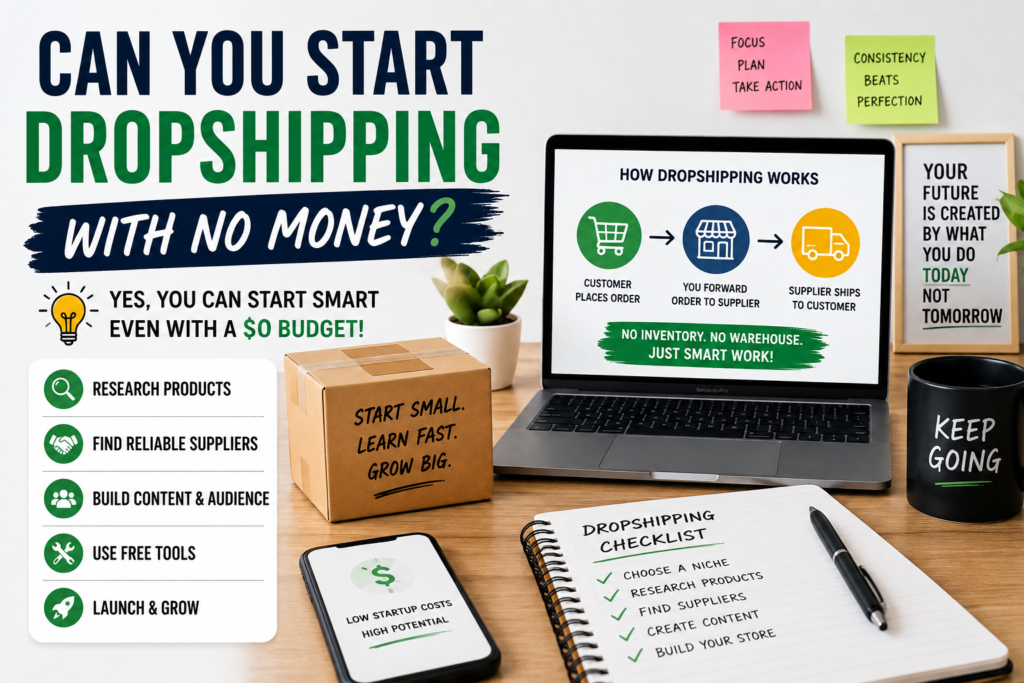
Can You Start Dropshipping With No Money?
Can You Start Dropshipping With No Money?
A lot of beginners wonder whether it’s genuinely possible to start dropshipping with no money, since the model is often marketed as a nearly cost-free way to launch an online store. The honest answer is more nuanced: you can start dropshipping with very little money, but “no money at all” is rarely fully accurate once you account for the small but real costs involved in setting up even the most minimal version of a store. This guide breaks down what dropshipping actually costs, where those unavoidable minimum expenses come from, and how to keep your starting costs as close to zero as realistically possible.
Why Dropshipping Is Marketed as “No Money” Business
Dropshipping removes the single biggest cost most ecommerce businesses face: inventory. You never purchase stock upfront — when a customer orders, you buy the item from a supplier who ships it directly to them. This is genuinely a dramatic reduction in startup capital compared to a traditional retail or ecommerce business holding its own inventory, which is where the “no money” framing comes from. But removing inventory costs doesn’t eliminate every cost involved in running a legitimate online store.
The Real Minimum Costs of Starting Dropshipping
Even with the leanest possible setup, a few small costs are difficult to avoid entirely if you want a genuinely functional store:
- A domain name — typically $10–$15 per year
- An ecommerce platform subscription — Shopify, for example, has a low-cost basic plan, though some platforms offer limited free trials
- Payment processing fees — a small percentage taken per transaction, which only applies once you actually make a sale
- Sample products — ordering a sample of what you plan to sell to verify quality before promoting it to customers, which is optional but highly recommended
These costs are genuinely minimal compared to almost any other business model, often totaling well under $100 to get a basic, functional store running — but it’s more accurate to describe this as “starting dropshipping with very little money” rather than literally zero.
Ways to Get as Close to Zero as Possible
If you’re determined to start dropshipping with no money or as close to it as possible, a few strategies help minimize costs:
Use free trial periods strategically. Many ecommerce platforms offer free trial periods, which can be enough time to build and test a basic store before any subscription cost kicks in.
Skip paid themes and apps initially. Free themes and the built-in functionality most platforms offer are sufficient for a basic store; paid upgrades can wait until the store is generating revenue.
Use free design tools. Tools like Canva’s free tier can handle logo creation and basic product image editing without hiring a designer or paying for premium software.
Market through free channels only. Relying on organic social media, content, and direct outreach rather than paid advertising removes what would otherwise be one of the largest ongoing costs for a dropshipping business.
Skip the sample order initially, with caution. Ordering a sample costs money, but skipping it entirely risks promoting a product you haven’t actually verified, which can backfire through poor reviews if quality issues emerge after launch.
Why Marketing Budget Matters More Than Starting Capital
Even if you successfully start dropshipping with no money or close to it, the ongoing challenge isn’t the initial setup cost — it’s driving traffic to the store without a marketing budget. Paid advertising is often how dropshipping stores scale quickly, and without it, growth depends entirely on organic methods like content, SEO, and direct outreach, all of which take considerably more time to produce results. Our guide on marketing for beginners: how to get your first customerscovers the realistic organic channels worth focusing on when there’s no advertising budget available.
Choosing Products Wisely When You Have No Budget to Test
Without money for paid ads to quickly test multiple products, choosing your initial product carefully through research rather than trial and error becomes more important. Our guide on how to choose products to sell online covers how to evaluate demand and viability before committing time to promoting a specific product, which matters more when you can’t afford to simply test several products with paid traffic to see what sticks.
Realistic Expectations for a No-Budget Dropshipping Store
Starting dropshipping with no money or minimal money generally means a slower path to initial sales compared to a store with a marketing budget behind it, since you’re relying entirely on free, organic channels that take time to build momentum. This doesn’t mean it’s not worth doing — many successful dropshipping businesses started exactly this way — but it does mean setting realistic expectations about the timeline, which is typically measured in months rather than days or weeks.
Reinvesting Early Profits
A common and sensible strategy for a no-budget dropshipping start is to reinvest whatever initial profit the store generates back into the business — a small amount of paid advertising to test what converts, a better theme, or a sample order of a promising new product. This gradual reinvestment approach lets the business grow its own capital organically rather than requiring a large upfront investment, while still allowing for some paid testing and growth once there’s actual revenue to fund it.
Comparing Dropshipping to Other Low-Budget Business Models
If your main goal is simply to start an online business with as little money as possible, it’s worth comparing dropshipping against other low-cost models rather than assuming it’s automatically the cheapest or easiest option. Affiliate marketing and freelancing both require even less upfront capital than dropshipping, since neither involves setting up a store, choosing suppliers, or handling customer-facing transactions for physical products. Dropshipping does offer the advantage of selling an actual product rather than just a service or recommendation, which some beginners find more straightforward to market, but it’s worth being clear-eyed about where it actually sits on the spectrum of low-budget online business ideas rather than assuming it’s the single cheapest option available.
Validating Demand Before Spending Anything
One of the smartest ways to protect a limited budget when trying to start dropshipping with no money is validating that real demand exists before spending anything at all, even the minimal amounts discussed above. Free research using tools like Google Trends can reveal whether interest in a potential product or niche is growing, shrinking, or highly seasonal, all without spending a cent. Checking existing marketplaces and communities for signs that similar products are already selling well is another no-cost way to gauge demand before committing even a small budget to domain registration and platform fees.
Using Free Trial Periods Effectively
Many ecommerce platforms offer free trial periods ranging from a few days to a few weeks, and using this window strategically can meaningfully extend how long you operate before any subscription cost is required. Building out your entire store — product listings, policies, design, and initial content — during a free trial period, then launching right as the trial is ending, maximizes the free runway available before you need to commit any actual money to the platform itself.
Starting on a Marketplace Instead of Your Own Store
An alternative path to start dropshipping with no money involves skipping a dedicated ecommerce platform entirely and instead listing dropshipped products on an existing marketplace, where setup costs can be lower or built into a revenue-share model rather than requiring an upfront subscription. This approach trades away some of the branding control and profit margin you’d have with your own store, since marketplaces typically take a cut of each sale, but it can reduce the minimum viable starting cost even further for someone determined to begin with essentially nothing upfront.
The Difference Between Starting Cheap and Staying Cheap
It’s worth distinguishing between keeping your starting costs low and assuming the business should stay that way indefinitely. Many successful dropshipping businesses that started with no money or close to it eventually reinvest in better tools, a proper paid theme, or a modest advertising budget once they’ve proven the business works. Treating the no-money approach as a deliberate starting strategy rather than a permanent constraint keeps you open to smart reinvestment once there’s actual revenue to justify it.
The Hidden Cost: Your Time
The real cost of starting dropshipping with no money isn’t financial — it’s time. Building a store, researching products, setting up marketing content, and handling customer service all take significant hours, particularly in the early months before any automation or outsourcing becomes financially justified. Beginners sometimes focus entirely on the financial cost being low without fully accounting for the substantial time investment required to make a no-budget approach actually work.
Tools That Help Without Costing Money
A few genuinely free tools can meaningfully support a no-budget dropshipping launch:
- Google Analytics — understand where traffic is coming from and which pages are converting
- Google Trends — gauge demand and seasonality for potential products before committing to them
- Free social media scheduling tools — many offer free tiers sufficient for a single small store’s posting needs
- Free email marketing platforms — most allow a reasonable number of subscribers before requiring a paid upgrade
Using these tools from the beginning gives you real data to work with rather than relying purely on guesswork about what’s actually working.
Common Mistakes When Starting With Little or No Budget
Skipping product research to save time. With no ad budget to quickly test multiple products, choosing poorly the first time wastes far more time than careful upfront research would have taken.
Underestimating the time commitment. A no-budget approach shifts the real cost from money to time, and underestimating this can lead to discouragement when results don’t materialize as quickly as expected.
Neglecting customer trust signals because they seem optional. Clear policies, honest product descriptions, and responsive communication matter just as much for a no-budget store as a well-funded one, since trust is free to build but costly to rebuild once lost.
Expecting the same growth speed as a funded competitor. Comparing your no-budget progress to a competitor spending heavily on paid ads sets an unrealistic benchmark that can lead to premature discouragement.
Ultimately, whether you can start dropshipping with no money comes down to how strictly you define “no money.” A genuinely functional, legitimate store will almost always involve some minimal cost, but that cost is small enough that budget alone rarely needs to be the barrier stopping someone from getting started, provided they’re willing to put in the organic marketing effort that a tighter budget requires.
Frequently Asked Questions
Is it truly possible to start dropshipping with absolutely no money? Not entirely — small costs like a domain name and basic platform fees are difficult to avoid completely, though total startup costs can realistically stay under $100, which is dramatically lower than most other business models.
What’s the minimum realistic budget to start dropshipping? Many beginners get a basic store running for somewhere between $20 and $100, covering a domain and the lowest-tier platform subscription, assuming marketing is handled through free organic channels initially.
How do I market a dropshipping store with no advertising budget? Organic social media content, SEO-focused blog content, niche community participation, and direct outreach are the main free channels available, though all take considerably longer to produce results than paid advertising.
Should I wait until I have more money before starting dropshipping? Not necessarily. Starting lean and reinvesting early profits as they come in is a common and often effective approach, allowing the business to grow its own capital rather than requiring a large upfront investment.
Is dropshipping still profitable when you start with no money? Yes, though margins tend to be thinner than other ecommerce models, and profitability depends heavily on effective organic marketing when there’s no advertising budget to accelerate traffic and sales in the early stages.
What’s the biggest risk of trying to start dropshipping with absolutely no money? The biggest risk is usually underinvesting in product research and quality verification to save the small cost of a sample order, which can lead to promoting a product with quality issues you only discover after customers start complaining.
7 thoughts on “Can You Start Dropshipping With No Money?”
Comments are closed.
[…] Can You Start Dropshipping With No Money? […]
[…] you’re interested in starting with a small budget, read Can You Start Dropshipping With No Money? and Can You Start Affiliate Marketing With No Money? for a closer look at the startup requirements […]
[…] If you’re starting with a very small budget, you may also want to read Can You Start Affiliate Marketing With No Money?. […]
[…] you’re considering this model, read Can You Start Dropshipping With No Money? to understand what you may be able to do with a very small starting […]
[…] If you’re considering this model, read Can You Start Dropshipping With No Money? […]
[…] you’re considering dropshipping, our article Can You Start Dropshipping With No Money? explains what you can realistically do with a very small starting […]
[…] you’re working with a tight budget either way, our guides on Can You Start Dropshipping With No Money? and Can You Start Affiliate Marketing With No Money? go deeper into what […]