New to online business? Start with our free 7-day roadmap and build your foundation step by step.
Get the Free Roadmap →Ecommerce
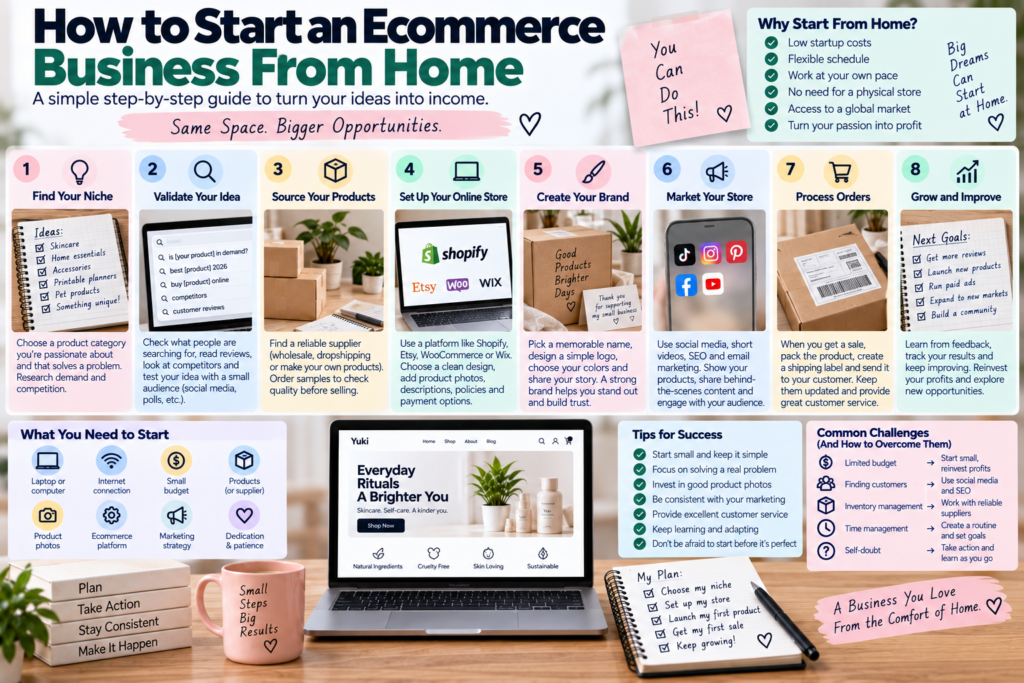
How to Start an Ecommerce Business From Home
How to Start an Ecommerce Business From Home
You don’t need a warehouse, a storefront, or even a dedicated office to start an ecommerce business from home. Thanks to modern platforms, dropshipping suppliers, and digital fulfillment services, a genuinely functional online store can be run from a spare room, a kitchen table, or anywhere with a reliable internet connection. This guide walks through exactly how to start an ecommerce business from home, covering the practical realities beginners often don’t think about until they’re already underway.
Why Running an Ecommerce Business From Home Works
The appeal of a home-based ecommerce business is straightforward: minimal overhead, no commute, and the flexibility to build something around your existing life rather than around a physical location. The trade-off is that you’re responsible for creating structure that a traditional workplace would otherwise provide — a dedicated workspace, clear working hours, and systems that keep the business organized without an office environment enforcing it naturally.
Step 1: Choose a Product That Suits a Home-Based Setup
Not every product fits comfortably into a home-based operation. Smaller, lightweight items that don’t require significant storage space tend to work best when you’re starting an ecommerce business from home, since space is genuinely limited compared to a dedicated warehouse. If your product idea requires substantial inventory or storage, dropshipping or an on-demand fulfillment model may be a better fit than holding stock yourself. Our guide on how to choose products to sell online covers how to evaluate product ideas more broadly.
Step 2: Set Up a Dedicated Workspace
Even a small, consistently used corner of a room makes a meaningful difference compared to working from wherever happens to be free at the moment. A dedicated space for packing orders, taking product photos, and handling administrative work helps maintain the kind of consistency and professionalism that’s harder to achieve when the business is scattered across the house.
Step 3: Choose Your Platform and Set Up Your Store
Platforms like Shopify or WooCommerce let you build a fully functional store without any specialized technical infrastructure beyond a laptop and an internet connection. Our guide on how to start an online store walks through this setup process in detail, covering everything from platform choice to the essential pages every store needs before launch.
Step 4: Decide on Your Fulfillment Approach
This decision matters more for a home-based business than almost any other. Options include:
- Self-fulfillment — packing and shipping orders yourself, which works well at lower volumes but becomes genuinely difficult to sustain in a home environment as order volume grows
- Dropshipping — a supplier ships directly to customers, meaning no inventory or packing space needed in your home at all
- Print-on-demand — for custom designs, a third party handles printing and shipping entirely
- Third-party logistics (3PL) — outsourcing storage and shipping once volume outgrows what’s reasonable to manage from home
Many home-based sellers start with self-fulfillment or dropshipping specifically because they require minimal physical space, then transition to a 3PL once order volume genuinely justifies the added cost and complexity.
Step 5: Create a System for Packing and Shipping
If you’re handling fulfillment yourself, even a simple system — a dedicated shelf for packing supplies, a consistent process for printing labels, a regular schedule for drop-offs at the post office or courier — prevents the chaos that can quickly develop when orders start arriving without any structure in place to handle them efficiently.
Step 6: Separate Business and Personal Finances
Even as a home-based operation, keeping a separate bank account and tracking business expenses distinctly from personal spending makes tax time considerably simpler and gives you a clearer, more accurate picture of whether the business is actually profitable once every real cost is accounted for.
Step 7: Build in Structure Despite Working From Home
Without a commute or an office environment to create natural boundaries, home-based entrepreneurs often struggle with the business bleeding into every hour of the day, or conversely, with procrastination since there’s no external accountability pushing work forward. Setting specific working hours, even if flexible, and treating them with the same seriousness as a traditional job tends to produce better sustained results than an entirely unstructured approach.
Managing the Practical Realities of a Home-Based Operation
A few practical considerations are worth planning for specifically because you’re operating from home rather than a dedicated commercial space. Noise and interruptions from family members or housemates can disrupt customer calls or focused work time, which is worth addressing proactively rather than letting it become an ongoing source of friction. Storage for inventory, packing supplies, and returns can expand faster than expected, so it’s worth having a plan for managing this before it takes over living space you need for other purposes. And separating “work mode” from “home mode” psychologically — even through something as simple as a specific chair or a closed office door — helps maintain the focus that a traditional workplace would otherwise provide naturally.
Internet reliability is another detail that’s easy to overlook until it causes a real problem. A dropped connection during a live chat with a customer, a failed order sync, or a missed shipping deadline because a page wouldn’t load can quietly damage the customer experience you’re trying to build. Having a backup option — even just a phone hotspot — is a small safeguard against an otherwise avoidable disruption. Similarly, having a plan for what happens if you’re sick, traveling, or simply unavailable for a few days matters more when you’re a one-person operation than it would in a business with multiple employees covering for each other.
Tools and Equipment That Make a Home-Based Setup Work
You don’t need an elaborate setup to run a credible ecommerce business from home, but a few tools consistently make the day-to-day work smoother. A reliable laptop, a printer capable of handling shipping labels, and a dedicated space to photograph products are usually enough to start. As the business grows, many home-based sellers add a label printer specifically to speed up the packing process, since manually cutting and taping standard printer paper labels becomes a genuine bottleneck once order volume increases.
For tracking inventory, orders, and expenses, free or low-cost tools are often sufficient in the early stages — a simple spreadsheet can work surprisingly well before a dedicated inventory system becomes necessary. Services like Google Workspace offer free or low-cost tools for email, spreadsheets, and document storage that many home-based sellers rely on before investing in more specialized software. As order volume grows, dedicated inventory and accounting tools become worth the investment, but there’s no need to over-invest in software before the business has proven it needs it.
How Much It Actually Costs to Start From Home
One of the main appeals of a home-based ecommerce business is the comparatively low starting cost next to a business that requires a physical retail location. Platform fees, a basic design tool, and perhaps a small initial product sample or two can realistically get a home-based store running for well under a few hundred dollars, depending on the model you choose. Dropshipping and print-on-demand models tend to carry the lowest upfront cost since you’re not purchasing inventory before a sale happens. Holding your own inventory requires more capital upfront but can offer better margins over time once you understand what actually sells.
It’s worth budgeting honestly rather than assuming the lowest possible cost scenario. Beyond the platform and product costs, factor in things like a business license if your area requires one, basic packaging supplies, and a buffer for the inevitable early mistakes — a wrong order, a damaged shipment, a refund — that every new seller runs into regardless of how carefully they plan.
Marketing Your Home-Based Ecommerce Business
Being home-based doesn’t change what actually works for marketing — the same principles apply regardless of where your operations are physically located. Our guide on marketing for beginners: how to get your first customers covers the foundational tactics that work regardless of business size or location, and building a consistent content or social media presence is just as achievable from a home office as it would be from a dedicated commercial space.
When to Consider Moving Beyond Home-Based Operations
As a home-based ecommerce business grows, there’s often a natural point where the home setup starts genuinely limiting growth — storage space runs out, order volume makes self-fulfillment unsustainable, or the business simply needs dedicated commercial space to continue scaling effectively. Recognizing this transition point, rather than trying to force continued growth within an outgrown home setup, often marks a meaningful and healthy next stage in the business’s development.
Tax and Legal Considerations for Home-Based Sellers
Running a business from home doesn’t exempt it from the same basic legal and tax obligations any other ecommerce business faces, even if the specific requirements vary by location. This can include registering a business name, understanding sales tax collection obligations, and keeping clear records of income and expenses. The U.S. Small Business Administration has a straightforward overview of registration basics that’s a reasonable starting point if you’re unsure what applies to your situation. Some areas also have specific rules around running a business from a residential address, particularly if inventory storage or regular deliveries become noticeable to neighbors. Checking local requirements early, rather than assuming a home-based setup is exempt from standard business obligations, avoids complications down the line.
Common Mistakes When Starting From Home
Underestimating space needs. Inventory and packing supplies tend to expand faster than beginners initially expect, quickly taking over more space than originally planned for.
No clear boundary between work and home life. Without intentional structure, home-based businesses can either consume every waking hour or never get consistent, dedicated attention.
Choosing a product poorly suited to home operations. Bulky, heavy, or storage-intensive products create outsized challenges in a home environment compared to products better suited to limited space.
Mixing personal and business finances. This creates confusion at tax time and makes it genuinely harder to understand whether the business is actually profitable.
Treating it as a part-time hobby indefinitely. A home-based business still benefits from being treated with real seriousness and structure, even if it starts as something you work on part-time alongside other commitments.
Ignoring internet or equipment reliability. A single missed order because of a connectivity issue or a broken printer can cost you a customer relationship that took real effort to build in the first place.
Not budgeting for the unexpected. Damaged shipments, refunds, and early pricing mistakes are nearly universal for new sellers — planning for them in advance makes them far less stressful when they happen.
Frequently Asked Questions
Do I need a business license to start an ecommerce business from home? This varies by location, so it’s worth checking local requirements, though many home-based businesses can start with minimal formal registration, particularly in the earliest, smaller-scale stages.
How much space do I actually need to start an ecommerce business from home? This depends heavily on your product and fulfillment model — dropshipping or digital products need almost no physical space, while holding inventory yourself requires dedicated storage that scales with your order volume.
Can I really run a profitable ecommerce business entirely from home? Yes, many genuinely successful ecommerce businesses started and continue operating from a home-based setup, particularly those using dropshipping, print-on-demand, or digital product models that minimize physical space requirements.
When should I consider moving out of a home-based setup? A reasonable signal is when storage space, noise, or order volume genuinely starts limiting your ability to operate effectively — at that point, a dedicated space or third-party fulfillment service often becomes a worthwhile investment.
What’s the biggest difference between a home-based ecommerce business and a traditional retail business?Overhead is the biggest difference. A home-based ecommerce business avoids rent, utilities, and staffing costs that a physical retail location requires, which means you can test an idea and reach profitability with significantly less financial risk.
Do I need separate business insurance to run an ecommerce business from home? It depends on your product and location, but it’s worth checking, since some homeowner’s or renter’s insurance policies don’t automatically cover business-related liability or inventory loss.