New to online business? Start with our free 7-day roadmap and build your foundation step by step.
Get the Free Roadmap →Ecommerce
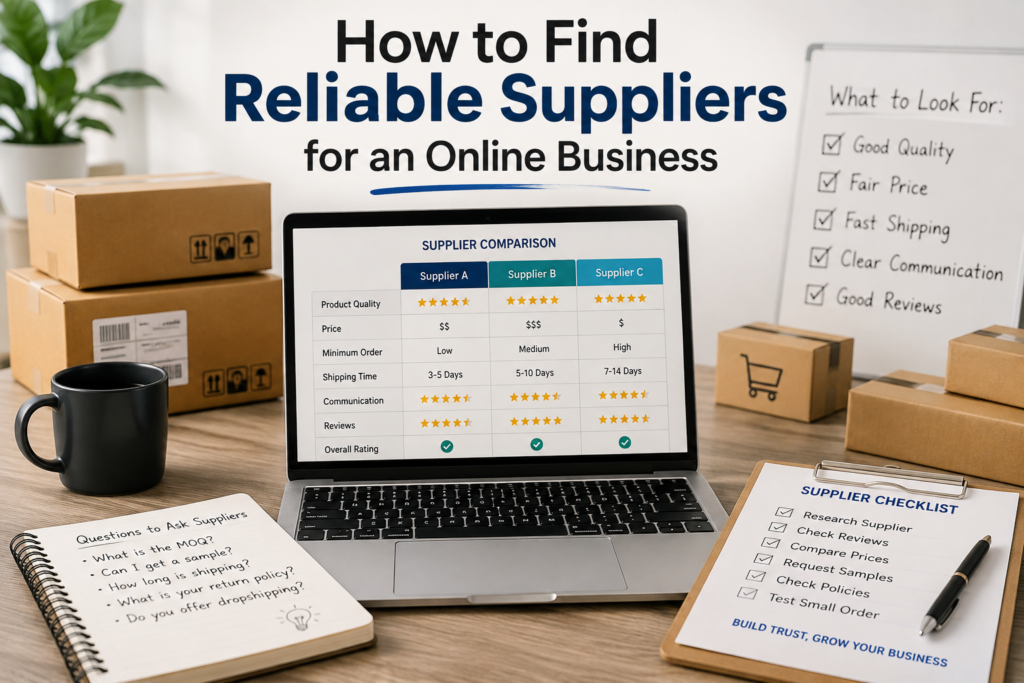
How to Find Reliable Suppliers for an Online Business
How to Find Reliable Suppliers for an Online Business
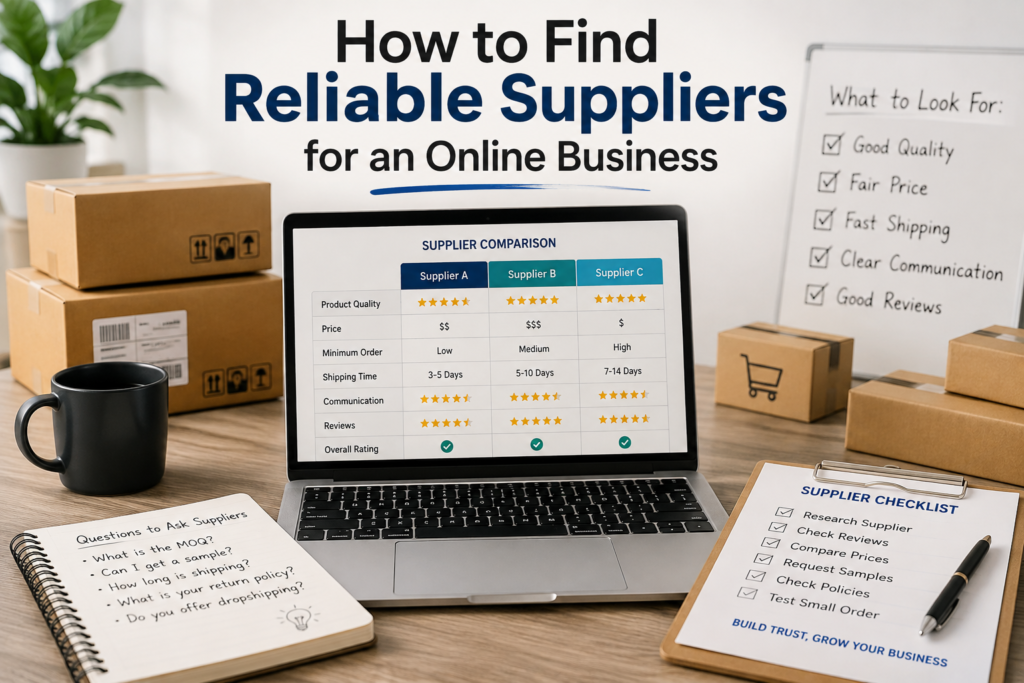
How to Find Reliable Suppliers.
Finding reliable suppliers is one of the most important steps when starting an online business. A good supplier can help maintain product quality, reasonable costs, and reliable delivery. A poor supplier can lead to damaged products, late shipments, unhappy customers, and lost money.
If you’re wondering how to find reliable suppliers, the process doesn’t have to be complicated. You can research different suppliers, compare their terms, request samples, ask the right questions, and test an order before committing to a large purchase.
How to Find Reliable Suppliers.
Whether you’re planning to sell your own products, buy wholesale inventory, or start a dropshipping business, choosing the right supplier can make a major difference in how smoothly your business operates.
What Should You Look for in a Reliable Supplier?
A supplier isn’t reliable simply because they have a professional-looking website or offer a low price.
Before choosing one, consider:
- Product quality
- Pricing
- Minimum order quantity
- Shipping options
- Delivery times
- Communication
- Return and replacement policies
- Product availability
- Business reputation
- Ability to handle future orders
The cheapest supplier isn’t always the best choice. If the product quality is poor or orders regularly arrive late, the money saved on the product can quickly disappear through refunds, replacements, and unhappy customers.
How to Find Reliable Suppliers Online
There are several ways to find suppliers, depending on the type of product and business model.
Search for Wholesale Suppliers
Wholesale suppliers sell products in larger quantities, usually at prices below retail.
Start by searching for suppliers that specialize in your product category. For example, if you want to sell home accessories, search for terms such as:
- Wholesale home accessories
- Home decor distributor
- Home products supplier
- Home accessories bulk supplier
Using different search terms can help you discover suppliers that you might miss with a single search.
Use Supplier Marketplaces and Directories
Supplier marketplaces and directories can help you compare different businesses and product options in one place.
However, being listed on a marketplace doesn’t automatically mean that every supplier is trustworthy. You should still research the individual supplier before placing an order.
Shopify’s guide to choosing suppliers explains several things businesses should consider when evaluating suppliers, including legitimacy, minimum orders, and test orders.
Contact Manufacturers Directly
If you already know what product you want to sell, contacting manufacturers directly can be another option.
Manufacturers may offer competitive pricing for larger orders, but they can also have higher minimum order requirements.
This approach can make more sense after you’ve tested your product and confirmed that there is demand.
Consider Local Suppliers
You don’t always have to source products from another country.
Local wholesalers and manufacturers may offer advantages such as:
- Faster delivery
- Easier communication
- Simpler returns
- Lower shipping times
- The possibility of inspecting products in person
The best option depends on your product, budget, customers, and business model.
How to Research a Supplier Before Ordering
One of the most important parts of how to find reliable suppliers is researching the supplier before spending a significant amount of money.
Look for information about:
- The company’s name
- Location
- Contact information
- Years in business
- Product specialization
- Customer reviews
- Shipping policies
- Return policies
Search for the supplier’s name together with terms such as reviews, complaints, or scam.
Don’t assume that one negative review automatically means a supplier is bad. Instead, look for patterns.
If many customers report the same problem with product quality, shipping, communication, or refunds, take those complaints seriously.
How to Check Supplier Reviews
Reviews can provide useful information, but don’t rely on a single rating.
Look for reviews that describe specific experiences.
For example, a detailed review about product quality and delivery is more useful than a review that simply says:
“Great supplier!”
Pay attention to comments about:
- Product quality
- Packaging
- Shipping speed
- Communication
- Order accuracy
- Customer service
- Refunds or replacements
Also be cautious when reviews appear unusually repetitive or lack specific details.
Should You Order a Product Sample?
Yes, whenever possible.
A sample allows you to inspect the product before committing to a larger order.
You can check:
- Materials
- Size
- Color
- Packaging
- Construction
- Functionality
- Overall appearance
- Whether the product matches its description
A sample can also help you create your own product photos and evaluate how the product looks in real life.
It may cost money to order a sample, but that cost can be much smaller than discovering a serious quality problem after ordering hundreds of units.
What Questions Should You Ask a Supplier?
Before working with a supplier, ask clear questions.
What Is the Minimum Order Quantity?
The minimum order quantity, often called MOQ, is the smallest number of units a supplier allows you to purchase.
A low MOQ can be helpful for beginners who want to test a product without investing heavily in inventory.
What Is the Price per Unit?
Ask for the current unit price and whether the price changes when you order larger quantities.
Don’t compare only the product price. Also consider shipping, packaging, taxes, duties where applicable, and other costs.
How Long Does Shipping Take?
Ask about available shipping methods and estimated delivery times.
If you’re selling to customers, shipping speed can have a direct effect on their experience.
Can I Order a Sample First?
Ask whether samples are available and how much they cost.
A supplier willing to let you evaluate the product before making a large commitment can make the testing process easier.
What Happens If Products Arrive Damaged?
Find out what happens if products are defective, damaged, or missing from an order.
Ask whether the supplier offers replacements, refunds, or another solution.
Can You Provide Product Information and Documentation?
Depending on the product, you may need specifications, labeling information, safety documentation, or other records.
Don’t assume that every product can be sold everywhere without checking the requirements that apply to your market.
How to Compare Different Suppliers
Don’t choose a supplier based only on price.
Create a simple comparison table:
| Factor | Supplier A | Supplier B | Supplier C |
|---|---|---|---|
| Product price | € | €€ | € |
| Minimum order | Low | Medium | High |
| Sample available | Yes | Yes | No |
| Shipping time | Fast | Medium | Slow |
| Reviews | Good | Good | Mixed |
| Communication | Good | Excellent | Poor |
You can add any other factors that matter to your business.
For example, one supplier might have the lowest product price but expensive shipping. Another might cost slightly more but offer better quality and faster delivery.
The cheapest option isn’t necessarily the best overall option.
How to Spot an Unreliable Supplier
There are several warning signs to take seriously.
Be cautious if a supplier:
- Pressures you to place a large order immediately
- Refuses to provide basic business information
- Avoids reasonable questions
- Refuses to provide a sample when one should be available
- Makes unrealistic promises
- Frequently changes prices or terms
- Has repeated serious complaints
- Provides inconsistent company information
- Insists on unusual payment arrangements
One warning sign doesn’t automatically mean that a supplier is fraudulent.
However, several warning signs together should make you slow down and investigate further.
If something doesn’t feel right, don’t rush simply because you’re worried about losing the opportunity.
There will always be another supplier.
How to Find Reliable Suppliers for Dropshipping and Wholesale
The best supplier also depends on your business model.
Dropshipping Suppliers
With dropshipping, the supplier generally stores the products and ships orders directly to customers.
This can reduce the amount of inventory you need to purchase upfront.
However, you have less control over fulfillment and packaging, which makes supplier reliability particularly important.
Wholesale Suppliers
With wholesale, you generally purchase inventory in advance and store it yourself or through a fulfillment service.
This requires more upfront investment, but it can give you greater control over inventory, packaging, and the customer experience.
Neither model is automatically better.
Choose the approach that fits your budget, product, storage situation, and business goals.
Should You Order a Large Quantity Immediately?
Usually, it’s better to test before scaling.
Imagine finding a supplier offering an attractive price for 500 units.
It might seem like a great deal.
But what happens if customers don’t like the product?
You could be left with hundreds of units that you can’t sell.
Instead, consider starting with a smaller order when possible.
Use the first order to evaluate:
- Product quality
- Customer interest
- Shipping
- Packaging
- Supplier communication
- Actual costs
- Potential profit
If everything works well, you can consider increasing your order later.
How to Calculate the Real Cost of a Product
The supplier’s unit price isn’t necessarily your final product cost.
Consider costs such as:
Product cost + shipping + packaging + platform fees + applicable taxes or duties = total cost
For example, a product that costs €5 from a supplier may cost considerably more once all additional expenses are included.
Knowing your total cost helps you determine whether your selling price leaves enough room for profit.
What Should You Check Before Choosing a Supplier?
Before making your decision, use this checklist:
☐ Have I researched the supplier?
☐ Have I checked reviews and complaints?
☐ Have I compared several suppliers?
☐ Do I understand the minimum order quantity?
☐ Have I checked shipping costs?
☐ Do I know the estimated delivery time?
☐ Can I order a sample?
☐ Have I checked the product quality?
☐ Do I understand the return or replacement policy?
☐ Have I calculated my total cost?
☐ Have I tested the supplier before placing a large order?
If you can’t answer several of these questions, take more time before committing.
Frequently Asked Questions
How do I find reliable suppliers for an online business?
Start by searching for suppliers that specialize in your product category. Research their reputation, compare prices and terms, check reviews, communicate with them directly, and request samples before placing a large order whenever possible.
Is it better to use a local supplier?
A local supplier may offer faster shipping and easier communication, but it may not always have the best prices or product selection. Compare local and international suppliers based on your specific needs.
Should I order samples before buying inventory?
Yes. A sample allows you to evaluate the product and supplier before committing to a larger order.
How many suppliers should I compare?
There is no fixed number. Comparing several potential suppliers gives you more information about pricing, quality, shipping, and service before making a decision.
Can I change suppliers later?
Yes. Your first supplier doesn’t have to be your permanent supplier. As your business grows, you can continue comparing suppliers and change when another option better fits your needs.
Final Thoughts
Finding a reliable supplier takes more than searching for the lowest price.
The goal is to find a supplier that can consistently provide the quality, pricing, communication, and delivery experience your business needs.
Start by researching several options. Ask questions. Request samples when possible. Compare the total costs, and don’t rush into a large order simply because a supplier offers an attractive deal.
Most importantly, test before you scale.
A little research at the beginning can help you avoid much bigger problems later.
If you’re still deciding what product to sell, start with How to Choose Products to Sell Online: A Beginner’s Guide. Once you’ve found an idea, use How to Validate a Product Idea Before Selling Online to test whether it makes sense before investing heavily.
Your supplier is part of your business. Choose carefully.
5 thoughts on “How to Find Reliable Suppliers for an Online Business”
Comments are closed.
[…] is one reason how to find reliable suppliers is an important part of building an ecommerce […]
[…] can read How to Find Reliable Suppliers for an Online Business for more […]
[…] article [How to Find Reliable Suppliers for an Online Business] goes deeper into this […]
[…] can read How to Find Reliable Suppliers for an Online Business to learn what to check before choosing a […]
[…] For more practical ecommerce guidance, continue with How to Validate a Product Idea Before Selling Online and How to Find Reliable Suppliers for an Online Business. […]