New to online business? Start with our free 7-day roadmap and build your foundation step by step.
Get the Free Roadmap →Marketing
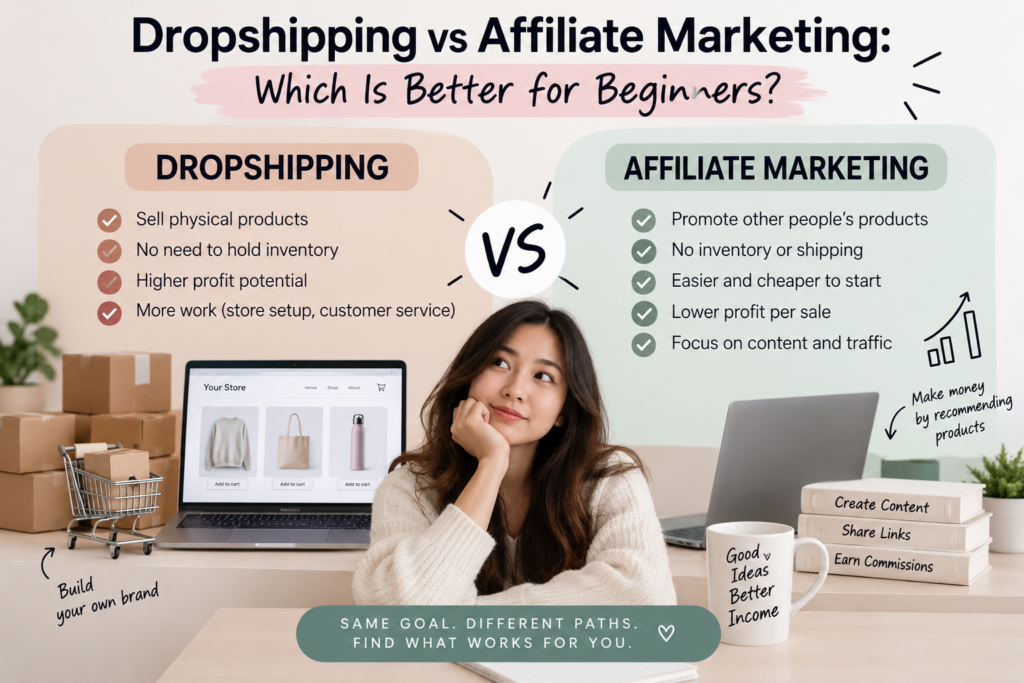
Dropshipping vs Affiliate Marketing: Which Is Better for Beginners?
Dropshipping vs Affiliate Marketing: Which One Actually Fits You?
So you’ve narrowed your online business search down to two contenders, and now you’re stuck comparing dropshipping vs affiliate marketing like it’s a final exam question. Fair enough — these are probably the two most talked-about beginner business models online, and honestly, both get oversold in different ways. One promises you your own branded store with almost no upfront investment. The other promises passive income from links you barely have to think about again. Neither promise is entirely true, but neither is a scam either.
Let’s cut through the noise and actually compare them side by side, so you can figure out which one fits your situation — not just which one has better marketing hype.
First Things First: What Are We Even Comparing?
Before diving into dropshipping vs affiliate marketing head-to-head, it helps to define each one quickly.
With dropshipping, you run your own online store. A supplier keeps the inventory and ships orders straight to your customers once they buy. You set the price, you build the brand, and — this is the part people forget — you’re also the one who deals with it when a shipment goes missing.
With affiliate marketing, you’re not selling your own product at all. Instead, you recommend someone else’s — through a blog post, a YouTube video, an Instagram caption, wherever — and you earn a commission whenever someone buys through your link. No inventory, no shipping, no awkward refund conversations.
Different setups, different daily realities. Which brings us to the real question.
Dropshipping vs Affiliate Marketing: What Does It Actually Cost to Start?
Here’s where affiliate marketing usually wins on paper. You can start creating content on platforms that cost nothing, and plenty of affiliate programs are completely free to join. Your biggest investment is time.
Dropshipping, on the other hand, tends to rack up costs before you’ve made a single sale — an ecommerce platform subscription, a domain, apps, payment processing fees, and usually some ad spend just to get eyes on your store. None of it is enormous individually, but it adds up faster than most beginners expect.
If you’re working with a tight budget either way, our guides on Can You Start Dropshipping With No Money? and Can You Start Affiliate Marketing With No Money? go deeper into what “starting with nothing” realistically looks like for each.
So Which One Actually Makes More Money?
This is the question everyone really wants answered, and unfortunately, there’s no clean winner here. It genuinely depends on your traffic, your conversion rate, and the math behind your specific numbers.
Dropshipping generally earns more per sale. If you sell a product for €40 and it costs you €20 from your supplier, that’s €20 in your pocket before expenses.
Affiliate marketing usually pays less per sale — say, a 5% commission on a €100 product, which works out to €5.
But here’s the catch: volume changes everything.
- Dropshipping: €15 profit × 20 sales = €300
- Affiliate marketing: €5 commission × 100 sales = €500
In that scenario, the affiliate marketer actually came out ahead — not because the commission was bigger, but because more people bought through the link. Margin matters, sure, but so does reach. Ignore either one and your math falls apart.
What About Day-to-Day Responsibility?
This is where the two models really start to feel different in practice, and it’s honestly one of the most overlooked parts of the dropshipping vs affiliate marketing decision. Affiliate marketing tends to be lighter on your plate, since the merchant handles the transaction, the shipping, and the customer complaints. You just point people in the right direction and step back.
Dropshipping, meanwhile, puts you squarely in charge of the entire buying experience. That’s more control, which some people genuinely want — but it also means more things can go wrong on your watch, and more emails asking “where’s my order?”
Which Scales Better Over Time?
Both models can grow, but they grow differently, which is worth understanding before you commit to either one.
Dropshipping scales by adding new products, increasing ad budgets, and improving how well your store converts visitors into buyers — though more orders inevitably means more operational work too.
Affiliate marketing, on the other hand, scales mostly through content and traffic. Publish more, reach more people, and your income tends to follow — without a corresponding spike in day-to-day workload, since you’re never the one fulfilling the order.
And What About Risk?
Dropshipping carries more direct business risk. Shipping delays, refunds, and quality control issues are yours to handle, full stop. Affiliate marketing sidesteps most of that, but it isn’t risk-free either — you’re relying on someone else’s program, and if they change their commission rates or shut the program down, your income moves with them, whether you like it or not.
Okay, But Which Is Better for Beginners?
Honestly? For most people just starting out, affiliate marketing tends to be the gentler entry point. There’s no inventory to manage, no fulfillment headaches, and it’s a genuinely useful way to learn how online audiences and traffic actually behave before you commit to anything bigger.
That said, dropshipping might suit you better if what you actually want is your own ecommerce brand — full control over pricing, product selection, and the whole customer experience from day one. If that’s the direction you’re leaning regardless of which model wins this comparison, take a look at our guide on how much money you need to start an ecommerce business.
Neither one is universally “easier.” It really comes down to whether you’re more excited about running a store or creating content.
Can You Actually Do Both?
Yes, and a lot of people end up doing exactly that instead of picking a side forever. A common path looks something like this:
Build content → grow an audience → earn affiliate income → learn what that audience actually wants → launch your own product through dropshipping or ecommerce
In other words, affiliate marketing can double as market research. Instead of guessing what to sell, you already know, because your audience has been telling you the whole time. Before turning that insight into an actual product launch, it’s worth reading our guide on how to validate a product idea before selling online.
Quick Side-by-Side Comparison
| Dropshipping | Affiliate Marketing | |
|---|---|---|
| Startup cost | Higher | Lower |
| Profit per sale | Usually higher | Usually lower |
| Daily workload | Higher (orders, service) | Lower |
| Control over pricing/brand | Full control | None |
| Financial risk | Higher | Lower, but platform-dependent |
| How it scales | More products, more ads | More content, more traffic |
So, Which Should You Actually Choose?
If you like the idea of running your own store, setting your own prices, and building something with your name on it, dropshipping gives you that — at the cost of more moving parts to manage.
If you’d rather start writing, filming, or creating content with as little overhead as possible, affiliate marketing is usually the more forgiving place to begin.
And if you’re still torn between dropshipping vs affiliate marketing after all this, remember there’s no rule forcing you to choose just one, forever. Plenty of successful entrepreneurs start with whichever feels lighter, learn from it, and layer the other one in once they’ve got some traction.
Frequently Asked Questions
Which makes more money, dropshipping or affiliate marketing? Neither wins automatically — it comes down to your traffic, conversion rate, and expenses. Dropshipping can offer a bigger profit per sale, while affiliate marketing can reach the same revenue with lower operating costs.
Is dropshipping more profitable than affiliate marketing? Sometimes, but it depends entirely on the business. Dropshipping gives you more pricing control, but it also comes with more expenses and more responsibility riding on your shoulders.
Which is better for beginners, dropshipping or affiliate marketing? Affiliate marketing is usually the gentler starting point, since there’s no inventory or order fulfillment to manage. Dropshipping fits beginners who already know they want to build an ecommerce brand from the start.
Can you do dropshipping and affiliate marketing at the same time? Yes, and plenty of entrepreneurs do. Many use affiliate marketing first to build an audience and test interest before launching their own dropshipping products.
Which one costs less to start? Affiliate marketing, generally. It doesn’t require inventory, a full ecommerce setup, or nearly as much upfront ad spend to get moving.
1 thought on “Dropshipping vs Affiliate Marketing: Which Is Better for Beginners?”
Comments are closed.
[…] You can also compare the two models in Dropshipping vs Affiliate Marketing: Which Is Better for Beginners? […]