New to online business? Start with our free 7-day roadmap and build your foundation step by step.
Get the Free Roadmap →Ecommerce
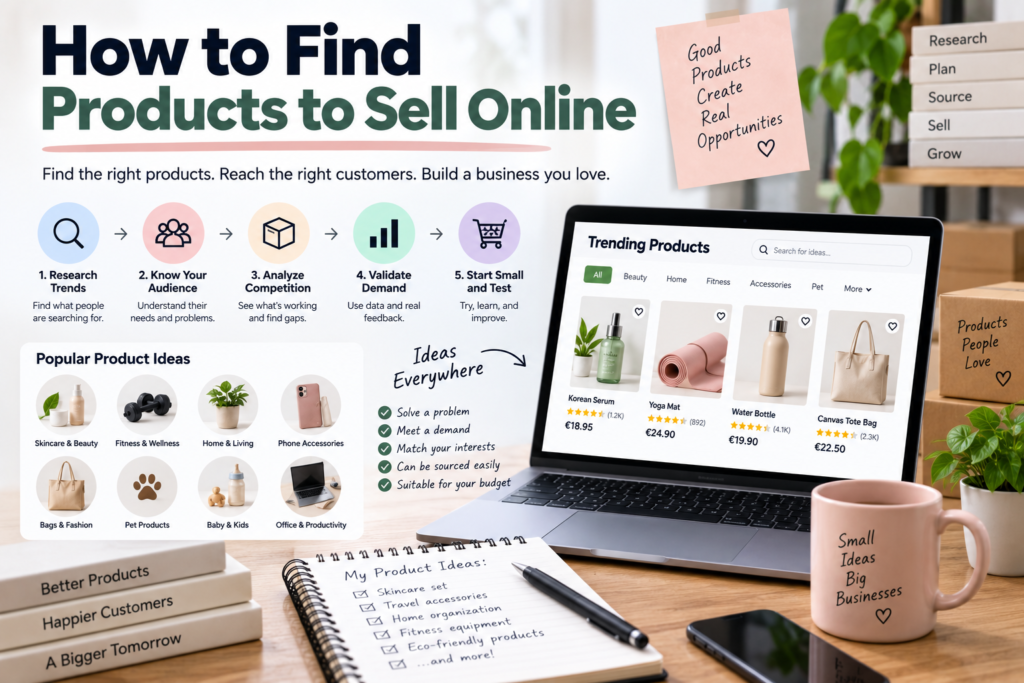
How to Find Products to Sell Online
How to Find Products to Sell Online
Every online business starts with the same unanswered question: what am I actually going to sell? It sounds like it should be the easy part — pick something, list it, done — but this decision quietly determines almost everything that follows, from how hard your marketing will need to work to how sustainable your margins actually are. Learning how to find products to sell online isn’t about stumbling onto a lucky trend; it’s a research process you can genuinely repeat.
This guide walks through exactly how to find products to sell online using a structured approach, rather than guessing and hoping something sticks — the same process whether you’re aiming for a single hero product or a broader catalog.
Where to Actually Look for Product Ideas
Beyond search tools, a few practical sources tend to surface ideas that search data alone might miss:
- Your own frustrations — products you’ve wished existed, or existing products you found genuinely disappointing
- Niche online communities — Reddit threads, Facebook groups, or forums where people discuss specific hobbies or problems in detail
- Customer reviews on existing products — complaints and requests buried in reviews of similar items often reveal exactly what’s missing from the current market
- Supplier catalogs — browsing wholesale or manufacturing marketplaces can surface product categories you hadn’t previously considered
Combining a few of these sources tends to produce more grounded ideas than relying on any single method alone when you’re trying to find products to sell online.
Start With Problems, Not Products
The strongest product ideas usually solve a specific, identifiable problem rather than existing purely because they seem interesting or trendy. Before searching for product ideas directly, it’s worth listing problems you personally understand — either from your own experience or from a community you’re genuinely familiar with. Products built around a real, specific problem tend to have clearer marketing angles and more durable demand than novelty items chasing a passing trend.
Use Search Data to Validate Demand
Once you have a few directions in mind, check whether real demand actually exists before committing further. Free tools make this surprisingly accessible:
- Google Trends shows whether interest in a topic or product category is rising, falling, or seasonal over time
- Google’s autocomplete reveals what people are actually typing when they search a related term
- Amazon’s search bar autocomplete shows real purchase-intent search phrases, since these searches often lead directly to a buying decision
This step alone can save you from building an entire business around a niche that looked promising but has little actual search demand behind it.
Look at What’s Already Selling
Existing demand is often a better signal than a completely untested, original idea. Browsing bestseller lists on marketplaces like Amazon or Etsy, or checking what’s trending on platforms like TikTok Shop, can reveal categories with proven demand. The goal isn’t to copy an existing product exactly — it’s to identify categories where people are already spending money, then find your own angle or improvement within that space.
Evaluate Competition Honestly
High competition isn’t automatically a bad sign — it usually means real demand exists. But it does mean you’ll need a genuine point of differentiation to compete. When evaluating a potential product, ask:
- Are a handful of massive brands dominating this space, or is it fragmented enough for a smaller seller to compete?
- What would make a customer choose my version over the established options?
- Is there a specific underserved audience within this broader category I could focus on instead?
Trying to compete head-on against dominant, well-funded brands in a saturated category is a difficult path for a beginner; finding an underserved niche within that category is usually more realistic.
Consider Your Margins Before Falling in Love With an Idea
An exciting product idea can quickly become impractical once you run the actual numbers. Before committing, roughly estimate:
- Product or manufacturing cost
- Shipping costs, both to you and to customers
- Platform or marketplace fees
- Realistic selling price based on competitor research
If the math doesn’t leave room for a sustainable margin after marketing costs, it’s worth reconsidering before investing further time. Our guide on how to price products for an online store covers this calculation in more depth once you’ve narrowed down a specific product.
Validate Before You Fully Commit
Rather than betting everything on a single untested idea, look for lower-risk ways to confirm real interest first — a small test batch, a pre-order campaign, or gauging interest within a relevant online community before investing in significant inventory. Our guide on how to validate a product idea before selling online walks through this process in much more detail, covering specific validation methods beyond just search data.
Physical Products vs. Digital Products
When thinking through how to find products to sell online, it’s worth considering both physical and digital options rather than defaulting automatically to physical goods. Digital products — templates, courses, ebooks — avoid inventory and shipping complexity entirely, trading that operational simplicity for a different kind of challenge around creation time and perceived value. Neither category is inherently better; the right choice depends on your skills, interests, and how much operational complexity you’re willing to take on.
Seasonal vs. Year-Round Demand
It’s worth deliberately checking whether a product idea’s demand is seasonal or consistent throughout the year, since this significantly affects how you’ll need to plan inventory and cash flow. A seasonal product can be highly profitable in its window but requires careful planning around the rest of the year, while a year-round product offers steadier, more predictable revenue but may lack the concentrated sales spikes a seasonal item can generate. Neither is automatically the better choice — it depends on whether you’d rather manage the complexity of seasonality or the steadiness of consistent, moderate demand. Checking a product’s search trend pattern over a full year, not just the current month, is one of the more overlooked steps when learning how to find products to sell online.
Sourcing Once You’ve Identified a Product
Once you’ve settled on a product direction, sourcing becomes the next decision:
- Manufacturing your own — most control, typically highest upfront cost and complexity
- Wholesale — buying existing products in bulk to resell, moderate control and cost
- Dropshipping — listing products without holding inventory, lowest upfront cost, least control
- Handmade — creating products yourself, strong differentiation potential, limited by your own production capacity
Each sourcing method affects your margins, control, and operational workload differently, and it’s worth choosing deliberately rather than defaulting to whichever option seems easiest at first glance.
Signs a Product Idea Might Not Be Worth Pursuing
A few warning signs are worth taking seriously before committing further:
- Search interest is declining rather than stable or growing
- Margins are too thin to support any real marketing spend once all costs are factored in
- The category is dominated by a few massive, well-funded competitors with no obvious gap to differentiate into
- You can’t clearly articulate why a customer would choose your version over existing alternatives
None of these alone is necessarily disqualifying, but multiple warning signs together are worth taking seriously before investing further time and money.
A Simple Process to Follow
If you want a straightforward starting sequence:
- List 3-5 problems or interests you genuinely understand
- Check search demand and trend data for related product ideas
- Research existing competition and identify a potential angle or gap
- Rough out realistic margins before committing further
- Validate interest on a small scale before full investment
This structured approach tends to produce more reliable results than searching for “trending products” lists and picking whatever looks appealing at the moment.
Frequently Asked Questions
How do I know if a product idea has enough demand? Checking search trend data, existing marketplace bestsellers, and community discussion around the topic all provide signals. No single source is perfect, but combining a few tends to give a reasonably reliable picture.
Should I pick a trending product or something with stable, long-term demand? Trending products can generate quick sales but often fade fast, while stable-demand products build a more sustainable business over time. Many successful sellers favor durable demand over chasing short-lived trends.
How much competition is too much when choosing a product? High competition isn’t automatically disqualifying — it often signals real demand. The key question is whether you can identify a genuine point of differentiation within that competitive space.
Is it better to find one product or build a full catalog? Many successful stores start by focusing deeply on a single strong product before expanding, since this makes marketing, branding, and inventory management considerably simpler in the early stages — it’s often easier to grow a catalog outward from one proven winner than to launch several untested products simultaneously.
2 thoughts on “How to Find Products to Sell Online”
Comments are closed.
[…] rather than assumed. If you’re still working out what to actually sell, our guide on how to find products to sell onlineis worth reading before finalizing this […]
[…] you’re still working this part out, our guide on how to find products to sell online is worth reading before you go any further down this list, since everything else here assumes […]