New to online business? Start with our free 7-day roadmap and build your foundation step by step.
Get the Free Roadmap →Selling Platorms
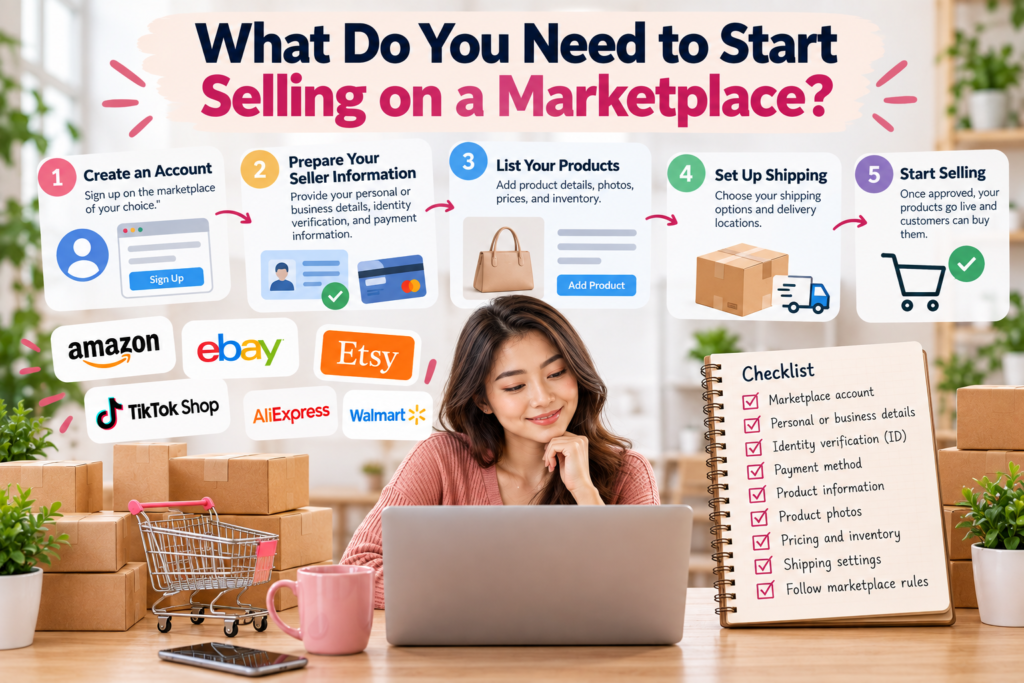
What Do You Need to Start Selling on a Marketplace?
What Do You Need to Start Selling on a Marketplace?
So you’ve decided a marketplace makes more sense than building your own store from scratch — a genuinely reasonable call, especially if you’re still figuring out whether your product idea even has legs. But before you can actually list anything, there’s a checklist of things you genuinely need in place first. Nothing complicated, but skipping a step tends to slow you down right when you’re trying to move fast.
Here’s exactly what you need to start selling on a marketplace, whether that’s Amazon, Etsy, eBay, or somewhere else entirely, walked through in the order you’ll actually need it.
1. A Clear Idea of What You’re Actually Selling
This sounds obvious, but it’s where a surprising number of people stall out before they’ve made any real progress. “I want to sell something online” isn’t a starting point — a specific product, with a specific audience in mind, is. Before you go further, you need to know what you’re listing, who it’s genuinely for, and roughly what it should cost once every expense is accounted for.
If you’re still working this part out, our guide on how to find products to sell online is worth reading before you go any further down this list, since everything else here assumes you already have a reasonably clear product direction.
2. A Seller Account on Your Chosen Marketplace
Every marketplace requires you to register as a seller before you can list anything, and the process usually asks for:
- A valid email address and phone number
- Government-issued ID for identity verification
- A bank account for receiving payouts
- Basic business or personal information, depending on the platform and your location
For Amazon specifically, this happens through Seller Central. Etsy and eBay have their own equivalent signup flows, each with slightly different requirements and verification timelines, so it’s worth checking the specifics for whichever platform you’re choosing before assuming the process is identical across all of them.
3. A Way to Get Paid
To start selling on a marketplace, you’ll need a connected bank account or payment method the platform can send your earnings to. Most marketplaces handle this directly through their own payment system rather than a third-party processor, so double-check what’s required during signup — some platforms hold your first payout for a short verification period before releasing funds, which is worth knowing in advance so it doesn’t catch you off guard when your first sale doesn’t immediately show up in your bank account.
4. Product Photos That Actually Do the Job
You don’t need a professional studio, but you do need clear, well-lit photos from multiple angles that show exactly what a buyer is getting. On a crowded marketplace, your photos are often the very first — and sometimes only — thing separating your listing from a dozen nearly identical ones sitting right next to it in search results.
If photography feels like the weakest part of your preparation, our guide on how to take product photos for an online storecovers exactly how to get genuinely usable results without expensive equipment.
5. A Written Listing: Title, Description, and Pricing
Once you’re ready to list, you’ll need to actually write the listing itself:
- A clear, keyword-relevant title (avoid vague, overly clever titles that don’t describe the product)
- A description that answers real buyer questions, not just a list of features copied from a manufacturer
- Pricing that accounts for the platform’s fees, not just your product cost in isolation
Underpricing to “compete” is a common early mistake — factor in every fee before you land on a final number, not after your first sale reveals the math didn’t actually work in your favor. Our guide on how to price products for an online storewalks through this calculation in more depth.
6. Inventory or a Fulfillment Plan
Depending on the platform and model you choose, you’ll need either physical stock ready to ship, or a fulfillment plan in place — whether that’s shipping it yourself, using a service like Fulfillment by Amazon (FBA), or working with a supplier if you’re dropshipping. Figuring this out before you go live avoids the scramble of an order coming in with no clear plan to actually fulfill it, which tends to create exactly the kind of slow, confusing customer experience that leads to bad reviews.
7. An Understanding of the Platform’s Fees
Every marketplace takes a cut somewhere — referral fees, listing fees, payment processing, sometimes fulfillment costs on top of all of that. Before you launch, it’s worth calculating your real margin after every fee is accounted for, not just your product cost versus your selling price. A product that looks profitable on paper can quietly break even, or worse, once every fee is factored into the actual math.
8. A Basic Understanding of the Platform’s Policies
Marketplaces have specific rules — some more particular than you’d expect — around things like prohibited categories, review practices, and customer communication. Reading through the platform’s actual seller policies before you launch can save you from an account suspension caused by an entirely innocent mistake down the line, which is a far more disruptive problem to deal with than the time it takes to read the policies upfront.
9. A Plan for Getting Your First Reviews
New listings without any reviews yet often struggle to gain traction, even with a genuinely solid product — buyers tend to trust social proof more than the listing copy itself, regardless of how well-written it is. Most marketplaces offer a compliant way to request honest reviews post-purchase (Amazon’s built-in “Request a Review” button, for example). Steer well clear of incentivized or fake reviews, which can get an account suspended fast and undo everything else you’ve done correctly.
10. Patience for the First Few Weeks
Nobody needs a tool or an account for this one, but it might genuinely be the most important item on the list. Most sellers don’t see meaningful traction in their first few days — visibility, reviews, and momentum tend to build gradually rather than instantly, even with a genuinely good product listed correctly. Going in expecting a slow start makes it far less discouraging when the first week doesn’t look like the success stories you’ve seen online, which are almost always survivorship bias rather than a realistic baseline.
Common Early Mistakes New Marketplace Sellers Make
A handful of avoidable missteps account for a large share of early struggles on any marketplace. Rushing a listing live with thin, generic descriptions is one of the most common — buyers on marketplaces often compare several nearly identical listings side by side, and a vague description loses that comparison every time against a more detailed competitor. Ignoring early customer messages is another: slow or absent responses to pre-purchase questions quietly cost sales that would have otherwise converted with a prompt, helpful reply. And setting pricing purely by copying a competitor’s number, without confirming your own costs actually support that price, is a fast way to discover you’re selling at a loss once real fees are subtracted.
How Customer Service Differs on a Marketplace
Unlike an independent store where you control every part of the customer experience, marketplace customer service operates within the platform’s own rules and expectations. Response time windows, required communication templates, and dispute resolution processes are often dictated by the marketplace itself rather than left entirely to your discretion. Understanding these expectations before your first sale — rather than learning them reactively during a dispute — helps you maintain good account standing and avoid the kind of policy violations that can jeopardize your ability to sell on the platform at all.
Choosing the Right Marketplace for Your Product
Not every marketplace suits every product equally. Amazon works well for products with broad, established demand and a willingness to compete on visibility within a massive catalog. Etsy tends to favor handmade, vintage, or craft-oriented products where a story and personal touch matter to buyers. eBay suits both new and used goods, with an audience often comfortable with auction-style or negotiated pricing. Matching your product to the marketplace where its specific strengths are actually valued tends to produce better early results than picking the most well-known platform by default.
Setting Up Your Business Information Correctly From the Start
Beyond the basic seller account signup, it’s worth getting your business details right from day one rather than needing to correct them later. This includes accurate contact information, a clear business name if you’re operating as more than a sole individual seller, and — depending on your location — any necessary tax registration. Getting this wrong initially can create friction later, particularly around payout verification or tax reporting, so it’s worth double-checking these details carefully during setup rather than rushing through them.
Understanding Shipping Requirements Before You List
Different marketplaces have different expectations around shipping speed, tracking, and communication. Amazon, for instance, has strict performance metrics around on-time shipping and order defect rates that can affect your account standing if not met consistently. Etsy and eBay have somewhat more flexible expectations but still reward sellers who communicate clearly and ship promptly. Understanding these specific requirements before your first sale comes in — rather than discovering them reactively — helps you avoid early account health issues that can be difficult to recover from.
Building a Simple Pre-Launch Checklist
Before actually going live, it’s worth running through a final check of everything covered above:
- Seller account fully verified and approved
- Payment method connected and confirmed
- Product photos taken and edited
- Listing copy written and proofread
- Pricing calculated with all fees included
- Inventory or fulfillment plan confirmed
- Platform policies reviewed for your specific category
- A plan in place for requesting reviews post-purchase
Working through this list methodically, rather than launching with gaps and fixing problems reactively, tends to produce a smoother first few weeks and fewer avoidable early mistakes.
Putting It All Together
To start selling on a marketplace, you genuinely don’t need much beyond a product, a verified seller account, decent photos, an honest listing, and a clear-eyed understanding of the fees involved. It’s less about needing elaborate infrastructure and more about making sure nothing’s missing before you go live — since fixing a gap after launch is almost always more disruptive, and more visible to potential customers, than catching it beforehand.
If you’re specifically considering Amazon, our full walkthrough on how to start selling on Amazon goes deeper into the platform-specific steps once you’ve got the basics covered here. And if you’re still weighing a marketplace against building your own branded store, our comparison of a marketplace vs. an online store breaks down the trade-offs in more depth than this checklist alone can cover.
Frequently Asked Questions
Do I need a business license to start selling on a marketplace? Not always — many marketplaces allow individual sellers without formal business registration, though this varies by platform and country, so it’s worth checking local requirements as you scale beyond a hobby-level operation.
How much money do I need to start selling on a marketplace? This varies by product and platform, but many beginners start with a modest budget covering initial inventory and any listing or subscription fees, often a few hundred dollars depending on the product category and sourcing method.
How long does it take to get approved as a seller? This depends on the platform — some approve accounts within minutes, while others, especially for restricted categories, can take several days for identity or category verification to complete.
Can I sell on more than one marketplace at once? Yes, and many sellers do exactly that — listing the same or similar products across multiple marketplaces to capture additional traffic and reduce reliance on any single platform’s algorithm or policy changes.
What happens if my account gets suspended? Most marketplaces provide an appeals process, though the specifics vary by platform and violation type. Understanding and following the platform’s policies from the start is the best way to avoid this situation entirely, since appeals can take significant time to resolve even when successful.