New to online business? Start with our free 7-day roadmap and build your foundation step by step.
Get the Free Roadmap →Ecommerce
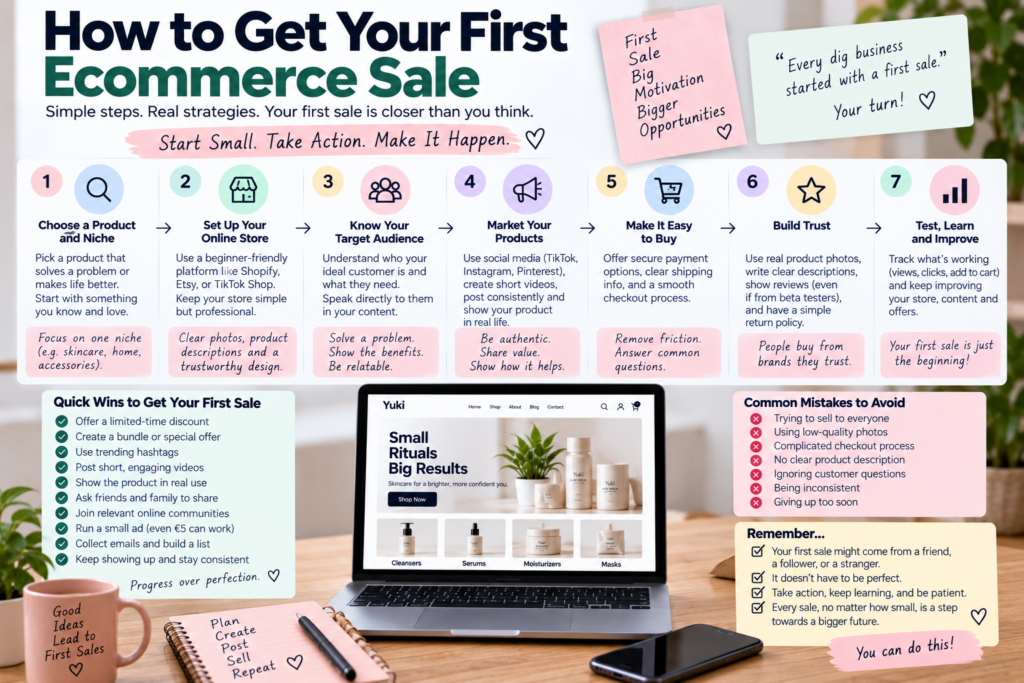
How to Get Your First Ecommerce Sale
How to Get Your First Ecommerce Sale
Every successful store had to figure out how to get your first ecommerce sale at some point, and that first sale often matters more psychologically than financially. It’s proof the fundamentals work — that a real person found your store, trusted it enough to pay, and completed checkout. This guide walks through the realistic paths to that first sale and what to focus on once your store is live but still waiting for its first customer.
Why the First Sale Feels Harder Than It Should
A brand-new store has none of the trust signals that help convert visitors later on — no reviews, no social proof, no established search ranking, and no returning customers vouching for the brand. This means your first sale typically has to come from a source that doesn’t depend on those signals: your own network, a specific targeted effort, or a community where trust is established some other way. Understanding this upfront prevents the common mistake of expecting organic search or cold social media traffic to deliver that first sale quickly, when in reality those channels usually take longer to mature.
Start With Your Existing Network
The fastest realistic path to your first ecommerce sale is usually people who already know and trust you. Friends, family, former colleagues, and existing social media connections are far more likely to give your new store a chance than a complete stranger with zero context. This doesn’t mean pressuring people into buying something they don’t want — it means letting people in your existing circle know the store exists and what it offers, which some of them will genuinely be interested in regardless of the personal connection.
Leverage a Niche Community
If your product serves a specific interest or need, niche online communities — a subreddit, a Facebook group, a forum — can be a surprisingly effective source for your first ecommerce sale, provided you participate genuinely rather than simply dropping a promotional link. Communities built around a shared interest tend to respond well to someone who clearly understands the topic and offers something genuinely useful, and poorly to anyone who shows up only to advertise. Spending time contributing before mentioning your product, when the community’s rules allow it at all, tends to produce far better results than an immediate pitch.
Use Content to Build Early Trust
Even a small amount of content — a few blog posts, a handful of social media posts showing the product in use, or a short video explaining what makes it worth buying — gives potential first-time customers something to evaluate beyond a bare product listing. Our guide on marketing for beginners: how to get your first customers covers this in more depth, but the core idea is that content fills the trust gap a brand-new store doesn’t have yet through reviews or reputation.
Make Your Product Page Actually Convert
Driving traffic to a product page that doesn’t convert wastes the effort it took to get visitors there in the first place. Clear photos, specific and honest descriptions, visible pricing, and a straightforward checkout process all matter more for a first-time visitor than they might seem to, since that visitor has no prior relationship with your brand to fall back on if something feels confusing or untrustworthy. Our guide on how to get visitors to trust your website and buy covers the specific trust signals that matter most for a brand-new store.
Consider a Small, Targeted Paid Push
While paid advertising usually isn’t the right first move for a completely untested store, a very small, highly targeted ad budget aimed at a specific audience segment can sometimes accelerate that first sale once you have at least a basic product page and some initial trust signals in place. This isn’t about scaling paid ads immediately — it’s about using a small test budget to get real data on who responds to your offer, which informs both your marketing and your product positioning going forward.
Offer an Incentive for the First Purchase
A modest first-purchase incentive — a small discount, free shipping, or a simple bundle offer — can be the nudge that turns genuine interest into an actual completed sale. This matters especially for a brand-new store, where a potential customer may be interested but hesitant simply because they haven’t seen anyone else buy from you yet. The goal isn’t to discount so heavily that the sale isn’t profitable, but to remove just enough hesitation that a genuinely interested visitor decides to go ahead.
Track What Actually Worked
Once you do get that first ecommerce sale, pay close attention to exactly how it happened — which channel brought the visitor, what content or conversation led to the decision, and what almost stopped them from buying. This information is disproportionately valuable for a new store, since it’s your first real data point about what actually converts, rather than a guess based on general advice. Setting up Google Analytics before you even get your first visitor means you’ll have this data available the moment it happens, rather than trying to reconstruct it after the fact.
Use Email to Capture and Convert Early Interest
Not every visitor who’s interested in your product is ready to buy the moment they land on your site. Capturing email addresses — through a simple discount offer, a free guide, or just a straightforward newsletter signup — gives you a way to follow up with people who showed interest but didn’t convert immediately. For a brand-new store trying to land that first ecommerce sale, this second chance matters more than it might seem, since many purchase decisions happen after multiple touchpoints rather than a single visit. A simple welcome email sequence that introduces your story, your product, and a modest incentive to complete a first purchase can quietly convert interest that would otherwise be lost the moment someone closes the tab.
Consider Reaching Out to Micro-Influencers or Niche Creators
You don’t need a large budget or a well-known influencer to benefit from this approach. Smaller, niche-focused creators — even those with just a few thousand genuinely engaged followers — often have more influence over a specific audience’s purchase decisions than their follower count alone would suggest. Reaching out with a straightforward offer, such as a free product in exchange for an honest review or mention, can introduce your brand-new store to an audience that already trusts the person making the recommendation. This kind of borrowed trust can meaningfully shortcut the credibility-building process that a completely new store would otherwise have to do entirely on its own.
Be Visible Where Your Specific Customer Already Spends Time
Rather than trying to be present everywhere at once, identifying the one or two places your ideal customer already spends time — a specific platform, a particular type of content, a recurring event or conversation — and showing up there consistently tends to produce better results than a thin, scattered effort. This focus matters especially before your first ecommerce sale, when you have limited time and no existing audience to lean on. A concentrated effort in the right place beats a diluted effort spread everywhere.
Why the First Sale Isn’t the Finish Line
It’s easy to treat the first sale as validation that the hard part is over, but in reality it’s closer to the starting signal than the finish line. One sale proves the fundamentals can work; it doesn’t yet prove the business can generate sales consistently or profitably at scale. Treating the first sale as the beginning of a repeatable process — understanding what worked and deliberately doing more of it — matters more than celebrating the milestone itself, even though celebrating it is entirely reasonable too.
Common Mistakes That Delay the First Sale
Waiting for the store to be “perfect” before telling anyone about it. A functional, reasonably polished store that’s actually live and promoted beats a flawless one nobody knows exists.
Relying entirely on organic search traffic early on. SEO takes time to build, and a brand-new store typically can’t rely on it for that crucial first sale.
Spreading effort across too many channels at once. Focusing deeply on one or two realistic channels — your network, one niche community, one piece of content — usually outperforms a thin effort spread across five different approaches.
Giving up after a slow first week or two. Most stores don’t get their first sale immediately after launch. A slow start isn’t necessarily a sign the business idea is flawed.
Not following up with people who showed interest but didn’t buy. A polite follow-up with someone who browsed or asked questions but didn’t complete checkout sometimes converts the sale that initial contact didn’t.
How Long It Typically Takes
There’s no universal timeline, but many new stores get their first sale within the first few weeks if they actively pursue the channels described above, rather than simply launching and waiting. Stores that rely purely on organic discovery with no active promotion effort often wait considerably longer — sometimes months — before that first sale happens, simply because there’s no deliberate path driving a potential customer to discover the store in the first place.
Frequently Asked Questions
How long does it usually take to get your first ecommerce sale? This varies, but stores that actively promote through their network, niche communities, and content often see their first sale within a few weeks, while those relying purely on organic traffic may wait considerably longer.
Should I run paid ads to get my first sale? Not necessarily as a first move. A small, highly targeted test budget can help once you have basic trust signals in place, but relying entirely on paid ads before understanding what converts can be an expensive way to learn.
What if my first sale comes from a discount and not full price? That’s fine. A first-purchase incentive is a reasonable way to overcome initial hesitation, and you can focus on building full-price demand once you have initial traction and trust signals in place.
Does the first sale really matter that much? Financially, not much on its own — but it’s meaningful proof that your offer, pricing, and store function well enough for a real person to complete a purchase, which is valuable validation before investing more heavily in growth.
What if I’ve tried everything and still haven’t gotten my first ecommerce sale? Before assuming the product itself is the problem, revisit the basics — is your offer actually reaching people who would want it, is your pricing reasonable, and is your checkout process working smoothly without unexpected friction. Often the barrier is distribution rather than demand, meaning the right people simply haven’t seen the offer yet.
Should I ask friends and family to buy just to get the first sale? It’s better to let people who are genuinely interested buy naturally rather than asking for pity purchases. A sale from someone who wouldn’t otherwise buy doesn’t give you useful data about whether your actual target customer finds the offer compelling.
Setting Realistic Expectations for the Weeks After Launch
It’s worth preparing mentally for the period between launching your store and landing that first ecommerce sale, since this stretch can feel discouraging if you’re expecting immediate results. Traffic in the first few days or weeks often comes from curiosity rather than genuine buying intent — people checking out the new store because you mentioned it, rather than people actively looking to purchase. This is normal, and it doesn’t mean the underlying business idea is flawed.
What matters more than the exact timeline is whether you’re taking consistent, deliberate action toward the channels most likely to produce a first sale rather than passively waiting for traffic to materialize on its own. Reviewing what’s working and adjusting your approach every week or two, rather than sticking rigidly to a single plan regardless of results, tends to get stores to that first sale faster than either giving up too early or refusing to adjust an approach that clearly isn’t working.