New to online business? Start with our free 7-day roadmap and build your foundation step by step.
Get the Free Roadmap →Marketing
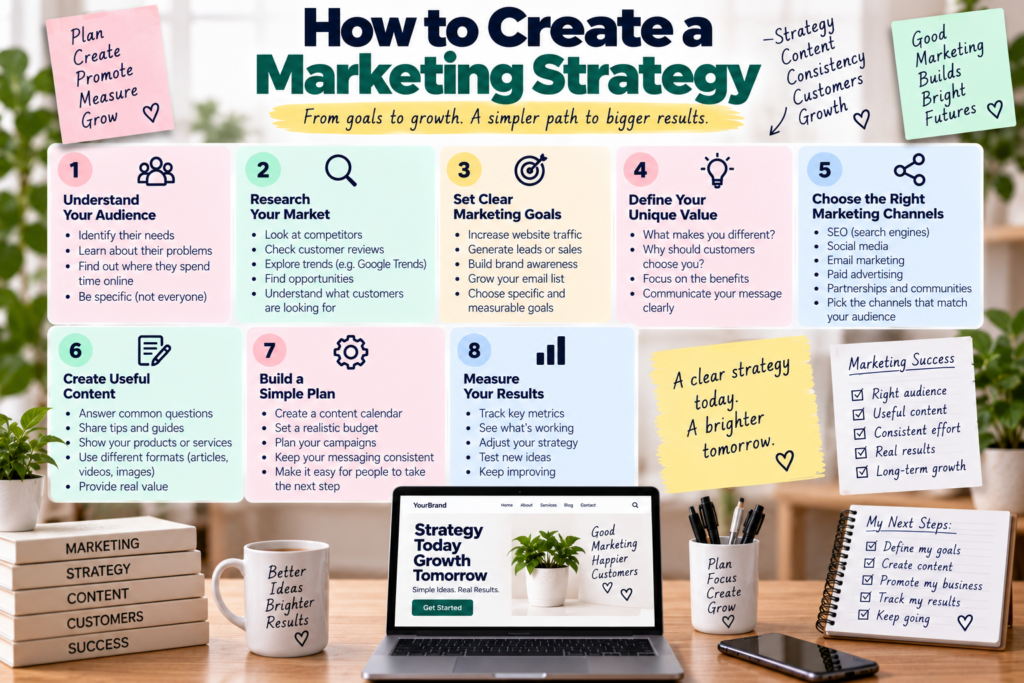
How to Create a Marketing Strategy
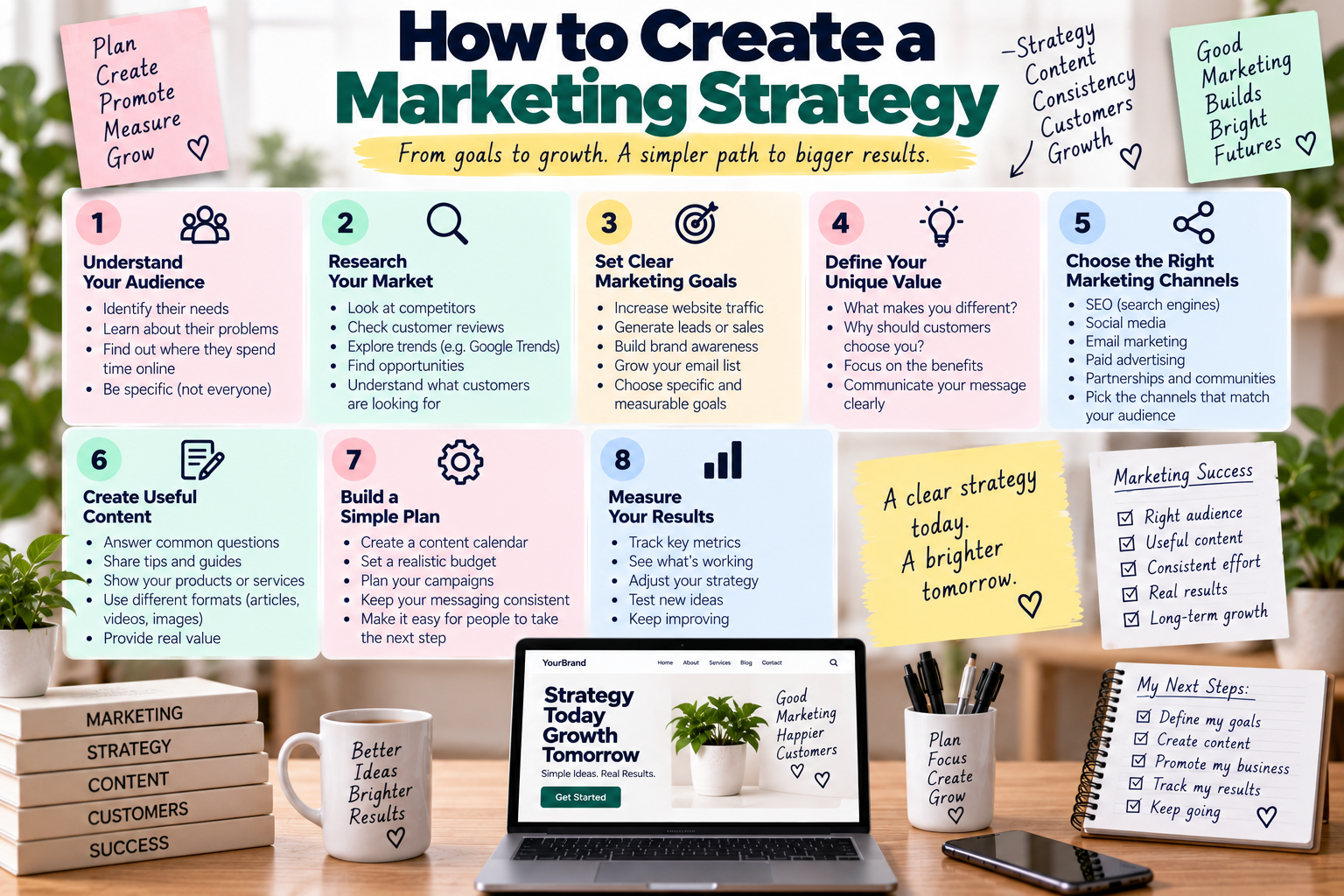
How to Create a Marketing Strategy
A clear marketing strategy is what separates businesses that grow predictably from those that market reactively, chasing whatever tactic happens to seem popular that particular week. This guide walks through how to create a marketing strategy from scratch, even if you’re doing it for the very first time with no prior marketing background.
What a Marketing Strategy Actually Is
A marketing strategy is the overall direction guiding your marketing decisions — who you’re targeting, what message you’re sending, and which channels you’ll use to reach them. It’s genuinely different from individual marketing tactics (like “post on Instagram” or “run a sale”), which are the specific actions that execute the broader strategy once it’s defined.
Why a Strategy Matters More Than Tactics Alone
It’s tempting to skip straight to tactics — posting content, running ads, sending emails — without ever stepping back to define the underlying strategy those tactics are supposed to serve. The problem with tactics-first marketing is that it tends to produce scattered, inconsistent effort: a social post here, an email campaign there, with no coherent thread connecting them. A genuine marketing strategy gives every subsequent tactical decision a clear purpose, making it considerably easier to evaluate whether something is actually working or just generating activity without real results.
Step 1: Define Your Target Audience
Every effective marketing strategy starts with a specific audience, not a general one. Get genuinely clear on:
- Who has the specific problem your product or service solves
- What matters most to them when making a purchasing decision
- Where they already spend time, whether online or offline
A strategy built around “everyone” inevitably produces generic messaging that resonates with no one in particular, since genuinely persuasive marketing speaks directly to a specific person’s specific situation.
Step 2: Clarify Your Positioning
Your marketing strategy should answer why someone should genuinely choose you over the alternatives available to them. This might be price, quality, speed, personalization, or a unique angle no competitor currently offers. Without clear positioning, your messaging tends to blend in with everyone else’s rather than standing out in a way that actually captures attention and consideration.
Step 3: Choose Your Primary Channels
Rather than trying to be present everywhere simultaneously, a focused marketing strategy deliberately picks the channels that best match your specific audience and available resources — whether that’s content and SEO, social media, email, or paid ads. For a breakdown of specific channels, see our marketing for beginners guide, which covers how to prioritize when you’re just starting out with limited time and budget.
Step 4: Set Measurable Goals
A marketing strategy without concrete goals is genuinely hard to evaluate. Define specific, trackable targets — website visits, email signups, sales — so you can tell whether your strategy is actually working, not just whether the associated activity feels productive in the moment.
Step 5: Build a Simple Timeline
Break your marketing strategy into distinct phases: what you’ll focus on in the first month, the next three months, and beyond that. This prevents the common trap of trying to execute everything simultaneously, which usually leads to inconsistent, half-finished effort spread across too many initiatives at once.
Understanding Your Competitive Landscape
A genuinely useful marketing strategy accounts for what competitors are already doing, not just your own ambitions in isolation. Understanding how similar businesses position themselves, which channels they’re active on, and what messaging they’re using helps you identify genuine gaps — places where you can differentiate meaningfully rather than simply echoing what’s already saturated in your specific space.
Aligning Strategy With Available Resources
One of the more common mistakes when building a marketing strategy is designing it around an idealized version of your business, rather than the actual time, budget, and skills you genuinely have available right now. A strategy built for a team of five rarely translates well to a solo founder working part-time on marketing. Being honest about your real constraints from the outset produces a strategy you can actually execute, rather than one that looks impressive on paper but quietly falls apart once you try to implement it.
How a Marketing Strategy Evolves Over Time
A marketing strategy isn’t meant to be static for the life of the business. As you gather real data about what’s working, as your audience understanding deepens, and as your available resources shift, the strategy itself should evolve to reflect that growing knowledge. Treating your initial strategy as a fixed, permanent document rather than a living one that improves with evidence tends to produce stagnation rather than genuine growth over time.
Reviewing and Adjusting Your Strategy
A marketing strategy isn’t fixed forever once written. Review your results every month or quarter using tools like Google Analytics, and adjust based on what the data genuinely shows — not just on what feels like it should be working based on assumption or habit.
Using Customer Insight to Sharpen Your Strategy
The best marketing strategies rarely come purely from internal brainstorming — they’re informed by genuine insight into how real customers talk about their problems, what nearly stopped them from buying, and why they ultimately chose to. If you already have even a handful of customers, their actual words and feedback often reveal positioning angles far more effective than anything generated purely through internal assumption. Building a habit of actively collecting and reviewing this feedback, then feeding it back into your strategy, keeps it grounded in reality rather than drifting toward what simply sounds good on paper.
Common Strategy Mistakes to Avoid
Skipping straight to tactics. Posting content or running ads without a defined underlying strategy tends to produce scattered, inconsistent results that are hard to meaningfully evaluate or improve.
Targeting too broad an audience. A strategy built around “everyone” rarely resonates deeply with anyone in particular, since generic messaging struggles to feel personally relevant to any specific individual.
Ignoring competitors entirely. Understanding the competitive landscape helps identify genuine differentiation opportunities that a strategy built in isolation would likely miss.
Setting vague, unmeasurable goals. Goals like “grow the business” provide no clear way to evaluate whether your marketing strategy is actually succeeding or simply generating activity.
Never revisiting the strategy. A strategy that’s written once and never updated based on real results eventually drifts out of alignment with what’s actually happening in the market and within your own business.
Connecting Strategy to Your Sales Process
A marketing strategy shouldn’t exist in isolation from what happens once someone actually shows interest. Mapping out what occurs from first contact through to a completed sale — and making sure your marketing efforts feed naturally into that process — closes a gap that’s easy to overlook when focused purely on generating traffic or awareness. A strategy that drives plenty of interest but has no clear path toward conversion leaves significant value on the table at exactly the point where it matters most.
Balancing Short-Term Wins With Long-Term Growth
A genuinely well-rounded marketing strategy balances tactics that produce faster, more immediate results with those that build durable, compounding value over a longer time horizon. Paid ads and direct outreach can generate quicker wins, while content and SEO build slower but tend to keep paying off well after the initial investment of time. Relying exclusively on either extreme tends to leave something valuable on the table — short-term tactics alone rarely build lasting momentum, while long-term tactics alone can leave you without the near-term results needed to sustain the business while waiting for them to mature.
A Simple Template to Get Started
If you want a concrete starting structure, a basic marketing strategy document might include:
- Target audience — a clear, specific description of who you’re marketing to
- Positioning statement — why someone should choose you specifically
- Primary channels — the one or two channels you’ll focus most effort on
- Goals — specific, measurable targets for the next 90 days
- Timeline — a rough phased plan for the coming months
This doesn’t need to be elaborate — a single clear page that you’ll actually refer back to is considerably more valuable than an exhaustive document that gets written once and then forgotten.
When to Bring In Outside Help
Many small businesses start by building and executing their marketing strategy entirely on their own, which is genuinely the right approach in the earliest stages when budgets are tight and the business itself is still being refined. As the business grows, though, it’s worth recognizing the point where bringing in specialized help — a freelancer, a part-time contractor, or eventually an agency — produces better returns than continuing to spread yourself across every marketing task alone. A reasonable signal to watch for is when marketing work is consistently being deprioritized in favor of other urgent tasks, suggesting the current capacity genuinely isn’t sufficient to execute the strategy as designed.
Frequently Asked Questions
How is a marketing strategy different from a marketing plan? A marketing strategy is the overall direction — who, what, why. A marketing plan is the specific, detailed execution of that strategy — what to post, when, and how. See our guide on how to create a marketing plan for a small business for the execution side of this process.
Do small businesses really need a formal marketing strategy? Yes — even a simple, one-page marketing strategy helps avoid wasted effort chasing every new tactic without a clear underlying direction connecting those individual efforts together.
How often should a marketing strategy be updated? Most small businesses benefit from reviewing their marketing strategy quarterly, adjusting based on what’s actually working rather than sticking rigidly to the original plan regardless of real-world results.
Can one person create and execute an entire marketing strategy alone? Yes, especially in the early stages of a business. Many small businesses start with the owner defining and executing the strategy directly, bringing in additional help later once the workload genuinely exceeds what one person can sustainably manage — starting solo also builds a genuine understanding of what works before handing any of it off to someone else.
2 thoughts on “How to Create a Marketing Strategy”
Comments are closed.
[…] SEO should also work alongside your broader marketing activities. For a wider overview, read How to Create a Marketing Strategy. […]
[…] you haven’t defined your broader direction yet, our guide on how to create a marketing strategy is worth working through first — the plan below builds directly on top of that […]