New to online business? Start with our free 7-day roadmap and build your foundation step by step.
Get the Free Roadmap →Ecommerce
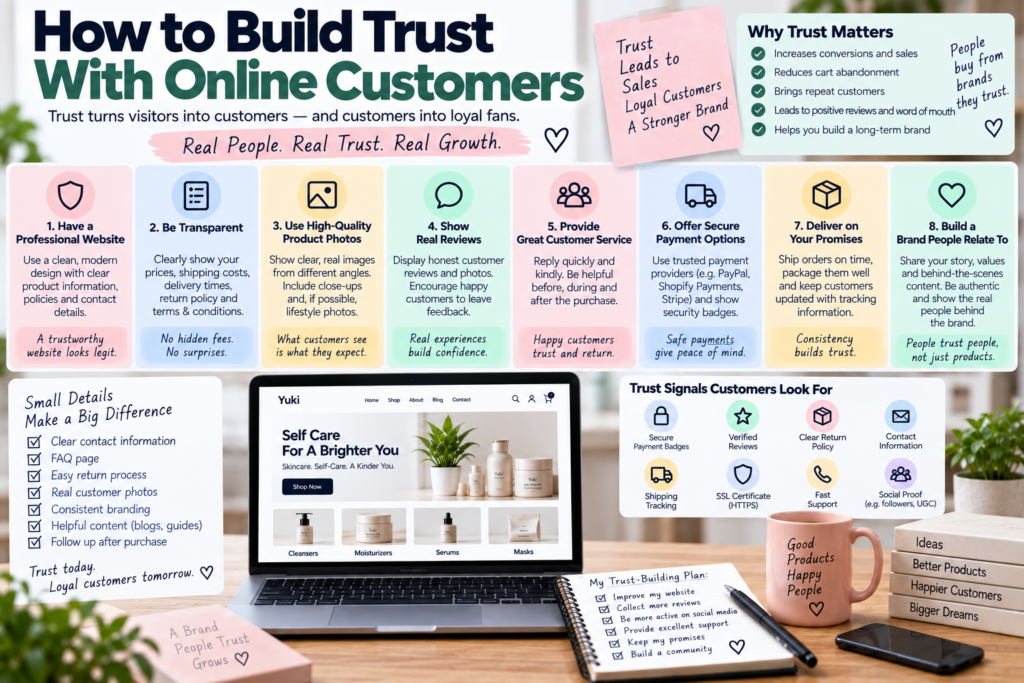
How to Build Trust With Online Customers
How to Build Trust With Online Customers
Knowing how to build trust with online customers is often the deciding factor between a visitor who browses and leaves and one who actually completes a purchase. Unlike a physical store, where a customer can see the product, the staff, and the space in person, an online store has to earn that same confidence entirely through design, content, and consistency. This guide covers the practical ways to build trust with online customers, from the first visit through to becoming a repeat buyer.
Why Trust Matters More Online Than In Person
In a physical store, trust builds through sensory cues — the quality of the space, a friendly interaction, the ability to physically inspect a product before paying. None of that exists by default online. Instead, trust has to be built deliberately through things like clear information, social proof, and a checkout process that feels secure and professional. Without these signals, even a genuinely great product can struggle to convert, simply because the visitor isn’t confident enough to hand over their payment details to an unfamiliar website.
Make Your Contact Information Clear and Visible
One of the simplest but most overlooked trust signals is making it obvious how to reach you. A visible contact page with a real email address, and ideally a phone number or live chat option, signals that there’s an actual business — and actual people — behind the website. Hiding this information, or making it difficult to find, raises an immediate and often subconscious red flag for a cautious visitor.
Use Real Product Photos and Honest Descriptions
Stock photography or overly generic product images can make a store feel impersonal or, worse, make customers suspicious that the product shown isn’t what they’ll actually receive. Using real photos — ideally from multiple angles, and showing the product in actual use where relevant — builds far more confidence than polished but generic stock imagery. The same applies to descriptions: honest, specific details about size, materials, and limitations build more trust than vague, overly promotional copy that avoids any mention of potential downsides.
Display Social Proof Prominently
Reviews, testimonials, and user-generated content are some of the most effective ways to build trust with online customers, since they come from a source the visitor sees as more objective than the store itself. Even a small number of genuine reviews outperforms having none at all, and displaying them prominently on product pages — rather than burying them on a separate page — maximizes their impact at the exact moment a customer is deciding whether to buy. If you’re a new store with few or no reviews yet, consider actively reaching out to your first customers and asking for feedback, since most won’t leave a review unprompted.
Have Clear, Easy-to-Find Policies
Shipping times, return policies, and privacy practices should be easy to locate, not buried in dense legal text or hidden several clicks deep. A visitor who can’t quickly find out what happens if the product doesn’t fit, arrives damaged, or simply isn’t what they expected is far less likely to complete a purchase, regardless of how much they like the product itself. Our guide on how to get visitors to trust your website and buy covers these specific trust signals in more depth.
Make Security Visible at Checkout
Even customers who aren’t technically savvy pick up on cues that suggest a checkout process is secure — an SSL certificate (shown as a lock icon in the browser), recognizable payment logos, and a checkout flow that looks professional rather than improvised. Platforms like Shopify and WooCommerce handle most of the technical security requirements automatically, but making these signals visible rather than assuming customers will simply trust the process matters for conversion, especially for first-time visitors unfamiliar with your brand.
Respond Quickly and Professionally to Questions
How you handle pre-purchase questions and post-purchase support requests says a great deal about whether a customer will trust you with future purchases, and whether they’ll recommend you to others. Slow or unhelpful responses erode trust quickly, while prompt, genuinely helpful communication — even when delivering bad news, like a delay or an out-of-stock item — tends to build more loyalty than customers might expect from a purely transactional relationship. Setting realistic response time expectations and consistently meeting them matters more than promising instant replies you can’t actually sustain.
Be Transparent About Shipping and Delivery
Vague or unrealistic shipping promises are one of the fastest ways to damage trust after a purchase. Being upfront about realistic delivery windows — especially if you’re using a dropshipping model where shipping times can be longer than customers typically expect — prevents the kind of disappointment that leads to refund requests and negative reviews, even when the product itself met expectations.
Build Trust Through Consistency Over Time
Trust isn’t built in a single interaction — it compounds across every visit, purchase, and support interaction a customer has with your brand. A store that consistently delivers what it promises, handles problems fairly, and communicates clearly builds a reputation that eventually becomes one of its strongest competitive advantages, since trust is considerably harder for a new competitor to replicate than price or product selection alone. This is particularly valuable for repeat purchases and referrals, both of which rely heavily on the confidence a customer has already built up through prior experience with your brand.
Use Content to Build Trust Before the Purchase
Helpful, genuinely useful content — buying guides, how-to articles, behind-the-scenes looks at how products are made — gives potential customers a chance to evaluate your expertise and credibility before they ever reach a product page. Our guide on marketing for beginners: how to get your first customers covers how content-driven trust-building fits into an overall marketing approach for a new store. This kind of content also tends to perform well in search over time, bringing in visitors who arrive already somewhat warmed up rather than completely cold.
Use Data to Understand Where Trust Is Breaking Down
Tracking where visitors drop off — at the product page, during checkout, or right after viewing shipping costs — can reveal specific points where trust is failing rather than leaving you to guess. Tools like Google Analytics let you see exactly where potential customers are leaving your site, which often points directly to a trust gap: an unclear policy, a confusing checkout step, or a lack of social proof at a critical decision point. Reviewing this data regularly, rather than only when sales feel slow, helps you build trust with online customers proactively instead of reactively guessing at what might be going wrong.
Trust Signals That Matter More on Mobile
A growing share of online shopping happens on mobile devices, and trust signals that work well on desktop don’t always translate cleanly to a smaller screen. A checkout process that requires excessive zooming or scrolling, contact information buried below several screens of content, or product photos that don’t display clearly on mobile all quietly undermine the same trust you’ve worked to build elsewhere on the site. Testing your store specifically on a phone, rather than assuming a desktop-optimized design translates well, catches these issues before they cost you mobile conversions — which for many stores now make up the majority of total traffic.
How Pricing Transparency Builds or Breaks Trust
Hidden fees that only appear at the final checkout step — unexpected shipping costs, taxes, or handling charges — are one of the fastest ways to lose a customer’s trust right before they complete a purchase. Being upfront about total costs as early as possible, ideally on the product page itself rather than only at checkout, prevents the frustration and abandoned carts that come from a customer feeling misled, even if the additional charges were never intentionally hidden. Transparent pricing from the start tends to convert better than a lower advertised price that increases unexpectedly later in the process, even though the final total might be identical either way.
The Role of Brand Consistency in Building Trust
A store that looks and sounds different across its website, social media, and email communication can unintentionally create doubt about whether everything is actually coming from the same legitimate business. Consistent branding — the same logo, color scheme, tone of voice, and messaging — across every customer touchpoint reinforces the sense that you’re dealing with an established, professional operation rather than something thrown together quickly. This consistency compounds over time, with each additional touchpoint reinforcing the trust built by the ones before it.
Common Mistakes That Undermine Trust
Using exclusively stock photography. This can make a store feel generic or, in some cases, outright suspicious to a cautious shopper.
Burying contact information or policies. Making it hard to find basic information raises doubt at exactly the moment a visitor is deciding whether to trust you with a purchase.
Ignoring or delaying responses to customer questions. Slow, inconsistent communication undermines the confidence a customer needs to complete a purchase or return for a second one.
Overpromising on shipping times or product claims. Short-term conversion gains from exaggerated claims are rarely worth the long-term damage to trust and reputation once reality doesn’t match the promise.
Having no visible social proof at all. Even a handful of genuine reviews meaningfully outperforms having none, particularly for a store with no existing brand recognition.
Trust Takes Longer to Build Than It Takes to Lose
It’s worth recognizing upfront that trust is asymmetric: it builds slowly through many consistent, positive interactions, but can be damaged significantly by a single bad experience, especially if it’s handled poorly. This asymmetry is part of why prioritizing trust-building efforts early, rather than treating them as optional polish once the “real” business priorities are handled, tends to pay off disproportionately over the life of the store.
How Trust Signals Differ for a Brand-New Store
A store with no sales history or reviews yet has to rely more heavily on the signals it can control directly — clear policies, honest descriptions, visible contact information, and professional design — since it doesn’t yet have the social proof that an established store can lean on. As the first reviews and repeat customers accumulate, the burden shifts somewhat, with social proof doing more of the trust-building work. Recognizing this shift helps new sellers understand which trust signals deserve the most attention early on, versus which naturally strengthen over time as the business matures.
Frequently Asked Questions
What’s the fastest way to build trust with online customers as a brand-new store? Clear contact information, honest product descriptions, and visible, easy-to-find policies are the quickest trust signals to implement, since they don’t depend on having an existing track record of sales or reviews.
Do customer reviews really make that much difference? Yes, significantly. Even a small number of genuine reviews measurably improves conversion rates compared to having no reviews at all, since they offer a perspective a visitor trusts more than the store’s own marketing claims.
How do I get my first reviews if nobody has bought yet? Reach out directly to your first customers after they’ve received their order and ask for honest feedback. Many customers are happy to leave a review when asked, even if they wouldn’t have done so unprompted.
Can a store recover from a trust-damaging mistake, like a late shipment or a product issue? Yes, often fully, if the issue is handled fairly and communicated clearly. Customers generally judge a business more by how it resolves a problem than by whether the problem happened in the first place.
Does having a professional-looking website design actually matter for trust? Yes. Visitors form an impression of credibility within seconds of landing on a page, and a cluttered, outdated, or unprofessional design can undermine trust before a customer even reads the product details.
How important is social media presence for building trust with online customers? An active, responsive social media presence can reinforce trust by showing there are real people behind the brand, but it’s a supplement to — not a replacement for — the core trust signals on your actual website, such as clear policies and honest product information.