New to online business? Start with our free 7-day roadmap and build your foundation step by step.
Get the Free Roadmap →Ecommerce
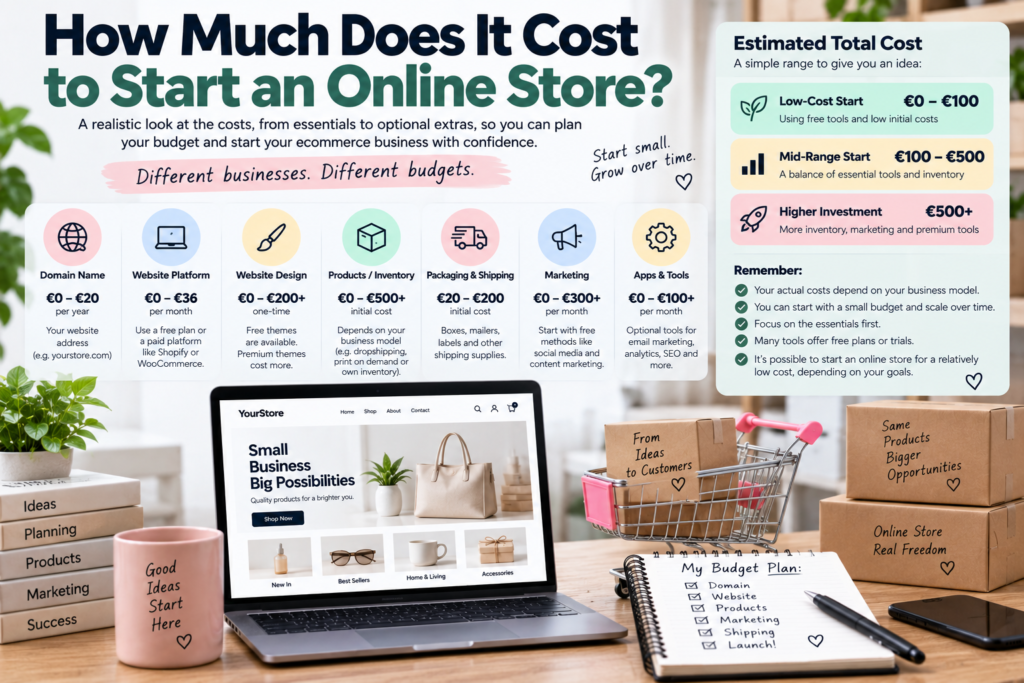
How Much Does It Cost to Start an Online Store?
How Much Does It Cost to Start an Online Store?
The cost of starting an online store can range from very little to several thousand euros, depending on what you sell, how you operate, and which tools you choose.
A beginner selling digital products may have very different costs from someone purchasing hundreds of physical products and paying for storage.
The important thing is to understand where your money will go before you launch.
If you’re looking for ways to keep your initial expenses low, our guide on How to Start an Online Store With No Money is a good place to start.
What Does It Cost to Start an Online Store?
There isn’t one fixed price.
Your online store costs can include:
- Domain name
- Website hosting or ecommerce platform
- Products or inventory
- Payment processing
- Packaging
- Shipping
- Marketing
- Business software
- Apps and extensions
- Professional services
- Returns and refunds
Some of these are optional at the beginning, while others become necessary depending on your business model.
That’s why it’s better to create your own startup budget rather than relying on a single number.
1. Domain Name
Your domain is your store’s web address, such as:
yourstore.com
A domain is usually one of the smaller expenses involved in creating an online store.
The price depends on the domain extension and registrar.
You don’t need an expensive or unusual domain.
Choose something that is:
- Easy to remember
- Easy to spell
- Relevant to your brand
- Not unnecessarily long
A good domain can make your store easier for customers to remember.
2. Ecommerce Platform or Hosting
Your next major expense may be the technology used to run your store.
There are two common approaches.
Hosted ecommerce platforms
Platforms such as Shopify provide many of the tools needed to operate an online store under a subscription model.
The exact price depends on the plan, billing period, location, and any additional services you use.
Check the current Shopify pricing page before budgeting because platform prices can change.
WordPress and WooCommerce
WooCommerce is an open-source ecommerce platform for WordPress. The core WooCommerce software is free to download, but you’ll still need hosting and may choose to pay for extensions, themes, or other services.
WooCommerce’s own documentation explains that payment processors can also charge transaction fees separately from WooCommerce itself.
This means “free platform” doesn’t necessarily mean “free store.”
3. Product Costs
If you’re selling physical products, inventory can become one of your biggest expenses.
For example, you might need to pay for:
- Initial inventory
- Samples
- Custom packaging
- Labels
- Product development
- Minimum order quantities
The amount you need depends heavily on your business model.
A traditional retailer may purchase inventory before making sales.
A dropshipping business may avoid buying large quantities upfront.
A print-on-demand business can produce products after an order is placed.
Digital products can eliminate physical inventory altogether.
If you’re still deciding what to sell, read How to Find Products to Sell Online.
4. Payment Processing Fees
When customers pay online, the payment provider may charge a processing fee.
The exact amount depends on the payment provider, country, payment method, and transaction.
For example, WooCommerce explains that payment gateway costs can include setup fees, subscriptions, and transaction fees depending on the provider.
These fees should be included in your calculations.
A product that appears profitable before payment fees may look very different after all expenses are included.
5. Shipping Costs
Shipping is another major consideration for physical products.
You may need to pay for:
- Packaging materials
- Shipping labels
- Carrier services
- Tracking
- International shipping
- Returns
- Damaged shipments
You can charge customers for shipping, offer free shipping, or use a combination of approaches.
However, free shipping isn’t actually free for your business.
If you don’t charge the customer separately, the cost has to be covered somewhere else, such as through your product pricing or overall margins.
6. Packaging
Packaging costs are easy to overlook when calculating online store costs.
Depending on your products, you may need:
- Boxes
- Mailers
- Tissue paper
- Tape
- Labels
- Thank-you cards
- Protective materials
Simple packaging can be enough when you’re starting.
You can upgrade your packaging later when you understand what customers value and what your business can comfortably afford.
7. Product Photography
Your customers can’t physically examine products through a screen.
Good photos can therefore be important for an online store.
You could start by taking your own photos with a smartphone and basic lighting.
Later, you might invest in:
- Professional photography
- Models
- Props
- Studio equipment
- Photo editing
You don’t necessarily need expensive photography equipment from day one.
Focus first on making the product clear and easy to understand.
8. Website Design
Website design costs can vary enormously.
You could use:
- A free theme
- A paid theme
- A freelancer
- An agency
- A custom design
A beginner doesn’t necessarily need a completely custom website.
Start with a clean design that works well on mobile devices and makes shopping straightforward.
Your priorities should be usability, product information, navigation, checkout, and trust.
Fancy animations are less important than making sure customers can actually complete their purchases easily.
9. Apps and Extensions
Depending on your platform, you may want additional tools for:
- Email marketing
- Reviews
- Inventory
- Product bundles
- Shipping
- Analytics
- Customer support
- Marketing
- Subscriptions
Some are free, while others use monthly or annual subscriptions.
WooCommerce, for example, has a marketplace containing both free and paid extensions. Current examples include free integrations as well as paid extensions with annual prices.
Don’t install every tool you see.
Start with the features you actually need.
10. Marketing Costs
Building an online store doesn’t guarantee that customers will find it.
You may eventually spend money on:
- Google Ads
- Social media advertising
- Influencer marketing
- Content creation
- SEO tools
- Email marketing
- Photography
- Video production
However, you don’t necessarily need a large advertising budget on day one.
You can also build free traffic through search engines, social media, useful content, and other organic channels.
Our Marketing for Beginners guide covers the basics of attracting customers online.
11. Business and Legal Costs
Depending on where you live and how your business operates, you may have additional costs related to:
- Business registration
- Accounting
- Taxes
- Licenses or permits
- Insurance
- Legal advice
- Professional services
These costs vary significantly by country and business structure.
If you’re launching a business in Spain, for example, you should check the current requirements that apply to your particular activity rather than relying on general ecommerce advice.
12. Returns and Refunds
Returns can also affect your budget.
You may need to cover:
- Return shipping
- Replacement products
- Refunds
- Damaged goods
- Customer service
- Restocking
Your return policy should be clear before you start accepting orders.
Don’t assume every sale represents money that you will permanently keep.
Some orders may eventually be returned or refunded.
13. How Much Should You Budget for Inventory?
There’s no universal answer.
Your inventory budget depends on:
- Product price
- Minimum order quantity
- Number of products
- Supplier
- Expected demand
- Storage space
- Business model
A beginner might choose to start with a small selection rather than purchasing a huge catalog.
Testing demand before committing to large quantities can reduce the amount of money at risk.
For more information, read How to Choose Products to Sell Online.
Example Startup Budgets
Instead of giving one number that supposedly works for everyone, it’s more useful to look at different scenarios.
Very low-budget store
A beginner might focus on:
- A basic domain
- Low-cost or existing hosting/platform
- A small product range
- Free design tools
- Organic social media
- Free content marketing
The main goal would be testing the idea rather than building a large operation immediately.
Small physical-product store
A store selling physical products may additionally need:
- Inventory
- Packaging
- Samples
- Shipping supplies
- Product photography
- Marketing
The more inventory you purchase upfront, the more cash you need.
Digital product store
A digital-product business can potentially have much lower physical costs because there is no traditional inventory or shipping.
However, you may still have expenses related to the website, payment processing, software, content creation, and marketing.
Dropshipping store
Dropshipping can reduce the need to purchase and store inventory upfront.
However, that doesn’t make it completely free.
You may still have platform costs, payment processing, product samples, marketing expenses, and other business costs.
How to Keep Your Startup Costs Low
If your budget is limited, prioritize the things customers actually need.
Start with fewer products
A smaller catalog is easier to manage and can reduce your initial inventory investment.
Use a simple design
You don’t need a custom website immediately.
Take your own photos
A smartphone can be enough to get started with product photography.
Use organic marketing
Create useful content before spending heavily on advertising.
Avoid unnecessary subscriptions
Review every recurring expense and ask whether it directly helps your business.
Test before scaling
Don’t assume that buying more inventory will automatically lead to more sales.
What Should You Spend Money on First?
When your budget is limited, prioritize:
1. A product people actually want
2. A reliable way to fulfill orders
3. A functional store
4. Secure payment processing
5. Clear product information
6. Customer service
7. A way to attract relevant visitors
A professional logo or expensive theme is much less important if your product doesn’t have demand or customers can’t figure out how to buy it.
How Much Does It Cost to Run an Online Store Each Month?
Startup costs aren’t the only expenses.
You may have recurring costs for:
- Ecommerce platform
- Hosting
- Apps
- Software
- Advertising
- Payment processing
- Shipping
- Inventory
- Customer service
Some expenses increase when your sales increase.
For example, payment processing and shipping are generally connected to transactions, while a platform subscription may be relatively fixed.
This is why you should separate one-time costs from recurring costs when creating your budget.
How to Calculate the Real Cost of Your Store
A simple way to think about your budget is:
Startup costs + monthly fixed costs + variable costs = total business costs
Startup costs
These might include:
- Domain
- Initial inventory
- Samples
- Equipment
- Initial branding
Fixed costs
These could include:
- Platform subscription
- Hosting
- Software subscriptions
Variable costs
These can include:
- Product cost
- Payment processing
- Packaging
- Shipping
- Advertising
- Returns
This gives you a much clearer picture than looking at the price of the ecommerce platform alone.
Frequently Asked Questions
How much money do I need to start an online store?
There is no fixed amount. Your budget depends on your products, business model, platform, inventory, shipping, marketing, and other expenses. Some models can be started with relatively little upfront spending, while inventory-heavy businesses can require much more.
Is it expensive to start an online store?
It can be, but it doesn’t have to be. A simple store with a small product range can cost considerably less than a large ecommerce operation with extensive inventory, custom development, and paid advertising.
Can I start an online store for free?
You can test many parts of an ecommerce idea without spending money, but a full store will usually involve some costs eventually. Even when the core software is free, you may still need hosting, a domain, payment processing, products, shipping, or other services.
What is the cheapest ecommerce platform?
There isn’t one platform that is cheapest for every business because the total cost depends on hosting, transaction fees, extensions, payment processing, and other requirements. WooCommerce’s core software is free, but you still need hosting and potentially other services.
How much does Shopify cost?
Shopify offers different plans and pricing can vary by billing period and market. Check the current Shopify pricing pagebefore making a budget because prices and offers can change.
Can I start an online store with €100?
It may be possible to test a simple business idea with a very small budget, depending on the business model and what resources you already have. However, €100 may not cover inventory, platform costs, shipping, marketing, and other expenses for a traditional physical-product store.
Final Thoughts
How Much Does It Cost to Start an Online Store? The honest answer is that it depends.
A small digital-product business, dropshipping store, and inventory-based ecommerce company can have very different startup budgets.
Instead of asking for one magic number, list your actual costs.
Start with what you genuinely need, avoid unnecessary subscriptions, test your product before making large investments, and increase your spending as your business gains evidence of demand.
The goal isn’t to spend as little as possible at all costs.
It’s to spend your money where it has a clear purpose.