New to online business? Start with our free 7-day roadmap and build your foundation step by step.
Get the Free Roadmap →Selling Platorms
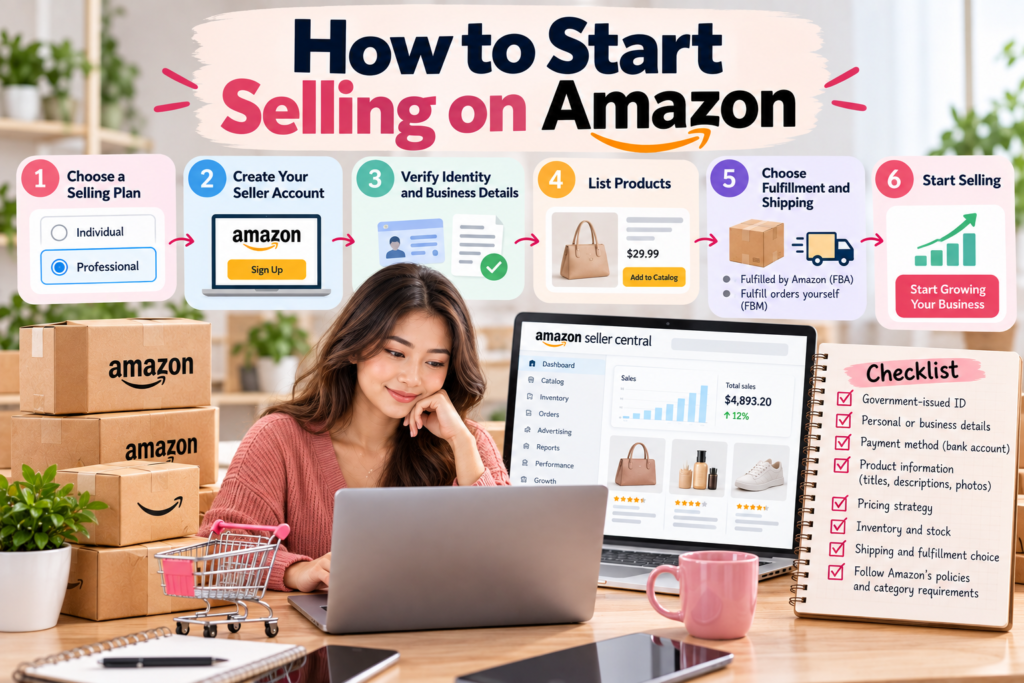
How to Start Selling on Amazon
How to Start Selling on Amazon (Without Getting Lost in the Process)
Amazon sells almost everything, to almost everyone, almost everywhere — which is exactly why so many first-time entrepreneurs land on the same idea: why not sell through Amazon instead of trying to build traffic from scratch? It’s not a bad instinct. But between seller accounts, fulfillment options, product research, and a dashboard that can feel like a cockpit, figuring out how to start selling on Amazon can feel more intimidating than it needs to be.
This guide breaks the whole process down step by step — what you actually need before you begin, how to choose a product worth selling, and the early mistakes that trip up most new sellers before they ever make their first sale.
Why Sell on Amazon in the First Place?
Before getting into how to start selling on Amazon, it’s worth understanding what you’re actually buying into. Amazon already has the traffic — hundreds of millions of shoppers who start their product search directly on the platform instead of Google. Instead of building an audience from zero, you’re tapping into one that already exists and already intends to buy.
The trade-off is competition and fees. You’re not the only seller with that instinct, and Amazon takes a cut of every sale along the way. Going in with realistic expectations from day one makes the whole process far less discouraging.
Step 1: Choose Your Selling Model
There isn’t just one way to sell on Amazon — the model you pick shapes everything else that follows.
- Retail arbitrage — buying discounted products elsewhere and reselling them on Amazon
- Wholesale — buying products in bulk directly from brands or distributors to resell
- Private label — creating your own branded product, often manufactured by a third party
- Dropshipping on Amazon — listing products without holding inventory yourself (more restricted by Amazon’s policies than other models)
- Handmade — selling products you make yourself, through Amazon Handmade
Most beginners learning how to start selling on Amazon gravitate toward private label or wholesale, since both offer more control and better margins than arbitrage, without the operational complexity of true dropshipping under Amazon’s stricter rules.
Step 2: Set Up Your Seller Account
Amazon offers two account types: Individual (no monthly fee, but a per-item charge) and Professional (a flat monthly fee, better suited once you’re selling consistently). If you’re just testing the waters, Individual is the lower-commitment starting point.
You’ll need:
- A valid ID and bank account for payouts
- A phone number and email for verification
- Basic business information, even if you’re selling as an individual
Head to Amazon Seller Central to begin the signup process directly.
Step 3: Research Your Product Before You Commit
This is the step that separates sellers who last from sellers who quietly give up after three months. Understanding how to start selling on Amazon successfully means understanding demand before you ever place an inventory order.
Look for products that:
- Have consistent, ongoing demand — not just a seasonal spike
- Aren’t dominated by a handful of massive, entrenched competitors
- Leave enough margin after Amazon’s fees, shipping, and product cost to actually be worth your time
Amazon’s own Product Opportunity Explorer can help surface demand and competition data directly within Seller Central. If you’re unsure whether your idea holds up, our guide on how to validate a product idea before selling onlinewalks through a broader validation process that applies here too.
Step 4: Understand Fulfillment — FBA vs. FBM
One of the bigger fulfillment decisions you’ll make early on is choosing between:
Fulfillment by Amazon (FBA) — you ship your inventory to Amazon’s warehouses, and they handle storage, packing, shipping, and customer service. This costs more per unit but saves you enormous operational effort, and often qualifies your listings for Prime shipping, which many buyers filter for specifically.
Fulfillment by Merchant (FBM) — you store and ship the products yourself. This gives you more control and can be cheaper at low volume, but it also means you’re personally responsible for shipping speed and customer service.
Many new sellers start with FBA specifically because it removes the logistics learning curve while they’re still figuring out the product and marketing side.
Step 5: Create a Listing That Actually Converts
A good product buried in a bad listing won’t sell. Once you’re ready to list, focus on:
- A clear, keyword-relevant title that describes exactly what the product is
- High-quality photos from multiple angles, including the product in use
- Bullet points that address real questions and objections, not just features
- Competitive but sustainable pricing based on your margin, not just what competitors charge
Step 6: Get Your First Reviews
Reviews are one of the biggest trust signals on Amazon, and new listings without any can struggle to gain traction even with a genuinely good product. Amazon’s “Request a Review” button (built into Seller Central) is the compliant way to prompt buyers for honest feedback — steer clear of incentivized or fake reviews, which can get your account suspended entirely.
Step 7: Monitor, Adjust, and Reinvest
Once live, learning how to start selling on Amazon shifts into learning how to keep selling on Amazon. Track your sales, profit margin after fees, and customer feedback regularly. Reinvest early profit into restocking your best-performing product before spreading into new ones — a common beginner mistake is diversifying too early, before the first product has actually proven itself.
Common Mistakes New Amazon Sellers Make
Skipping product research. Picking a product because it seems interesting, rather than because the data supports demand and reasonable competition.
Underestimating fees. Amazon’s referral fees, FBA fees, and storage costs add up — calculate your real margin before committing inventory budget.
Weak listings. Poor photos or vague descriptions lose sales even when the product itself is solid.
Ignoring Amazon’s policies. Incentivized reviews, certain dropshipping practices, and other policy violations can get an account suspended fast — it’s worth reading Amazon’s seller policies directly before you start.
Frequently Asked Questions
How much money do I need to start selling on Amazon? This varies by model — arbitrage can start with a small budget, while private label typically requires more upfront capital for inventory and branding. Many beginners start with a few hundred to a couple thousand dollars, depending on the product.
Is FBA worth it for a beginner learning how to start selling on Amazon? For many beginners, yes — it removes the logistics burden and often improves visibility through Prime eligibility, though it does reduce your margin per unit compared to handling fulfillment yourself.
How long does it take to make your first sale on Amazon? This depends heavily on your product, listing quality, and competition, but many new sellers see their first sales within the first few weeks of going live, especially with a properly optimized listing.
Do I need a business license to sell on Amazon? Not always — many people start as individual sellers without a formal business registration, though requirements can vary by country and tax situation, so it’s worth checking local regulations as you scale.
2 thoughts on “How to Start Selling on Amazon”
Comments are closed.
[…] sold through their platform, often bundled with faster shipping perks for buyers. Our guide on how to start selling on Amazon covers exactly how this option works in […]
[…] or branded backgrounds. If you’re planning to list on Amazon specifically, our guide on how to start selling on Amazon covers image requirements in more detail alongside the rest of the listing […]