New to online business? Start with our free 7-day roadmap and build your foundation step by step.
Get the Free Roadmap →Selling Platorms
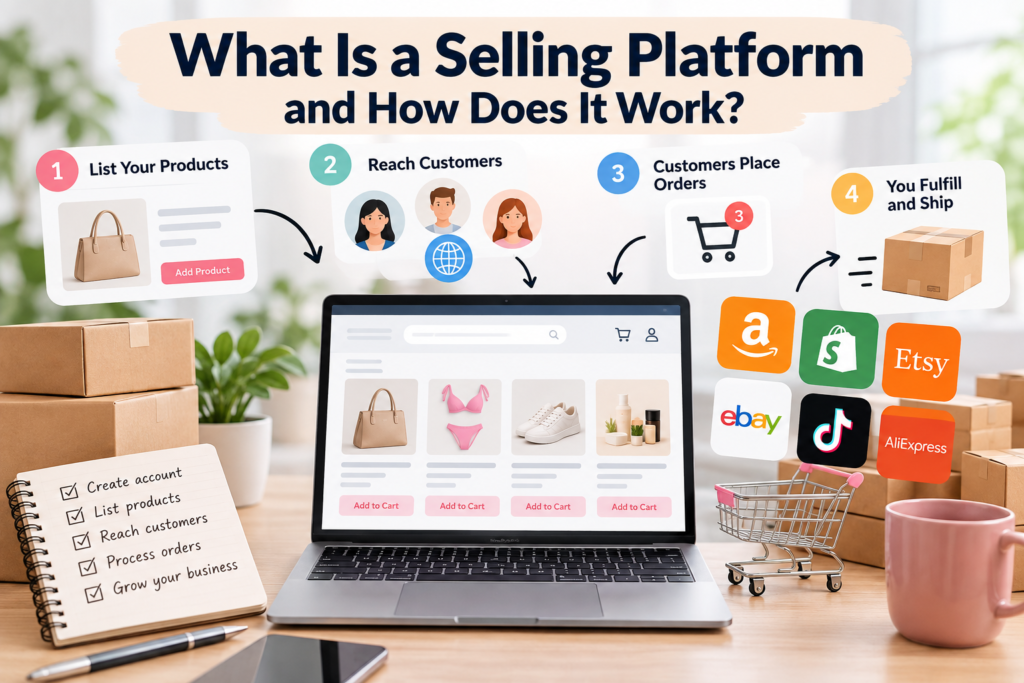
What Is a Selling Platform and How Does It Work?
What Is a Selling Platform and How Does It Work?
You’ve probably seen the phrase “selling platform” thrown around a dozen times while researching how to start an online business — usually with zero explanation of what it actually means. Is it just a fancy word for a website? Is Amazon one? Is Instagram one now too? Honestly, the term gets used so loosely that it’s no wonder it feels confusing.
So let’s actually clear it up. This guide breaks down what a selling platform really is, how it works under the hood, and — more usefully — how to figure out which type actually makes sense for what you’re trying to sell.
Okay, So What Is a Selling Platform?
At its core, a selling platform is any online system that lets you list something for sale and actually get paid for it. That’s intentionally broad, because it needs to cover a lot of ground — everything from a fully independent online store you built yourself, to a single listing tucked inside a massive marketplace like Amazon.
Behind the scenes, most of them handle some mix of:
- Product listings and storefronts
- Payment processing
- Order and inventory tracking
- Customer communication
- Sometimes, shipping and fulfillment too
Here’s the part that actually matters, though: how much of that is handled for you versus left for you to figure out depends entirely on which type you pick. And that’s where things start to diverge quite a bit.
The Main Types (Because They’re Not All the Same)
Not every option in this space works the same way, and lumping them together is where a lot of the confusion comes from. Broadly, you’re choosing between a few categories:
Marketplaces — think Amazon, eBay, and Etsy. You list your product alongside thousands of other sellers, but in exchange, you’re tapping into traffic that already exists. You don’t get to control the overall site design, but you also don’t have to build an audience from nothing.
Ecommerce platforms — tools like Shopify or WooCommerce, where you build and run your own independent store. Full control over branding and the customer experience, sure — but also full responsibility for actually getting people there.
Social commerce — selling directly through Instagram, TikTok, or Facebook Shops, right inside the app your audience is already scrolling through anyway.
Digital product platforms — services like Gumroad or Payhip, built specifically for ebooks, templates, and courses rather than anything you’d ship in a box.
So How Does the Whole Thing Actually Work?
Strip away the branding and the differences, and most of these systems run on a surprisingly similar process underneath:
- You create a listing — photos, description, price, the usual
- Someone finds it — either through built-in browsing (marketplaces) or traffic you drove there yourself (independent stores)
- Payment gets processed — securely, usually with a fee taken somewhere along the way
- The order gets fulfilled — by you, by a fulfillment service, or by a supplier if you’re dropshipping
- Everything after the sale gets handled — tracking, returns, reviews, the occasional customer complaint
The mechanics rhyme across almost every option out there. What actually changes is how much control you get, how much traffic shows up automatically, and how much responsibility lands on your shoulders instead.
Marketplace or Your Own Store? The Real Trade-Off
If there’s one thing worth understanding before choosing a selling platform, it’s this: you’re really choosing between traffic and control, and you rarely get both in equal measure.
A marketplace hands you shoppers who are already there, already browsing, already intending to buy something. The catch is you’re standing shoulder to shoulder with every other seller on that same page, with limited room to actually stand out. If that route interests you, our guide on how to start selling on Amazon walks through exactly what that looks like in practice.
An independent store flips the equation — full control over branding, pricing, the whole customer relationship — but nobody’s showing up unless you bring them yourself. There’s no built-in foot traffic waiting on day one.
Nobody’s Doing This for Free: How Fees Work
Most platforms make their money through some combination of:
- Listing fees — you pay to publish, whether it sells or not
- Transaction fees — a cut taken from every completed sale
- Subscription fees — a recurring cost just to keep the lights on
- Payment processing fees — a smaller slice specifically for handling the money part
It’s easy to get drawn in by something that looks cheap upfront, only to realize later how much those transaction fees quietly eat into your margin once real sales start rolling in. Worth doing the math before you commit, not after.
So Which One’s Actually Right for You?
Honestly, it depends on what you’re selling and where the people who’d buy it already hang out.
- Got a physical product people are already searching for? A marketplace gets you in front of buyers the fastest, no contest.
- Want to actually build something with your name on it long-term? An independent store gives you that room to grow a real brand.
- Selling something digital, like a course or a template? A digital product platform was basically built with exactly that in mind.
- Already got people following you on social media? Social commerce lets you sell right where they already are, no extra click required.
And here’s the thing nobody tells beginners enough: you don’t have to pick just one forever. Plenty of businesses run an independent store and keep a presence on Amazon or Etsy, just to capture whatever traffic the marketplace brings in on top.
Frequently Asked Questions
Is a selling platform the same as an online store? Not quite. An online store is just one flavor of it — a storefront you fully control. Marketplaces and social commerce fall under the same general umbrella, but they work pretty differently in practice.
Which one’s best if I’m just starting out? Depends on your product and your budget, honestly. Marketplaces tend to be gentler for beginners since the traffic’s already there. Independent stores give you more control, but you’re on the hook for finding your own visitors.
Do I have to commit to just one? Nope. Plenty of sellers run more than one at once — an independent store for brand control, plus a marketplace listing for extra reach.
How much does this actually cost? It varies a lot. Some charge nothing upfront and just take a cut per sale; others charge a monthly fee on top of transaction costs. Worth comparing the total cost against how much you actually expect to sell before locking anything in.