New to online business? Start with our free 7-day roadmap and build your foundation step by step.
Get the Free Roadmap →Marketing
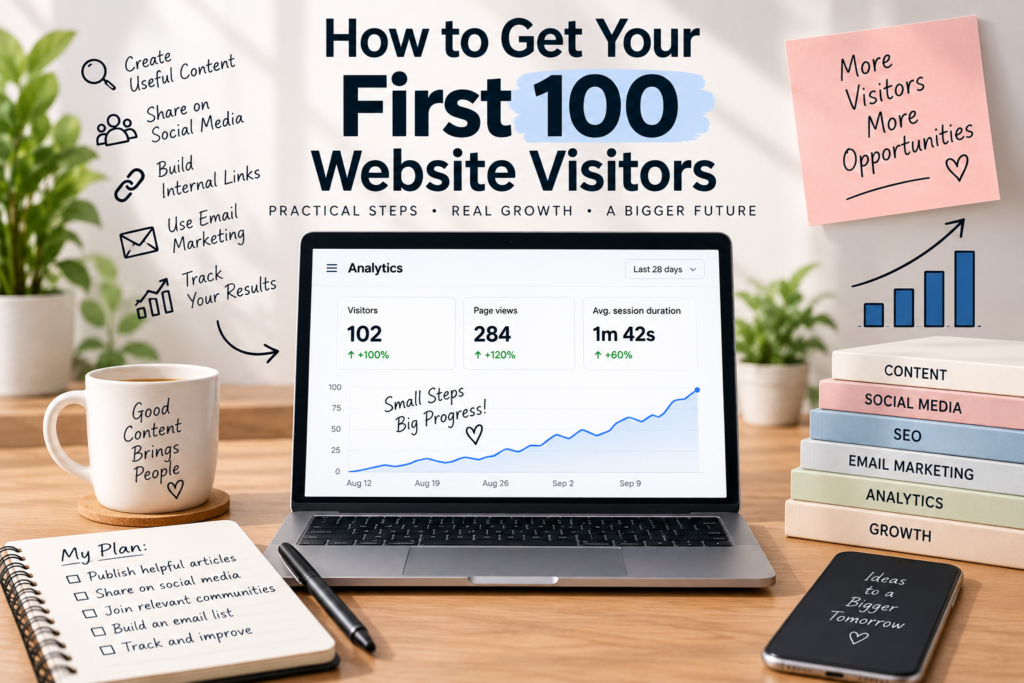
How to Get Your First 100 Website Visitors
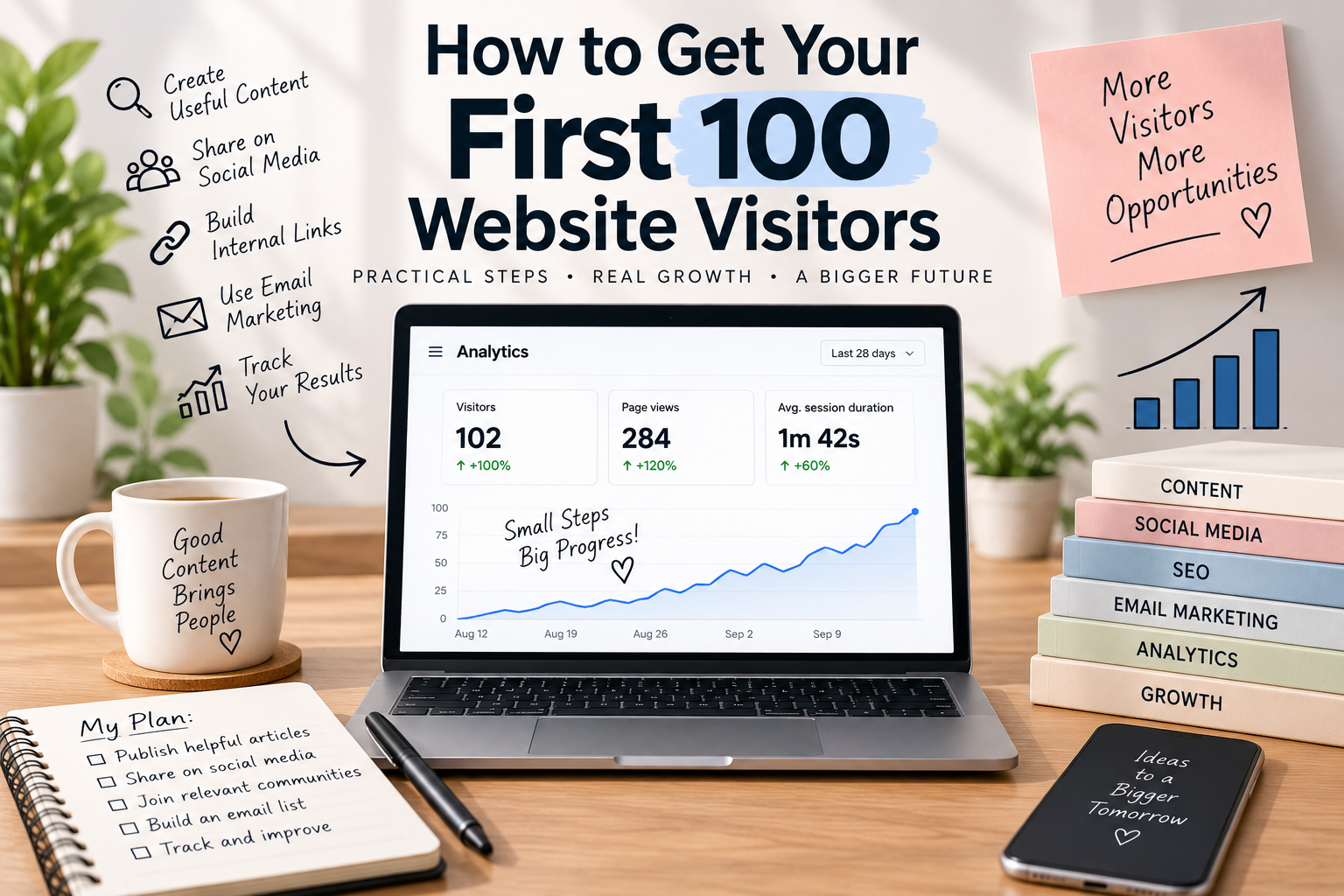
How to Get Your First 100 Website Visitors
Getting your first 100 website visitors can feel like the hardest milestone in the entire life of a new site — before that, it’s genuinely easy to wonder if anyone will ever actually see what you’ve built. This guide covers realistic, beginner-friendly ways to get your first 100 website visitors without needing a big budget or an existing audience to lean on.
Why This Milestone Matters More Than It Seems
A hundred visitors doesn’t sound like much in the grand scheme of a growing website, but it’s disproportionately important for one specific reason: it’s your first real signal. Before this point, everything about your site is theoretical — you’re guessing whether people will find it interesting, whether your messaging resonates, whether the whole idea works at all. Once you have even a small trickle of real visitors, you start getting actual data instead of assumptions, which is what makes everything after this stage considerably easier to navigate.
Start With People Who Already Know You
The fastest way to get your first 100 website visitors is almost always your existing network — friends, family, past colleagues, and any social media following you already have, however modest. Sharing your new site directly, rather than waiting for people to organically stumble onto it, gets you moving immediately instead of sitting in silence hoping for traffic to appear on its own.
Don’t just post a link once and move on, either. A brief explanation of what the site actually offers, and specifically why it might be useful to that particular person, tends to generate meaningfully more clicks than a bare link dropped with no context.
Share in Relevant Online Communities
Forums, Facebook groups, and subreddits related to your niche are often full of people who’d genuinely be interested in what you’ve built, if you can reach them in a way that doesn’t feel like spam. Sharing your site there — when it’s genuinely relevant to the community’s actual interests, not just conveniently self-promotional — is a realistic way to get your first 100 website visitors relatively quickly.
The key distinction that separates welcome shares from unwelcome ones is context: showing up purely to drop a link reads as spam and often gets removed or ignored, while genuinely participating in the community first, then sharing your site when it naturally fits a conversation, tends to be received far better.
Publish Your First Few Pieces of Content
Even a couple of well-written, specific blog posts can start attracting search traffic, though this particular channel builds more slowly than direct sharing. While SEO traffic takes time to develop, publishing early gives search engines time to crawl and start indexing your content, which contributes to your first 100 website visitors gradually over the following weeks and months, even without any additional active promotion.
Use Social Media to Drive Initial Traffic
Posting about your new site or content on platforms where you already have some presence — even a small one — can help get your first 100 website visitors faster than waiting purely on organic search, which typically takes considerably longer to build any real momentum for a brand-new site with no existing authority.
If you don’t yet have any social media presence to speak of, this is worth building in parallel with your site itself, rather than treating it as a separate project to tackle only after the website is fully finished.
Engage Directly, One Person at a Time
At this early stage, direct outreach — messaging specific people who might genuinely benefit from your site — can be surprisingly effective, even though it clearly doesn’t scale well as a long-term strategy. For your first 100 website visitors specifically, it doesn’t need to scale; it just needs to work for this one initial push to get real data flowing.
Consider a Small Paid Boost
A very small ad budget — even $5-10 total — on a platform like Meta or Google can help get your first 100 website visitors if organic efforts are moving more slowly than you’d like, giving you early data on what messaging and targeting actually resonates with real people, rather than continuing to guess.
Answer Questions on Q&A Platforms
Sites like Quora and Reddit are full of people actively asking questions your content might genuinely answer. Providing a genuinely helpful, detailed answer — with a natural link back to relevant content on your site when it actually adds value — can bring in visitors who are already primed with real interest in the topic, rather than cold traffic with no context for why they’re there.
Reach Out to Others in Your Niche
Emailing or messaging other site owners, bloggers, or creators in a related (but non-competing) space can occasionally result in a mention, a link, or a shoutout — particularly if you can offer something of genuine value in return, like sharing their content with your own small audience or collaborating on something together. This tends to work considerably better as a two-way exchange than as a one-sided request for a favor.
Submit to Relevant Directories or Communities
Depending on your niche, there may be curated directories, newsletters, or community roundups that accept submissions from new sites. These won’t drive enormous volumes of traffic on their own, but they can meaningfully contribute a handful of visitors while you’re specifically trying to reach that first 100, and they sometimes come with a small SEO benefit too through the resulting backlink.
Track Where Your Visitors Actually Come From
Use a free tool like Google Analytics to see which channel — social, search, direct outreach, community shares — is actually driving your first 100 website visitors. This tells you where to focus once you’re working to reach your next, considerably larger milestone, rather than continuing to spread effort evenly across channels that clearly aren’t producing results for your specific site and audience.
Creating a Simple Weekly Push Plan
Rather than treating this goal as a vague, ongoing background task, it helps to structure a specific, time-bound push toward it. A realistic first-week plan might include: sharing directly with your personal network on day one, identifying and genuinely engaging with two or three relevant online communities across days two and three, publishing one solid piece of content by day four or five, and reviewing early analytics data by the end of the week to see what’s actually producing results so far. Having concrete, specific actions tied to specific days tends to produce far more momentum than a loose, open-ended intention to “get more traffic eventually” without a clear plan attached to it.
The Role of Patience Versus Persistence
It’s worth distinguishing between two things that often get confused: patience with the process, and persistence in actually taking action. Patience means understanding that a hundred visitors won’t necessarily appear within the first 48 hours, and that’s genuinely fine and expected. Persistence means continuing to actively try different channels and approaches during that waiting period, rather than passively waiting for results to simply appear on their own. The sites that reach this milestone fastest tend to combine both — realistic expectations about timeline, paired with consistent, deliberate effort across the channels most likely to work for their specific situation.
What to Do Once You’ve Hit 100 Visitors
Reaching this first milestone is a genuine signal worth pausing to actually interpret, not just a number to celebrate and move past immediately. Look closely at which specific channel brought in the most visitors, and consider concentrating more deliberate effort there rather than spreading evenly across everything you tried initially. If a particular piece of content or a particular community source performed noticeably better than the rest, that’s a strong, genuinely useful signal about what to double down on next as you work toward larger traffic numbers.
Common Mistakes at This Early Stage
Waiting for organic discovery. Expecting people to simply find a brand-new site with no existing authority or backlinks tends to result in a long, disheartening silence rather than any meaningful traffic.
Spreading too thin too early. Trying five different traffic channels simultaneously with minimal effort in each often produces weaker overall results than focusing deeply on two or three that genuinely fit your specific situation and audience.
Ignoring the data once it starts coming in. Even a small amount of traffic contains genuinely useful signal about what’s actually working — not reviewing it at all wastes information you’ll wish you’d captured and learned from later.
Giving up too soon. A hundred visitors can take anywhere from a few days to a few weeks depending heavily on effort and channel — abandoning the effort after only a couple of days rarely gives any single approach a fair, realistic chance to actually work.
Building Momentum Beyond the First 100
Once you understand which channel or channels are working, the path from 100 to your next milestone tends to look like more of the same — just with better-informed targeting and considerably more confidence in what you’re doing, since you’re no longer operating purely on guesswork. If content and SEO were part of what worked initially, our guide on how to get more traffic to your website covers the next stage of that process in more depth. If direct outreach and community engagement drove your initial results, our guide on marketing for beginners: how to get your first customers builds directly on those same underlying tactics.
Setting Realistic Expectations for Timeline
There’s no single universal timeline for reaching your first 100 website visitors — it depends heavily on your existing network size, how much time you can dedicate to active promotion, and which channels genuinely fit your specific niche and audience. Some sites reach this milestone within days through aggressive direct outreach; others take several weeks relying more heavily on slower-building organic channels like search or community engagement. Neither timeline is inherently wrong — what matters more is that you’re actively working toward it rather than passively waiting and hoping for visitors to simply appear.
Frequently Asked Questions
How long does it take to get your first 100 website visitors? This varies significantly, but many new sites reach this milestone within the first few weeks to a couple of months with consistent, deliberate promotion effort across a few well-chosen channels.
Do I need paid ads to reach my first 100 website visitors? No. Many sites reach this milestone entirely through organic sharing, existing personal networks, and community engagement before ever using any paid advertising at all.
What matters more — visitor count or visitor quality? Especially early on, relevant visitors who might genuinely engage with your content or product matter considerably more than raw visitor count pulled in from completely unrelated or low-intent traffic sources.
Should I focus on one traffic channel or several at once? For your very first 100 visitors specifically, focusing deeply on two or three channels that genuinely fit your niche tends to produce better, faster results than spreading thin across many channels simultaneously with minimal effort in each — you can always expand to additional channels once you understand which ones are genuinely working for your specific audience and niche.