New to online business? Start with our free 7-day roadmap and build your foundation step by step.
Get the Free Roadmap →Marketing
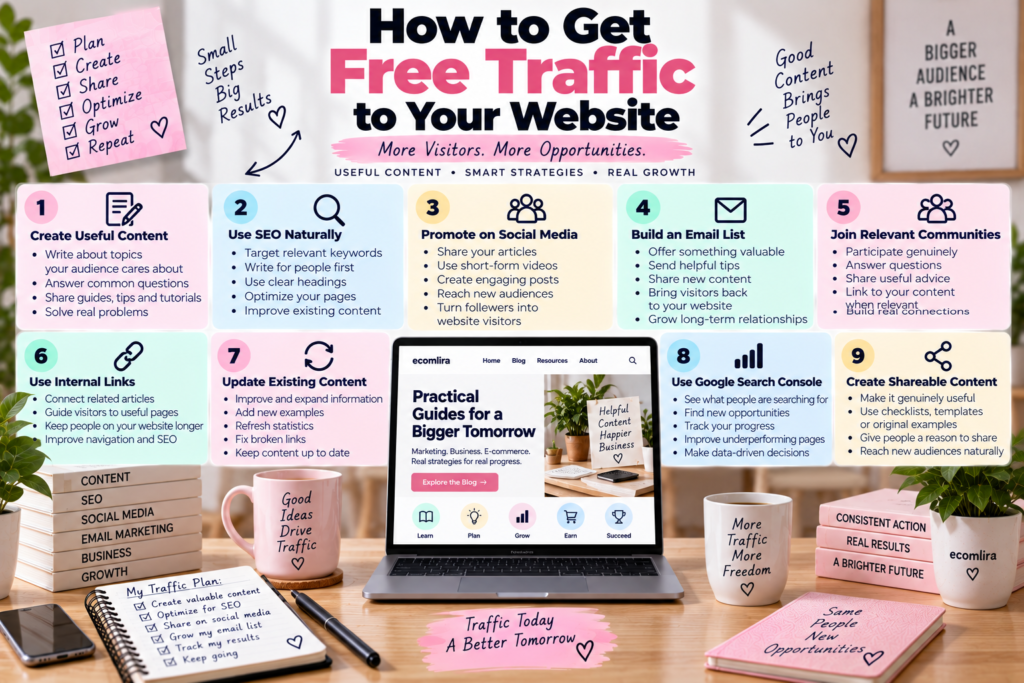
How to Get Free Traffic to Your Website
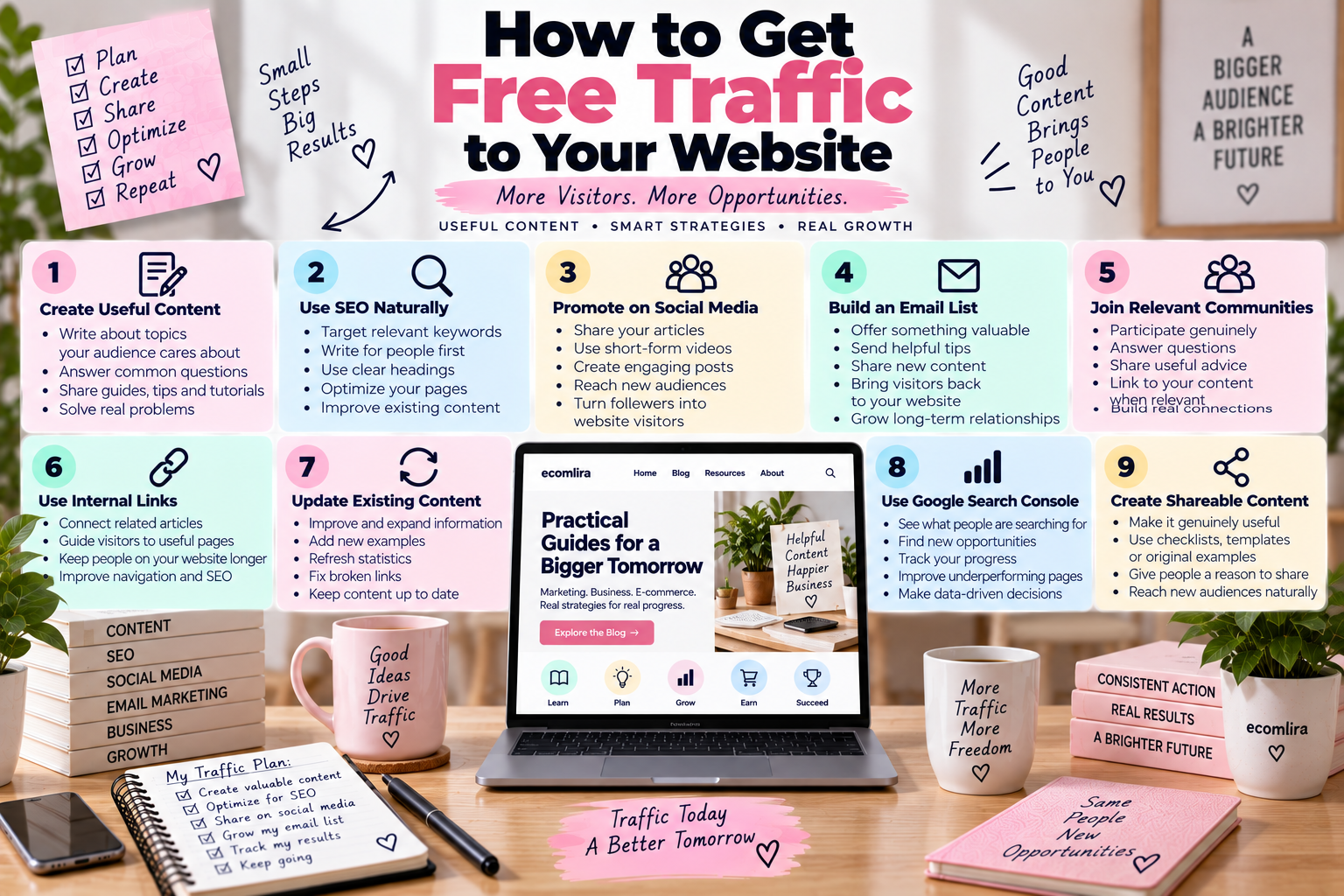
How to Get Free Traffic to Your Website
If you’re working with a limited budget, finding ways to get free traffic to your website is essential before you can even consider justifying spending on paid ads. This guide covers proven, no-cost strategies to get free traffic to your website using consistent time and effort instead of ad spend, along with a realistic sense of how long each approach actually takes to start producing results.
Why Free Traffic Deserves Serious Attention, Not Just a Backup Plan
It’s tempting to treat free traffic as a stopgap you’ll rely on only until you can afford paid ads. In reality, several free channels — particularly SEO and content — tend to produce more durable, compounding results than paid traffic ever does, since the content keeps working long after you’ve stopped actively promoting it. Building genuine skill in these channels early on tends to pay dividends well beyond the initial budget-constrained period that first pushed you toward them.
Search Engine Optimization (SEO)
SEO is one of the most effective ways to get free traffic to your website, since it targets people already actively searching for what you offer, rather than interrupting them with something they weren’t looking for. This involves researching relevant keywords, structuring content clearly around those terms, and building internal and external links over time. See our guide on what is SEO and how does it work for the underlying fundamentals if you’re newer to this specific channel.
SEO does come with a meaningful trade-off: it’s genuinely slow to start producing results, often taking several months before meaningful traffic materializes. But once it does start working, it tends to keep working with minimal ongoing effort compared to channels that require continuous active promotion.
Answer Questions on Forums and Communities
Platforms like Reddit, Quora, and niche-specific forums are full of people actively asking questions related to your niche, right now, in real time. Genuinely helpful, detailed answers — with a natural link back to relevant content on your site when it actually adds value to the conversation — can get free traffic to your website without any ad spend at all.
The key distinction between this working well and backfiring is genuineness: answers that read as helpful first and promotional second tend to be well-received, while answers that feel like a thin excuse to drop a link tend to get removed or downvoted, sometimes damaging your reputation within that specific community going forward.
Publish Consistently on Social Media
While social platforms don’t guarantee traffic the way search intent does, actively sharing useful content and engaging authentically with your audience is still one of the more accessible ways to get free traffic to your website, especially in the early stages before your SEO efforts have had time to build any real momentum.
Collaborate With Others in Your Niche
Partnering with non-competing businesses or creators in your niche — through guest posts, shoutouts, or joint content projects — can get free traffic to your website by tapping into an audience that’s already relevant and interested in your general topic area, without you needing to build that specific audience from scratch yourself.
Repurpose Content Across Multiple Platforms
A single well-researched blog post can become a social media post, a short video script, or an email newsletter with relatively modest additional effort. Repurposing content this way multiplies your chances to get free traffic to your website from a single piece of original research and writing work, rather than requiring entirely new content for every channel you want to use.
Optimize for Search Intent, Not Just Keywords
Getting free traffic to your website through SEO isn’t purely about including the right keywords in the right places — it’s fundamentally about genuinely answering what someone searching that specific term actually wants and needs to know. Content that satisfies real search intent tends to rank better and hold its position more durably over time than content that’s technically optimized but doesn’t actually deliver genuine value to the reader who clicked through.
Build an Email List From Day One
An email list is one of the more underrated free traffic sources, since it gives you a direct, repeatable channel to bring people back to your website whenever you publish something new — without depending on any algorithm’s mood on a given day. Free tools like Mailchimp make it straightforward to start collecting emails even before you have significant traffic to convert into subscribers, so you’ll have a growing owned audience to draw on as your content library expands over time.
Tracking Free Traffic Without Paid Analytics Tools
You don’t need an expensive analytics suite to understand what’s working. Google Analytics and Google Search Consoleare both free and, together, show you exactly which pages are attracting visitors, which search terms are driving that traffic, and where visitors are dropping off before converting into a subscriber or customer. Checking this data on a regular basis — weekly or monthly, depending on your traffic volume — helps you double down on what’s genuinely working rather than continuing to guess at which of your free traffic efforts are actually paying off.
Leverage Existing Platforms With Built-In Audiences
Beyond your own website, platforms like Medium, LinkedIn, or niche-specific publishing platforms sometimes let you publish content that reaches their existing audience, occasionally with the ability to link back to your own website. This won’t replace building your own domain authority over time, but it can supplement free traffic while your own site is still building initial momentum and search visibility.
Participate Genuinely in Niche Communities
Beyond simply answering direct questions, becoming a genuinely recognized, helpful presence within a specific online community — a Discord server, a specialized Facebook group, an active subreddit — tends to naturally generate curiosity about who you are and what you do, often leading people to check out your website organically without you needing to explicitly promote it in every single interaction.
Get Featured in Roundups or Directories
Many niches have regularly published roundup posts, curated newsletters, or directories that feature new or interesting resources. Reaching out to the people behind these — with a genuine, specific pitch for why your content or site fits what they cover — can occasionally result in free, targeted traffic along with a potential SEO benefit from the resulting backlink.
Be Consistent and Genuinely Patient
Free traffic strategies generally take meaningfully longer to show results than paid traffic does, but they tend to compound in a way paid traffic simply doesn’t. A blog post that gets free traffic to your website today can keep bringing visitors for years afterward, unlike a paid ad that stops delivering the moment you stop actively paying for it. This compounding nature is exactly why free channels are worth serious investment, not just treated as a temporary substitute until budget becomes available.
Combining Multiple Free Channels for Compounding Results
The strongest free traffic strategies rarely rely on just one channel in isolation — they combine several in a way that reinforces each other. Content published for SEO can be repurposed for social media and community sharing. Answers given in forums can link back to that same content. An email list built from early visitors can be used to promote future content, driving a second wave of traffic to pieces that might otherwise have faded after their initial publication. Thinking of these channels as an interconnected system, rather than separate isolated tactics, tends to produce meaningfully better cumulative results over time.
Common Mistakes When Pursuing Free Traffic
Expecting immediate results from SEO. This channel specifically takes months to build momentum — judging it after just a few weeks tends to lead to premature, unwarranted abandonment.
Being purely promotional in communities. Content or comments that only ever pitch your own site tend to be ignored or actively resented by genuine community members who can tell the difference.
Neglecting to track what’s working. Free doesn’t mean untracked — understanding which specific channels are actually producing results is just as important here as it would be with paid traffic.
Giving up after trying only one channel. Different niches respond differently to different free channels — what works well for one site may not work nearly as well for another, and it’s worth testing a few before concluding none of them are effective for your specific situation.
Being Realistic About What “Free” Actually Costs
It’s worth naming something often glossed over: free traffic isn’t free in the truest sense — it costs your time, and often a meaningful amount of it, especially in the earlier stages before any channel has built real momentum. Writing consistently useful content, genuinely engaging in communities, and building relationships with other creators all require sustained effort over weeks and months. This isn’t a reason to avoid free channels — it’s simply a reason to go in with accurate expectations rather than assuming “free” means “effortless,” which tends to lead to disappointment and premature abandonment when results don’t materialize instantly.
How to Prioritize When You Can Only Focus on One or Two
If your time is genuinely limited, prioritize based on where your specific audience already spends time and how quickly you realistically need results. If you need faster initial traction, community engagement and direct outreach tend to produce visible results sooner. If you’re building for the longer term and can be patient, investing heavily in SEO and content tends to produce the most durable, compounding results over a longer time horizon.
Frequently Asked Questions
How long does it take to get free traffic to a website? This varies significantly by strategy, but SEO and content-based free traffic typically take a few months to build genuinely noticeable momentum, while community engagement and direct sharing can produce faster, more immediate initial results.
Is free traffic better than paid traffic? Neither is inherently better in every situation — free traffic tends to be more sustainable and durable long-term, while paid traffic can produce faster, more immediate results when you need visibility quickly. Many established businesses ultimately use both together as complementary channels.
What’s the fastest way to get free traffic to a website? Engaging directly in relevant online communities and sharing genuinely useful content tends to produce faster initial results than SEO specifically, which usually takes considerably longer to build meaningful momentum from a brand-new site.
Can free traffic alone sustain a growing business? Yes, for many businesses, particularly once SEO and content channels have had sufficient time to build real momentum and search authority — though combining free channels with occasional paid promotion often accelerates overall growth beyond what free traffic alone would achieve on its own timeline, especially when trying to reach a new audience segment quickly.