New to online business? Start with our free 7-day roadmap and build your foundation step by step.
Get the Free Roadmap →Marketing
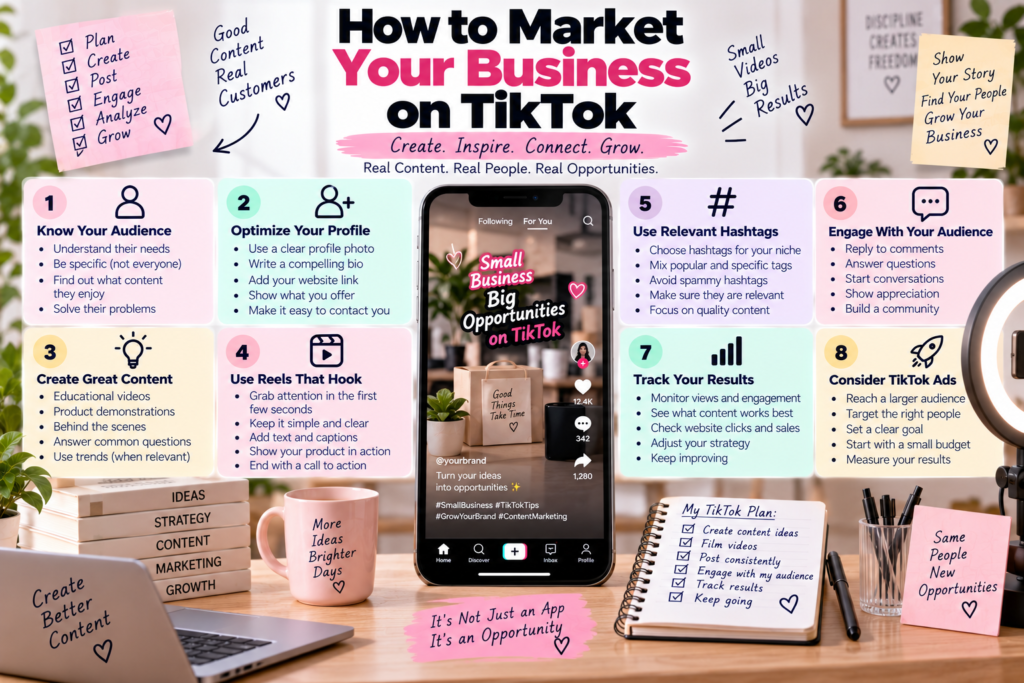
How to Market Your Business on TikTok
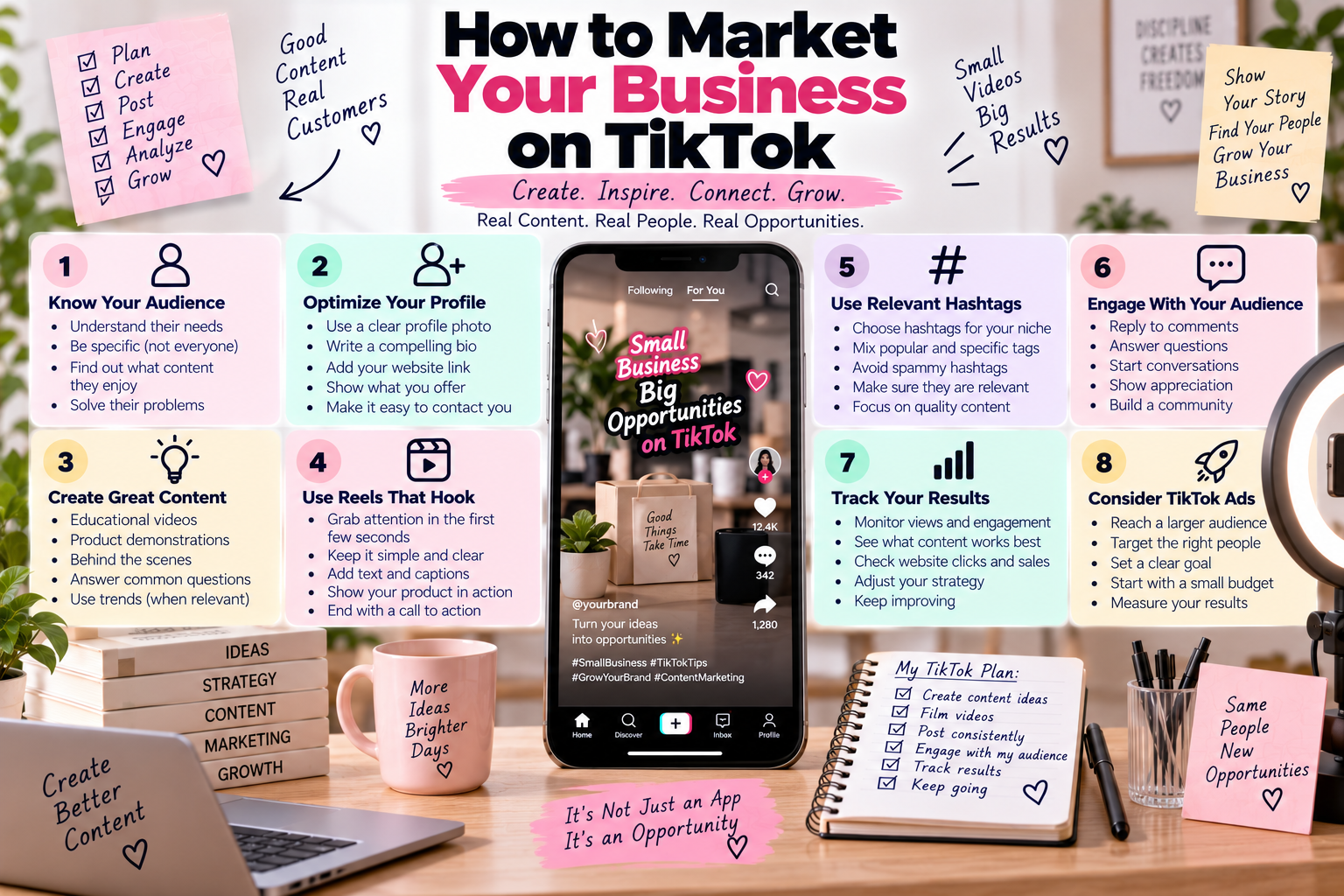
How to Market Your Business on TikTok
TikTok has become one of the fastest ways to build an audience from absolute zero, which makes it a genuinely appealing platform to market your business on — especially for beginners without any existing following elsewhere. This guide covers how to market your business on TikTok effectively, even as a complete newcomer with no prior video experience or existing audience to lean on.
Why TikTok Works Differently Than Other Platforms
Before diving into tactics, it’s worth understanding what makes TikTok genuinely different from platforms like Instagram or Facebook. Most social platforms rely heavily on your existing follower count to determine how far content spreads — a post from an account with ten followers typically reaches a tiny fraction of that from an account with ten thousand. TikTok’s algorithm operates far more independently of follower count, testing content with a small initial audience regardless of your account size, then expanding distribution based purely on how that content performs. This means a brand-new account can genuinely reach thousands of people if the content resonates, which is a major reason so many businesses choose to market their business on TikTok specifically in the early stages, when they have no existing audience elsewhere to draw from.
Understand How TikTok’s Algorithm Actually Works
TikTok’s algorithm evaluates a range of signals — watch time, completion rate, shares, comments, and rewatches — to decide whether a video deserves wider distribution beyond its initial test audience. Videos that keep viewers watching until the end, or that get rewatched, tend to get pushed further, regardless of who posted them or how established their account is. Understanding this mechanic changes how you should think about content: the goal isn’t just getting a view, it’s holding attention for the full duration of the video, which is a meaningfully different optimization target than platforms built primarily around follower relationships.
Focus on Entertainment and Value, Not Polish
TikTok audiences generally respond better to authentic, slightly rough content than to overly polished, ad-like videos that feel like traditional advertising. To market your business on TikTok successfully, prioritize genuinely useful or entertaining content over high production value — a video shot on a phone with good lighting and a clear hook often outperforms an expensively produced commercial that feels out of place in the native TikTok feed.
Use Trends Strategically, Not Blindly
Participating in trending sounds, formats, or challenges can meaningfully boost visibility when you market your business on TikTok — but only when the trend genuinely fits your brand and niche. Forcing an irrelevant trend onto unrelated content often reads as inauthentic to TikTok’s specifically trend-savvy audience, and can actually hurt rather than help your credibility with viewers who recognize the mismatch immediately.
Post Consistently and Frequently
Because TikTok rewards fresh content and ongoing experimentation, businesses that successfully market themselves on the platform tend to post frequently — often daily or every other day, particularly in the early growth phase when you’re still learning what specifically resonates with your audience. This frequency also gives the algorithm more data points to work with, helping it understand your content and audience more accurately over time.
Show the Human Side of Your Business
TikTok audiences tend to favor personality-driven content over anything that feels overly corporate or distant. Behind-the-scenes footage, the actual people behind the business, and honest, unpolished storytelling tend to perform noticeably better than polished advertisements when you market your business on TikTok. This is one of the platform’s most consistent patterns across virtually every niche — viewers connect with people, not faceless brand accounts.
Use TikTok Analytics to Refine Your Approach
TikTok’s built-in analytics (available once you switch to a Pro or Business account) show which videos are performing best, along with data on audience demographics, watch time, and traffic sources. Reviewing this regularly helps you market your business on TikTok more effectively over time, letting you double down on formats and topics that are genuinely resonating rather than continuing to guess at what might work.
Hook Viewers in the First Few Seconds
Because TikTok’s algorithm weighs watch time and completion rate so heavily, the opening seconds of any video are disproportionately important. A slow, meandering introduction loses viewers before they ever reach your actual message, regardless of how good the content becomes later in the video. Strong TikTok content typically front-loads the most interesting or surprising element, then delivers the rest of the value once attention is already secured.
Engage With Comments and Build Community
Responding to comments — especially with video replies, which TikTok specifically favors and often surfaces further — helps build a sense of genuine community around your account, beyond just passively broadcasting content outward. Viewers who feel like they can actually interact with a real person behind the account tend to become more loyal followers and, eventually, more likely customers.
Use TikTok’s Native Features Rather Than Cross-Posting
Content originally created for other platforms and simply reposted to TikTok — often complete with visible watermarks from Instagram or other apps — tends to underperform compared to content made specifically for TikTok’s format and native audience expectations. The platform’s algorithm has also been known to deprioritize content bearing another platform’s watermark, making it worth creating original content directly within TikTok when possible, rather than solely repurposing content from elsewhere.
Show the Product in Actual Use, Not Just Described
For businesses selling physical products, TikTok content that demonstrates the product genuinely being used — rather than simply describing its features in a static shot — tends to perform considerably better, since it fits the platform’s native, demonstration-heavy content style that audiences have come to expect and prefer.
Consider TikTok Ads Once Organic Content Is Working
Once you understand what resonates organically, TikTok Ads Manager lets you scale that specific content to a larger, more precisely targeted audience beyond organic reach alone. This is a natural next step once you’ve validated an approach for free first, rather than guessing blindly with ad spend before you understand what your specific audience actually responds to.
Connecting TikTok Back to Your Website or Store
TikTok content builds awareness and audience, but it’s worth having a clear, low-friction path for interested viewers to actually reach your website or store — a link in your bio, or product tags if you’re using TikTok Shop directly. If you’re still setting up the store this traffic will eventually funnel toward, our guide on how to start an online store covers that foundational setup in detail.
Building a Content Series Instead of One-Off Videos
Rather than treating each TikTok video as an isolated post, building a recurring series or format — a weekly Q&A, a recurring “behind the scenes” segment, a consistent problem-solving format — gives viewers a reason to specifically seek out your next video rather than encountering your content purely by algorithmic chance. Series-style content also makes planning considerably easier, since you’re not starting from a completely blank idea every single time you sit down to create something new.
Understanding TikTok’s Different Content Categories
Content on TikTok tends to fall into a few broad categories worth understanding: educational content that teaches viewers something specific and useful, entertainment content built around humor or surprise, and demonstration content that shows a product or process in action. Most successful business accounts rotate between these categories rather than relying exclusively on just one, since different viewers respond to different formats, and variety also helps prevent your own content from feeling repetitive to your growing, returning audience over time.
Collaborating With Creators in Your Niche
Beyond posting your own content, partnering with established creators already active in your niche — through sponsored content, product exchanges, or genuine collaborations — can introduce your business to an audience that’s already primed to be interested, since they’re already following someone whose content overlaps meaningfully with your own. This tends to be considerably more efficient early on than trying to build an entirely new audience completely from scratch through your own account alone.
How TikTok Compares to Instagram for Business Marketing
TikTok and Instagram serve genuinely different purposes, even though they’re often mentioned together. TikTok tends to favor discovery of completely new audiences through its algorithm-driven feed, while Instagram often performs better for nurturing an audience you’ve already built elsewhere, thanks to its more relationship-driven distribution model. Our guide on how to market your business on Instagram covers that platform’s distinct dynamics in more depth if you’re weighing where to focus your limited time and energy first.
Timing and Frequency Considerations
While daily posting tends to help newer accounts build algorithmic momentum faster, it’s worth balancing frequency against genuine content quality — a rushed, low-effort video posted purely to hit a daily quota often performs worse than a slightly less frequent but genuinely well-thought-out post. Many successful accounts settle into a sustainable rhythm somewhere between three and seven posts per week, adjusting based on what their specific capacity and content pipeline can realistically support without burning out or sacrificing quality for the sake of frequency alone.
Common Mistakes to Avoid
Treating TikTok like traditional advertising. Overly polished, sales-focused content tends to underperform compared to native, authentic-feeling posts that fit the platform’s established norms.
Giving up too early. Many accounts don’t find their footing for the first several weeks or even months of consistent posting — abandoning the platform after only a handful of videos rarely gives the algorithm enough data to properly understand and distribute your content.
Ignoring analytics. Posting purely on instinct, without ever reviewing what’s actually performing well, tends to plateau growth considerably faster than a more data-informed, iterative approach.
Forcing irrelevant trends. Jumping on every trending sound or format regardless of fit dilutes your brand identity and can come across as inauthentic to TikTok’s specifically trend-aware audience.
Frequently Asked Questions
Do I need to go viral to market my business on TikTok successfully? No. Steady, consistent growth from non-viral content is common and often more sustainable than relying entirely on a single viral moment that may never come, or may not repeat even if it does.
How often should I post to market my business on TikTok? Many successful accounts post daily or near-daily, especially when starting out, since frequency helps the algorithm learn what content resonates with your specific audience more quickly than sparse, infrequent posting would.
Is TikTok only useful for younger audiences? While TikTok’s core audience skews younger, its user base has broadened considerably in recent years, and many businesses across different niches and demographics now market successfully on the platform, well beyond its original younger-skewing user base.
What kind of content performs best when marketing a business on TikTok? Content that entertains, educates, or genuinely demonstrates something in an authentic way tends to outperform polished, ad-like content — the platform generally rewards native-feeling posts over anything that feels like traditional advertising transplanted from elsewhere, so testing a mix of formats early on tends to reveal what specifically resonates with your particular audience faster than committing to just one approach from the start.