New to online business? Start with our free 7-day roadmap and build your foundation step by step.
Get the Free Roadmap →Ecommerce
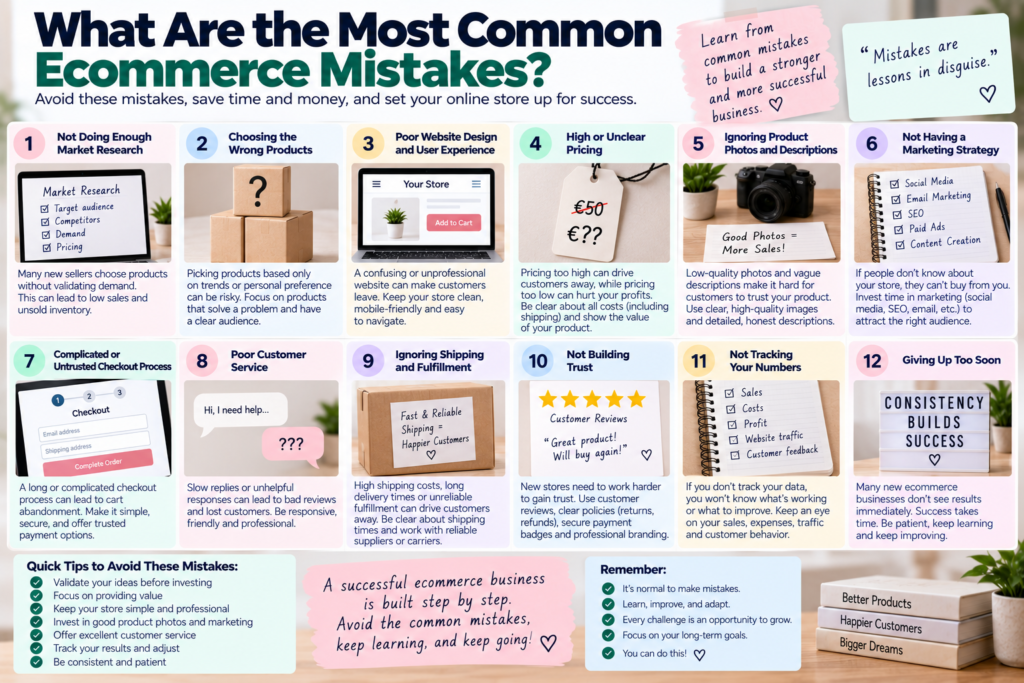
What Are the Most Common Ecommerce Mistakes?
What Are the Most Common Ecommerce Mistakes?
Every ecommerce business makes mistakes — that’s genuinely unavoidable. What separates stores that recover and grow from those that quietly fail is whether those mistakes get caught and corrected early, or whether they’re allowed to compound unnoticed for months. This guide covers the most common ecommerce mistakes beginners make, why they happen, and how to actually avoid or fix each one.
Mistake 1: Skipping Product Validation
One of the most common ecommerce mistakes is building an entire store around a product idea that was never actually confirmed to have real demand. Excitement about an idea is not the same as evidence that people will pay for it. Before investing significant time or inventory budget, checking search trends, competitor activity, and genuine community interest helps confirm a product is worth pursuing. Our guide on how to choose products to sell online covers this validation process in more depth.
Mistake 2: Underpricing Out of Fear
New sellers frequently underprice their products, worried that a higher price will scare away customers. In practice, this is one of the common ecommerce mistakes that quietly undermines a business’s sustainability — thin margins leave no room for marketing, returns, or platform fees, and a business that can’t afford to grow can’t actually grow. Our guide on how to price products for an online store walks through the proper calculation to avoid this trap.
Mistake 3: Weak or Inconsistent Product Photography
Blurry, poorly lit, or inconsistent product photos are among the most visible common ecommerce mistakes, since they directly undermine trust before a customer even reads a product description. Online shoppers can’t physically inspect a product, so photography carries disproportionate weight in the buying decision. Our guide on how to take product photos for an online store covers how to fix this without expensive equipment.
Mistake 4: Ignoring Mobile Experience
A large and growing share of online shopping happens on mobile devices, yet many new stores are built and tested primarily on desktop, with mobile treated as an afterthought. A clunky mobile checkout or hard-to-read product page quietly costs sales that the store owner may never even realize they lost, since there’s no obvious signal pointing to this specific cause.
Mistake 5: No Plan for Driving Traffic
A beautifully built store with no visibility strategy behind it doesn’t sell anything, regardless of how good the product or design actually is. This is one of the more common ecommerce mistakes among technically-minded founders who invest heavily in building the store itself but treat marketing as something to figure out later, after launch, rather than planning for it from the start.
Mistake 6: Overcomplicating the Checkout Process
Every additional step, required field, or forced account creation in checkout increases the chance a customer abandons their cart before completing a purchase. Simplifying checkout to the fewest necessary steps is one of the highest-leverage, lowest-effort fixes available to most new stores, yet it’s frequently overlooked in favor of more visible concerns like product selection or marketing.
Mistake 7: Neglecting Trust Signals
A store with no genuine About page, unclear return policy, or no visible way to contact a real human tends to trigger quiet hesitation in new visitors, regardless of how good the actual product is. This is a particularly common ecommerce mistake for brand-new stores with zero reviews yet, where trust signals matter even more than they will once the business is established. Our guide on how to get visitors to trust your website and buy covers this specific issue in depth.
Mistake 8: Poor Inventory Management
Overselling a product that’s actually out of stock, or tying up cash in inventory that isn’t moving, are both common ecommerce mistakes that stem from inadequate inventory tracking. Without a clear system — even a simple spreadsheet in the early stages — it’s easy to lose track of what’s actually available, leading to canceled orders and frustrated customers.
Mistake 9: Ignoring Customer Service Until It’s a Crisis
Treating customer service as an afterthought rather than a core part of the business tends to show up in reviews eventually, often at the exact moment a store is trying to build credibility. Fast, honest communication when something goes wrong — a late shipment, a damaged item — often matters more to long-term reputation than the fact that something went wrong in the first place.
Mistake 10: Trying to Do Everything at Launch
New store owners often try to launch with a large catalog, multiple marketing channels, and every feature imaginable simultaneously. This spreads limited time and resources too thin to execute any single element well. Focusing on a smaller, well-executed launch — one strong product, one primary marketing channel — tends to produce better early results than an ambitious, scattered approach.
Mistake 11: Ignoring Analytics From Day One
Many new stores don’t set up basic tracking until months after launch, missing valuable early data about what’s working and what isn’t. Free tools like Google Analytics and Google Search Console cost nothing to set up and provide genuinely useful insight from the very first visitor, making this one of the easier common ecommerce mistakes to simply avoid from the start.
Mistake 12: Copying Competitors Without Understanding Why
Looking at what competitors do is useful for research, but directly copying their pricing, messaging, or product selection without understanding the underlying reasoning behind those choices can lead to decisions that don’t actually fit your own specific situation, costs, or audience. What works for an established competitor with different resources and history may not translate directly to a brand-new store.
Mistake 13: Expecting Immediate, Dramatic Results
Many beginners expect significant sales within the first few days or weeks of launching. In reality, most ecommerce businesses take considerably longer than expected to gain real traction, particularly when relying on organic traffic sources like SEO or content, which take months to build momentum. Unrealistic expectations around timeline lead directly to premature discouragement and abandonment of genuinely viable strategies.
Mistake 14: Not Testing the Full Purchase Flow Personally
It’s surprisingly common for a new store owner to never actually complete a full test purchase themselves before launching — meaning broken links, confusing steps, or payment errors go unnoticed until a real customer encounters them and simply leaves instead of reporting the problem. Walking through your own checkout process personally, ideally on both desktop and mobile, catches issues before they cost you actual sales.
Mistake 15: Ignoring Return and Refund Policies Until a Dispute Arises
Launching without a clear, visible return policy creates ambiguity that becomes a genuine problem the first time a customer wants to return something. Thinking through this policy in advance — rather than improvising reactively during an actual dispute — produces a more consistent, professional experience and reduces the stress of handling the situation under pressure.
Mistake 16: Choosing the Wrong Fulfillment Model Too Early
Committing to a fulfillment approach — holding significant inventory yourself, for example — before genuinely understanding order volume and cash flow needs can create unnecessary strain early on. Many new stores would benefit from starting with a lower-commitment fulfillment model while validating demand, then shifting to a more operationally intensive approach once volume justifies it, rather than over-investing in infrastructure before it’s genuinely needed.
Mistake 17: Ignoring the Competitive Landscape Entirely
Launching a store without any awareness of who else serves a similar audience can lead to pricing, positioning, or messaging that doesn’t actually differentiate from already-established options. A reasonable amount of competitor research — not to copy, but to understand where genuine gaps exist — helps avoid launching directly into oversaturated territory with no clear reason for a customer to choose you specifically over an established alternative.
How to Catch Mistakes Before They Compound
Many of the mistakes above share a common thread: they’re far easier and cheaper to fix early than after they’ve been allowed to compound over months. Building in regular self-review — checking analytics monthly, testing your own checkout periodically, reading your own product pages as if you were a stranger — helps catch issues before they’ve quietly cost significant sales or damaged your reputation with customers who never bothered to complain, simply leaving instead.
Building a Habit of Regular Self-Audits
Rather than discovering these common ecommerce mistakes reactively, through lost sales or frustrated customers, it’s worth building a regular habit of reviewing your own store with fresh eyes — monthly or quarterly, depending on how quickly things change. Walking through the purchase flow yourself, reviewing recent analytics for anything unusual, and reading recent customer messages for recurring themes all help surface problems while they’re still small and inexpensive to fix, rather than after they’ve quietly accumulated into a larger, harder-to-diagnose issue.
Learning From Mistakes Without Losing Momentum
It’s worth noting that making mistakes isn’t itself a sign of failure — it’s a normal, expected part of building any new business. The businesses that struggle most tend to be the ones that either never identify their mistakes at all, or identify them but become so discouraged that they lose momentum entirely rather than simply correcting course and continuing forward. Treating mistakes as data rather than verdicts on the viability of the whole business tends to produce considerably more resilient, long-term entrepreneurs.
Frequently Asked Questions
What’s the single most damaging common ecommerce mistake? There’s no universal answer, but skipping product validation tends to be particularly costly, since it can mean months of effort invested in something that never had real demand behind it in the first place.
How can I avoid common ecommerce mistakes as a complete beginner? Learning from documented mistakes like the ones above, testing your own store thoroughly before launch, and setting up basic analytics from day one all help catch issues early, before they’ve had a chance to compound into larger problems.
Are these mistakes avoidable, or are they a normal part of starting a business? Both, in different ways. Many of these mistakes are genuinely avoidable with some upfront planning, but some degree of trial and error is a normal, expected part of running any business — what matters most is catching and correcting issues quickly rather than expecting perfection from the very start.
How long does it typically take to recover from a major ecommerce mistake? This varies considerably depending on the specific mistake and how quickly it’s identified and corrected, but most operational and marketing mistakes are recoverable with adjustment, unlike mistakes involving serious legal or financial missteps, which can be more consequential and harder to reverse.