New to online business? Start with our free 7-day roadmap and build your foundation step by step.
Get the Free Roadmap →Ecommerce
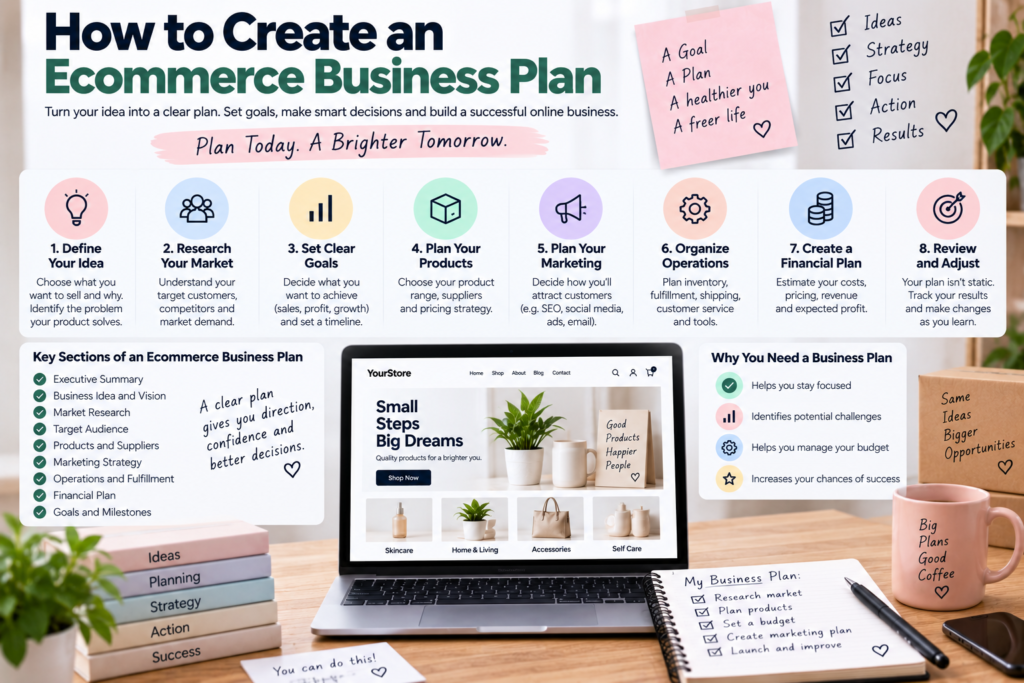
How to Create an Ecommerce Business Plan
How to Create an Ecommerce Business Plan
“Business plan” has a reputation problem. It sounds like something you’d only need if you were walking into a bank asking for a loan — a formal, intimidating document full of jargon nobody actually reads afterward. In reality, a good ecommerce business plan is something far more useful: a working reference that forces you to think through decisions before they become expensive mistakes, and keeps you oriented once the business is actually running.
This guide covers exactly how to create an ecommerce business plan that’s actually useful — not a document you write once and forget, but one you’ll genuinely refer back to.
Why Bother With a Business Plan at All?
It’s tempting to skip straight to building a store, especially when platforms make it so easy to just start. But an ecommerce business plan forces you to answer questions upfront that are far more expensive to figure out after you’ve already invested time and money — questions like who you’re actually selling to, how much things will really cost, and what success is supposed to look like.
Section 1: Executive Summary
Start with a brief overview of what your business actually is — what you’re selling, who it’s for, and what makes it worth pursuing. Even though this section appears first, it’s often easiest to write last, once you’ve worked through the rest of the plan and know exactly what you’re summarizing.
Section 2: Market and Audience Research
This is where your ecommerce business plan gets specific about who you’re actually selling to. Include:
- A clear description of your target customer — demographics, interests, pain points
- Evidence of demand — search trends, competitor activity, or existing community interest
- An honest assessment of your competition and what differentiates you from them
Tools like Google Trends can provide supporting data here, helping validate whether interest in your niche is genuinely there rather than assumed. If you’re still working out what to actually sell, our guide on how to find products to sell onlineis worth reading before finalizing this section.
Section 3: Products and Sourcing
Detail exactly what you’re selling and how you’ll get it:
- Product descriptions and, if relevant, initial catalog size
- Sourcing method — manufacturing, wholesale, dropshipping, or handmade
- Supplier relationships, if already established
- Quality control approach
Being specific here — rather than vague — makes the rest of your ecommerce business plan considerably more useful, since sourcing decisions directly affect almost every other number in the plan.
Section 4: Pricing and Financial Projections
This section turns your idea into real numbers:
- Cost per unit (product, shipping, fees — the full picture)
- Target pricing and expected margin
- Startup costs (platform fees, initial inventory, branding, marketing)
- Ongoing monthly costs
- Realistic revenue projections for the first 6-12 months
Keep these projections grounded rather than optimistic — a business plan built on best-case assumptions tends to create nasty surprises once real numbers start coming in. It helps to build three scenarios rather than one: a conservative estimate, a realistic middle estimate, and an optimistic one — this gives you a range to plan around rather than a single number that either feels falsely reassuring or turns out to be wildly off. If you haven’t worked through your specific pricing yet, our guide on how to price products for an online store walks through the actual math in more depth.
Section 5: Marketing and Customer Acquisition
Outline how you’ll actually get customers, since a great product with no visibility doesn’t sell itself:
- Primary marketing channels you’ll focus on (content, social media, paid ads, SEO)
- Your general customer acquisition strategy for the first few months
- Rough marketing budget, if applicable
This section doesn’t need to be exhaustive — a focused plan for one or two channels tends to be more realistic and useful than a vague list of everything you could theoretically try.
Section 6: Operations and Fulfillment
Describe how orders will actually be handled day to day:
- Fulfillment method — self-fulfillment, third-party logistics, marketplace-managed, or dropshipping
- Expected shipping timelines
- Customer service approach — how you’ll handle questions, returns, and issues
Thinking through operations at the planning stage, rather than improvising once orders start coming in, tends to prevent a lot of early stumbling.
Section 7: Goals and Milestones
Set specific, measurable goals for your first few months and first year — revenue targets, customer counts, or specific product launches. Vague goals like “grow the business” are hard to act on; specific ones like “reach 50 sales in the first two months” give you something concrete to measure progress against. Breaking a larger annual goal into smaller monthly checkpoints also makes it easier to notice early if you’re falling behind, giving you time to adjust course rather than discovering the shortfall only at year’s end.
Keeping Your Ecommerce Business Plan Realistic
A common trap when writing an ecommerce business plan is drifting into overly optimistic projections — assuming higher conversion rates, lower costs, or faster growth than is realistic for a brand-new, unproven business. It’s worth deliberately stress-testing your numbers: what happens if sales come in at half your projection? Does the business still survive that scenario, or does it collapse immediately? Planning for a more conservative outcome tends to produce a more resilient business than planning purely for the best case.
How a Business Plan Connects to Your Broader Launch
A business plan doesn’t exist separately from the rest of your setup — it should directly inform decisions like your platform choice, your fulfillment model, and your initial marketing spend. Once you’ve worked through the sections above, the practical next step is translating that plan into an actual store. Our guide on how to start an online store walks through that build-out process in detail, picking up right where the planning stage leaves off.
Should Your Business Plan Be Formal or Simple?
Unless you’re specifically seeking outside funding or a loan, your ecommerce business plan doesn’t need to follow a rigid, formal template. A simple document — even a few clear pages covering the sections above — is often more useful than an elaborate one, precisely because you’re more likely to actually refer back to it and update it as things change. The value comes from the thinking process, not the polish of the final document.
Revisiting and Updating Your Plan
An ecommerce business plan isn’t something you write once and file away. Revisit it every few months, especially early on — update your numbers based on actual results, adjust your marketing approach based on what’s genuinely working, and refine your goals as you learn more about your specific market. Treating it as a living document rather than a one-time exercise is what makes it genuinely useful rather than just an academic activity.
Common Mistakes When Writing a Business Plan
Being too vague. Generic statements like “target a wide audience” or “grow steadily” don’t give you anything concrete to act on or measure against.
Skipping the financial section. It’s tempting to focus on the exciting parts (product, branding) and rush through the numbers — but the financial section is often where the real viability questions get answered.
Writing it once and never returning to it. A business plan that just sits in a drawer provides far less value than one you actively revisit and adjust as the business evolves.
Overplanning before launching. At some point, the plan needs to translate into action. Spending months perfecting a document without ever actually testing the business in the real market defeats the purpose.
Frequently Asked Questions
Do I need a formal business plan to start an ecommerce business? Not necessarily, unless you’re seeking outside funding. A simpler, working plan covering the core sections is often more practical and more likely to actually get used.
How long should an ecommerce business plan be? There’s no fixed length — what matters is covering the key sections (audience, products, financials, marketing, operations) with enough specificity to be genuinely useful, whether that takes 2 pages or 20.
Should I write a business plan before or after building my store? Generally before, or at least alongside early setup — working through pricing, audience, and financial projections upfront helps avoid costly mistakes that are harder to correct after the store is already live.
How often should I update my ecommerce business plan? Revisiting it every few months, especially in the first year, helps keep it aligned with actual results and market conditions rather than the assumptions you started with.
What’s the biggest difference between a hobby and a real ecommerce business plan? A hobby approach tends to skip the financial projections and operational details entirely, focusing only on the product. A genuine plan forces you to confront real costs, realistic timelines, and a concrete path to profitability before you’ve invested significant time or money.
Finding these issues on paper is much easier than discovering them after spending thousands on inventory.
A plan can also give you a clearer direction when deciding what to work on next.
1. Write a Simple Business Summary
Start with a short description of your business.
Explain:
- What your business will sell
- Who it will serve
- Where you’ll sell
- What makes the business different
- What you want to achieve
For example:
“We sell affordable organization products for people living in small apartments through our online store and selected marketplaces.”
That’s enough to give you a starting point.
You can expand the summary later.
2. Decide What You Will Sell
Your plan should clearly explain your products or services.
List the products you intend to offer and describe why customers might want them.
Consider:
- Product features
- Customer benefits
- Product quality
- Price range
- Product variations
- Packaging
- Availability
- Potential competitors
If you haven’t chosen your products yet, read How to Find Products to Sell Online.
Don’t assume that a product will sell simply because you personally like it.
Research the market and look for evidence that potential customers are interested.
3. Define Your Target Customer
A good ecommerce business plan should explain who you’re trying to reach.
Your target customer could be defined by things such as:
- Age
- Location
- Interests
- Lifestyle
- Needs
- Budget
- Shopping habits
You don’t need to create an imaginary customer with dozens of personal details.
Instead, focus on characteristics that actually affect what you sell and how you market it.
For example:
Target customer: People who work from home and want affordable products to make their workspace more organized.
That description can influence your product selection, website messaging, content, and advertising.
4. Identify the Problem You’re Solving
Ask yourself why someone should buy from you.
What problem are you helping them solve?
Perhaps you’re offering:
- A more convenient product
- A more affordable option
- A better-designed product
- A specialized product for a particular audience
- A bundle that makes purchasing easier
- A product that’s difficult to find locally
Your answer doesn’t need to be revolutionary.
Sometimes a business succeeds by making an existing solution more convenient or appealing to a specific group.
5. Research Your Market
Market research helps you understand the environment you’re entering.
Look at:
- Competitors
- Customer reviews
- Prices
- Search behavior
- Product demand
- Industry trends
- Common complaints
- Customer expectations
You can use Google Trends to compare relative search interest over time. Google Trends can be useful for identifying patterns and seasonality.
Remember that search interest doesn’t guarantee sales.
A popular topic can also have strong competition.
Your goal is to understand the market rather than find a number that guarantees success.
6. Analyze Your Competitors
List some businesses that sell similar products.
Then compare:
| Area | Questions to Ask |
|---|---|
| Products | What do they sell? |
| Prices | How much do they charge? |
| Branding | How do they position themselves? |
| Website | Is it easy to navigate? |
| Reviews | What do customers like or dislike? |
| Shipping | What options do they offer? |
| Marketing | Where do they attract customers? |
Don’t copy your competitors.
Use their businesses to understand the market and identify opportunities to differentiate yourself.
For example, customers may repeatedly complain that competitors have poor product information.
You could make detailed product education part of your own customer experience.
7. Choose Your Business Model
Your plan should explain how your business will operate.
You might use:
- Traditional inventory
- Dropshipping
- Print-on-demand
- Digital products
- Wholesale
- Handmade production
- Subscriptions
Your choice affects your startup costs, fulfillment process, inventory, pricing, and daily operations.
For example, a traditional inventory model may require you to purchase products before selling them.
A dropshipping model can reduce the need to hold inventory yourself but means you’ll depend more heavily on suppliers.
Choose a model that fits your actual resources rather than simply choosing the one that sounds easiest.
8. Choose Where You Will Sell
Your online selling platform is another important part of the plan.
You could sell through:
- Your own website
- Shopify
- WooCommerce
- Amazon
- Etsy
- eBay
- Social commerce channels
- Multiple platforms
Think about where your target customers already shop.
You don’t necessarily need to sell everywhere.
Starting with one main channel can make your operations easier to manage.
Later, you can expand if another platform makes sense for your business.
9. Plan Your Pricing
Your pricing strategy should be based on more than your product cost.
Consider:
Product cost + shipping + packaging + payment fees + platform fees + marketing + returns + other expenses
Then compare your expected selling price with competitors and customer expectations.
Don’t automatically choose the cheapest price.
A lower price can attract customers, but it also reduces the amount of money available to cover expenses.
Your pricing should support the overall business.
For more detail, we’ll cover this in a future article: How to Price Products for an Online Store.
10. Estimate Your Startup Costs
Write down everything you’ll potentially need to pay for before launching.
Your ecommerce startup costs might include:
- Domain
- Website or ecommerce platform
- Initial inventory
- Product samples
- Packaging
- Photography
- Software
- Business registration
- Marketing
- Shipping supplies
Separate one-time expenses from recurring expenses.
For example, a domain may be an annual expense, while an ecommerce platform may charge a recurring subscription.
Our guide on How Much Does It Cost to Start an Online Store? explains these expenses in more detail.
11. Estimate Your Ongoing Expenses
Your business will continue to have costs after launch.
These could include:
- Inventory
- Shipping
- Packaging
- Platform subscriptions
- Software
- Advertising
- Payment processing
- Returns
- Customer service
Try to estimate your monthly expenses before deciding how much money you need.
You don’t need perfect numbers.
Reasonable estimates are enough to help you understand what you’re getting into.
12. Create a Sales Forecast
A sales forecast is an estimate of how many products you might sell and how much revenue that could generate.
Don’t treat your forecast as a guarantee.
Instead, create different scenarios.
Conservative scenario
What happens if sales are lower than expected?
Expected scenario
What might happen if your store performs reasonably well?
Optimistic scenario
What happens if demand is stronger than expected?
This approach is more useful than assuming your store will immediately become successful.
For example, you could estimate:
100 visitors → 2 purchases → €40 average order = €80 revenue
The actual numbers could be higher or lower.
The purpose is to understand how traffic, conversion, and order value interact.
13. Plan How You’ll Get Customers
A strong ecommerce marketing plan should explain how people will discover your business.
Potential channels include:
SEO
Create useful pages and articles that answer questions your customers search for.
Social media
Publish useful and relevant content on platforms where your audience spends time.
Email marketing
Build relationships with people who have chosen to hear from your business.
Paid advertising
Use advertising when you have the budget and can track whether it is producing worthwhile results.
Marketplaces
Selling through established marketplaces can put your products in front of people who are already shopping.
You don’t need to use every channel.
Choose the ones that make sense for your audience and resources.
14. Plan Your Content
Content can support your store even when you’re not directly selling something.
For example, you could publish:
- Buying guides
- Tutorials
- Product comparisons
- How-to articles
- Product demonstrations
- Frequently asked questions
- Educational videos
This can help potential customers discover your business and learn about the problems your products solve.
Google’s SEO Starter Guide provides additional guidance on creating content and making websites easier for search engines to understand.
15. Plan Your Order Fulfillment
Your plan should explain what happens after someone places an order.
Ask:
- Where will products be stored?
- Who will package them?
- Which carrier will you use?
- How long will delivery take?
- How will customers track orders?
- What happens if an item arrives damaged?
- How will returns work?
If you’re using dropshipping, identify how your supplier handles these processes.
Don’t wait until your first sale to figure out fulfillment.
16. Plan Your Customer Service
Customers may contact you before and after purchasing.
Decide:
- How customers can contact you
- How quickly you’ll respond
- How you’ll handle complaints
- How you’ll process returns
- How you’ll deal with damaged products
- What information customers need after ordering
Good customer service doesn’t require a huge team.
Even a small business can create clear processes for handling common questions.
17. Decide What Makes Your Business Different
Your unique selling proposition explains why someone might choose your business instead of another.
Your difference could be:
- Specialized products
- A specific target audience
- Better product education
- Convenient bundles
- Unique designs
- Personalized service
- A particular brand identity
- A better customer experience
You don’t need to claim that your business is better at everything.
Find one or two meaningful reasons for customers to choose you.
18. Set Your Goals
Your business plan should contain clear goals.
Instead of saying:
“I want my store to become successful.”
Use specific goals such as:
- Launch the store by a particular date.
- Publish 20 useful articles.
- Get the first 10 customers.
- Build an email list.
- Test three product ideas.
- Reach a specific monthly revenue target.
Your goals can change as you learn.
That’s normal.
19. Track Your Important Numbers
Once your store launches, compare your results with your original assumptions.
Track metrics such as:
- Website visitors
- Product views
- Orders
- Conversion rate
- Average order value
- Revenue
- Expenses
- Returns
- Repeat purchases
You can then update your ecommerce business plan based on actual results.
For example, perhaps you expected one product to be your bestseller but another product receives much more attention.
That information can influence your future inventory and marketing decisions.
20. Keep Your Business Plan Simple
A business plan shouldn’t become a document you write once and never look at again.
Keep it practical.
Your plan might be only a few pages.
As your business changes, update:
- Products
- Customers
- Competitors
- Costs
- Marketing
- Sales expectations
- Goals
A simple plan that you actually use is more valuable than a 50-page document that sits on your computer.
Simple Ecommerce Business Plan Template
You can structure your plan like this:
Business
What does your business sell?
Target customer
Who are you selling to?
Problem
What need or problem does your product address?
Products
What products will you offer?
Business model
How will the business source, sell, and fulfill products?
Selling channels
Where will customers buy?
Competition
Who else sells similar products?
Pricing
What will you charge and why?
Startup costs
What do you need to spend before launch?
Ongoing costs
What will you need to pay regularly?
Marketing
How will potential customers discover you?
Fulfillment
How will orders reach customers?
Goals
What do you want to achieve during the first stage?
This basic structure can be enough to give a beginner a clear starting point.
Frequently Asked Questions
Do I really need an ecommerce business plan?
You don’t legally need a formal business plan just to start every type of online business. However, creating one can help you organize your idea, understand your costs, identify risks, and make better decisions.
How long should an ecommerce business plan be?
There is no required length. A simple beginner plan can be a few pages as long as it covers your products, customers, business model, costs, marketing, operations, and goals.
What should an ecommerce business plan include?
It should generally explain your business, products, target customers, competitors, business model, selling channels, pricing, costs, marketing, fulfillment, and goals.
Should I write a business plan before choosing products?
You can start researching your products first, then build the plan around your strongest idea. Product research and business planning often influence each other.
Can I change my ecommerce business plan later?
Yes. Your plan should change as you gather real information. Customer feedback, sales data, costs, and market conditions may all lead you to adjust your strategy.
Can a beginner create an ecommerce business plan?
Absolutely. You don’t need an MBA or advanced business knowledge. Start with straightforward questions about what you’re selling, who you’re serving, how you’ll operate, and what it will cost.
Final Thoughts
Creating an ecommerce business plan doesn’t mean you need to predict the future.
It’s a way to organize your ideas and test your assumptions before investing heavily in your business.
Start with the basics: define your customer, choose your products, research competitors, select a business model, calculate your costs, and decide how you’ll reach customers.
Then turn those ideas into a simple plan.
As your store grows, your original assumptions may change. That’s not a failure. It’s part of learning how your business actually works.
The best plan is one that helps you make better decisions—not one that looks impressive on paper.