New to online business? Start with our free 7-day roadmap and build your foundation step by step.
Get the Free Roadmap →Ecommerce
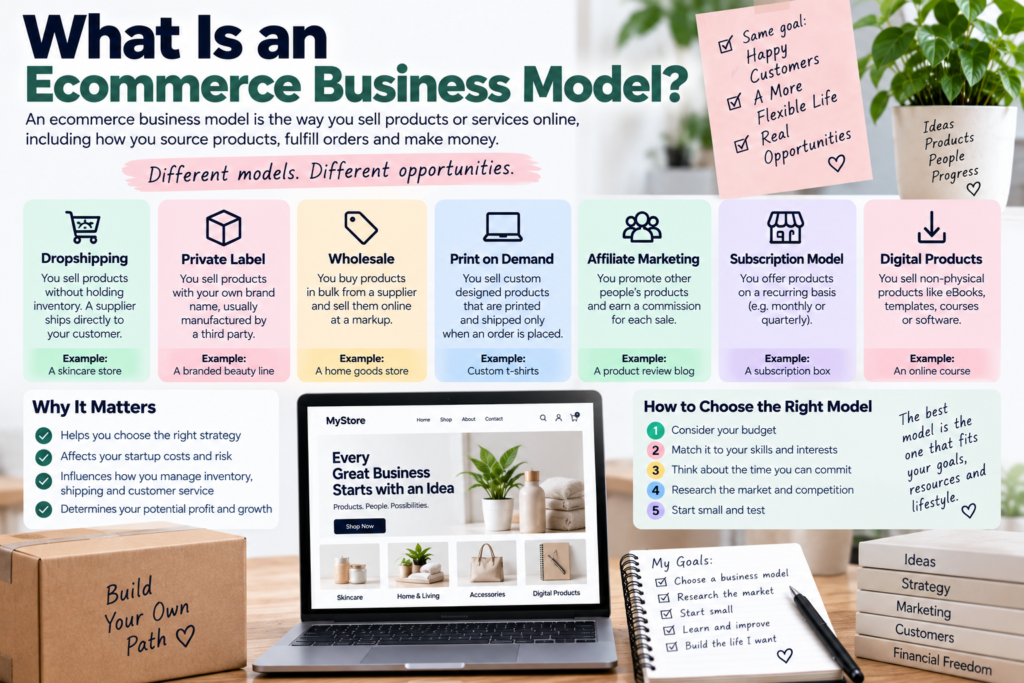
What Is an Ecommerce Business Model?
What Is an Ecommerce Business Model?
Before launching a store, it’s worth understanding exactly what an ecommerce business model actually is and which type fits your situation, since this decision shapes nearly every other choice you’ll make — from how much capital you need to how you fulfill orders. An ecommerce business model simply describes how an online business creates, delivers, and captures value through selling products or services over the internet. This guide breaks down the main types of ecommerce business models, how they differ, and how to figure out which one makes sense for you.
Why the Business Model Decision Comes Before Everything Else
Many beginners jump straight to choosing a product or a platform without first deciding which ecommerce business model they’re actually building. This creates problems down the line, since a product that works well for one model might be a poor fit for another. Settling on the model first gives every subsequent decision — product selection, pricing, platform choice, and marketing approach — a clearer framework to work within, rather than figuring it out through trial and error after you’ve already invested time and money.
Inventory-Based Ecommerce (Holding Your Own Stock)
This is the traditional ecommerce business model: you purchase or manufacture products, hold them as inventory, and ship them to customers yourself or through a fulfillment partner once an order comes in. The main advantage is better control over quality, branding, and margins, since you’re not dependent on a third party for fulfillment. The trade-off is higher upfront capital requirements and the operational responsibility of managing storage, packing, and shipping, or paying a third-party logistics provider to handle it for you.
Dropshipping
In a dropshipping ecommerce business model, you list products for sale without holding any inventory yourself. When a customer orders, you purchase the item from a supplier who ships it directly to the customer. This dramatically lowers the upfront capital required to start, since you’re not buying stock before a sale happens, but it typically comes with thinner margins and less control over fulfillment speed and quality, since you’re relying entirely on a third party to execute correctly.
Print-on-Demand
Similar to dropshipping in that you don’t hold inventory, a print-on-demand ecommerce business model specifically involves custom designs printed onto products like t-shirts, mugs, or posters only after a customer orders. A third-party provider handles printing, packaging, and shipping. This model is particularly well-suited to sellers whose main value comes from design or creative work rather than product sourcing, since the physical product itself is typically a commodity item available to any seller on the same platform.
Wholesale and Private Label
A wholesale ecommerce business model involves purchasing products in bulk from a manufacturer, often at a significant discount, and reselling them — sometimes under your own brand (private label) and sometimes as-is. This model can offer strong margins once volume increases, but typically requires more upfront capital than dropshipping and carries the operational demands of holding real inventory. Private labeling specifically allows for more brand differentiation than simply reselling someone else’s existing product line.
Subscription-Based Ecommerce
Rather than selling individual one-time purchases, a subscription ecommerce business model charges customers on a recurring basis for ongoing access to a product or curated selection of products. This can apply to physical goods (a monthly snack box, a replenishable consumable) or digital products and services. The appeal is more predictable, recurring revenue compared to one-off sales, though it requires sustained value delivery to keep subscribers from canceling, which adds its own ongoing operational demands.
Digital Products
A digital ecommerce business model sells products that exist entirely in digital form — ebooks, templates, software, online courses, or stock design assets — with no physical shipping involved at all. Margins tend to be considerably higher than physical product models since there’s no manufacturing or shipping cost per sale, but the business still depends heavily on effective marketing, since digital products don’t benefit from the same kind of impulse-driven discovery that a physical storefront or marketplace listing sometimes provides.
Business-to-Consumer vs. Business-to-Business Ecommerce
Beyond fulfillment and inventory approach, an ecommerce business model also differs by who the customer actually is. Business-to-consumer (B2C) ecommerce sells directly to individual shoppers and typically involves lower order values but higher order volume. Business-to-business (B2B) ecommerce sells to other companies, often involving larger order values, longer sales cycles, and different marketing and sales approaches entirely, since business buyers typically make more deliberate, research-driven purchase decisions than individual consumers.
How to Choose the Right Ecommerce Business Model for You
The right ecommerce business model depends on a combination of factors: how much capital you can realistically invest upfront, how much time you can dedicate to fulfillment and operations, and what kind of products or skills you already have access to. Someone with limited capital but significant time to invest in marketing might lean toward dropshipping or print-on-demand, while someone with more capital and an interest in building a long-term, differentiated brand might be better suited to private label or inventory-based ecommerce. Our guide on how to choose products to sell online covers how product selection interacts with these broader model decisions.
Combining Multiple Models
Many successful ecommerce businesses don’t stick to a single pure model indefinitely. A store might start with dropshipping to test demand cheaply, then transition to holding inventory on its best-selling products once demand is proven, while continuing to dropship slower-moving or more experimental items. Recognizing that your ecommerce business model can evolve as the business matures, rather than treating the initial choice as permanent, gives you more flexibility to adapt as you learn what actually works.
How Your Business Model Affects Pricing and Margins
Different ecommerce business models carry fundamentally different margin structures, which directly affects how you should approach pricing. Dropshipping and print-on-demand typically carry the thinnest margins due to supplier and platform fees, meaning pricing has to be set carefully to remain profitable after all costs. Inventory-based and private label models can offer stronger margins once volume increases, but require more accurate forecasting to avoid being stuck with unsold stock. Our guide on how to price products for an online store covers pricing strategies that account for these differences across models.
Marketplace Ecommerce vs. Your Own Store
Another dimension that cuts across the models above is where you actually sell. Marketplace ecommerce means listing products on an established platform like Amazon, Etsy, or eBay, benefiting from their existing traffic and built-in trust, but competing directly against other sellers and paying listing or referral fees. Building your own store, through a platform like Shopify or WooCommerce, gives you full control over branding, pricing, and the customer relationship, but means you’re responsible for driving all of your own traffic rather than relying on a marketplace’s existing audience. Many sellers eventually use both, treating marketplaces as an additional sales channel alongside their own branded store rather than choosing exclusively between the two.
Social Commerce as an Emerging Model
Social commerce — selling directly through platforms like Instagram, TikTok, or Facebook using their built-in shopping features — has grown into its own meaningful ecommerce business model rather than simply being a marketing channel for an external store. This model benefits from extremely low friction between discovery and purchase, since a customer can go from seeing a product in their feed to completing checkout without ever leaving the app. The trade-off is less control over the customer experience and data compared to a fully owned website, and heavy dependence on a platform’s algorithm and policies, which can change with little notice.
How Capital Requirements Differ Across Models
Understanding the realistic capital requirements of each ecommerce business model helps set appropriate expectations before you commit. Dropshipping and digital products generally require the least upfront capital, often startable for a few hundred dollars or less. Print-on-demand sits in a similar range. Private label and wholesale models typically require a more significant upfront investment, often ranging from a few thousand dollars upward depending on the product and minimum order quantities from manufacturers. Subscription models vary widely depending on whether physical products are involved. Matching your available capital honestly against a model’s typical requirements prevents the common mistake of choosing a model that looks appealing in theory but isn’t actually financially realistic for your current situation.
Researching Demand Before Committing to a Model
Whichever ecommerce business model you’re considering, validating that real demand exists before fully committing protects you from the most expensive beginner mistake: building an entire operation around an idea nobody actually wants to buy. Tools like Google Trends can help you gauge whether interest in a product category is growing, shrinking, or seasonal before you invest significant time or money into any particular model or niche.
How Your Long-Term Goals Should Influence Your Choice
Beyond the practical considerations of capital and operational capacity, it’s worth thinking about what you actually want the business to become over the next few years. If building a recognizable, long-term brand with strong customer loyalty is the goal, private label or inventory-based models tend to support that better than dropshipping, since you have more control over product quality, packaging, and the overall customer experience. If the priority is testing multiple ideas quickly with minimal risk, dropshipping or print-on-demand’s low commitment makes more sense as a starting point, even if you eventually transition to a different model once you’ve found something that works.
Common Mistakes When Choosing an Ecommerce Business Model
Choosing a model based purely on low startup cost. Dropshipping’s low barrier to entry is appealing, but it isn’t automatically the easiest path to profitability, since thin margins require higher sales volume to generate meaningful income.
Not considering how much operational work a model actually requires. Holding inventory and handling fulfillment yourself demands more ongoing time than many beginners initially expect.
Switching models too frequently without giving one a fair test. Jumping between dropshipping, print-on-demand, and inventory-based models before any one has had enough time to prove itself wastes the learning that comes from sticking with an approach long enough to actually evaluate it.
Ignoring how the model affects marketing requirements. Subscription and B2B models, in particular, often require different marketing strategies than a typical one-time-purchase B2C store, and applying the wrong approach can waste significant effort.
Ultimately, there’s no single “best” ecommerce business model that works for everyone — only the model that best matches your available capital, time, risk tolerance, and long-term ambitions for the business. Taking the time to genuinely understand how each model works before committing saves considerable time and money compared to learning these differences the hard way after you’re already underway.
Frequently Asked Questions
What’s the easiest ecommerce business model for a complete beginner? Dropshipping and print-on-demand tend to be the most accessible starting points due to low upfront capital requirements, though they typically come with thinner margins than models involving your own inventory.
Can I combine more than one ecommerce business model in the same store? Yes, and many successful stores do, often starting with a lower-risk model like dropshipping to validate demand before transitioning certain products to an inventory-based approach.
Which ecommerce business model has the best profit margins? This varies, but private label and digital products often offer stronger margins than dropshipping or print-on-demand, since there are fewer per-unit fees eating into each sale.
Do I need to pick one ecommerce business model and stick with it forever? No. Many businesses evolve their model over time as they learn more about demand, their own operational capacity, and what’s actually most profitable for their specific products and audience.
Is social commerce a real ecommerce business model or just marketing? It’s increasingly treated as its own model, since purchases can be completed entirely within a social platform without ever visiting an external website, which changes how you think about the full customer journey from discovery to checkout.
How do I know if I’ve chosen the wrong ecommerce business model? Signs include consistently thin or negative margins that don’t improve with volume, operational demands that don’t match your available time, or a mismatch between what the model requires and your long-term goals for the business. Recognizing this early allows for a course correction before too much time or capital is committed.