New to online business? Start with our free 7-day roadmap and build your foundation step by step.
Get the Free Roadmap →Ecommerce
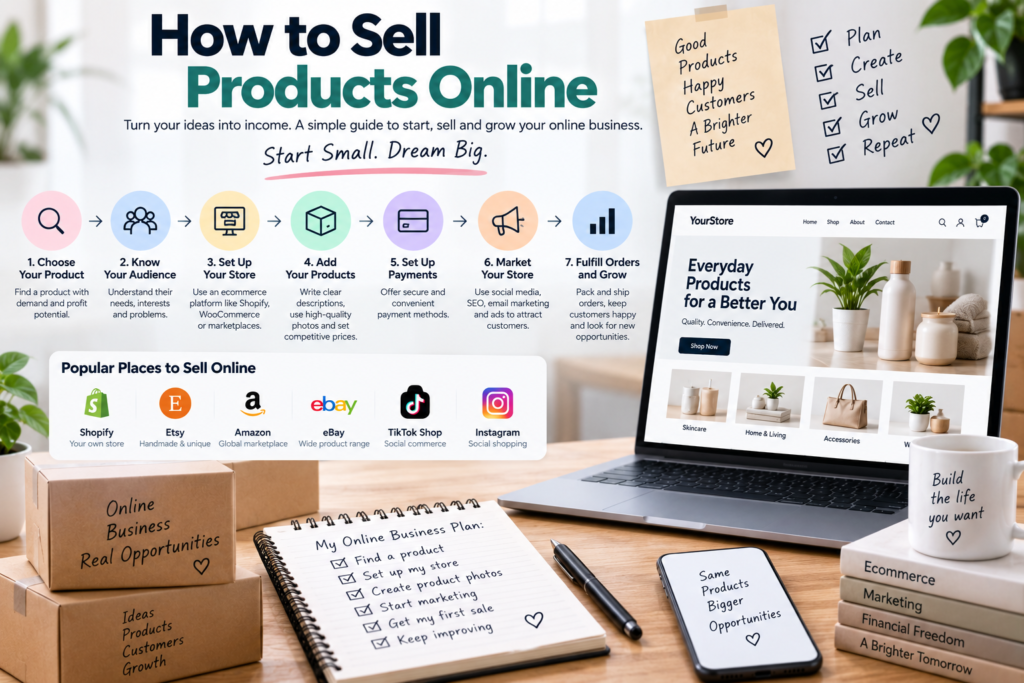
How to Sell Products Online
How to Sell Products Online
There’s no single “right” way to sell products online anymore — that’s both the good news and the slightly overwhelming part. A decade ago, the options were more limited; today, you can build your own store, list on a marketplace, sell through social media, or combine several of these at once. Figuring out how to sell products online successfully isn’t really about picking the one “correct” method — it’s about understanding your options well enough to choose the combination that actually fits your product and situation.
This guide walks through the practical steps of how to sell products online, from deciding where to sell through to what actually gets someone to click “buy.”
Step 1: Decide What You’re Selling
Before anything else, get specific about your product — not just the category, but who it’s actually for and what problem it solves. Vague products marketed to “everyone” tend to struggle, since generic messaging rarely resonates strongly with anyone specific. If you’re still narrowing this down, our guide on how to find products to sell online walks through a more structured approach to landing on something worth pursuing.
Step 2: Choose Where You’ll Sell
This is one of the bigger decisions in how to sell products online, and it genuinely shapes everything downstream. Your main options are:
Your own independent store — full control over branding and customer relationships, using platforms like Shopify or WooCommerce, but you’re responsible for generating your own traffic.
Marketplaces — platforms like Amazon, Etsy, or eBay where you tap into existing built-in traffic, at the cost of more direct competition and less brand control.
Social commerce — selling directly through Instagram, TikTok, or Facebook Shops, meeting customers where they’re already scrolling.
Many sellers eventually use more than one channel at once. Our guide on what is a selling platform and how does it workbreaks down these options in more depth if you’re still deciding.
Step 3: Set Up Your Storefront or Listings
Once you’ve chosen where to sell, build out the actual product pages or listings. Regardless of platform, strong listings tend to share a few things in common:
- Clear, high-quality photos from multiple angles
- A description that addresses real buyer questions, not just a feature dump
- Transparent pricing with no hidden surprises at checkout
- Easy-to-find shipping and return information
If photography feels like a weak point, our guide on how to take product photos for an online store covers exactly how to get usable results without professional equipment.
Step 4: Set Prices That Actually Work
Pricing to sell products online successfully means covering your real costs — product, shipping, fees — while staying competitive enough to convert. Underpricing out of fear of not selling is a common early mistake that quietly undermines the business’s sustainability. Our guide on how to price products for an online store walks through the actual math involved.
Step 5: Set Up Secure Payment Processing
Customers need a trustworthy, frictionless way to pay. Services like Stripe and PayPal handle the security and compliance side automatically, meaning you don’t need to build this infrastructure yourself. A confusing or untrustworthy-feeling checkout process is one of the fastest ways to lose a sale you already had — this step deserves real attention, not an afterthought.
Step 6: Plan How Orders Get Fulfilled
Decide how products will actually reach customers — handling shipping yourself, using a third-party logistics service, relying on a marketplace’s fulfillment program, or working with a dropshipping supplier. Each approach trades off cost, control, and operational effort differently, and the right choice depends heavily on your order volume and available time.
Step 7: Drive Traffic to Your Listings
A great product that nobody sees doesn’t sell. Common approaches to bringing in visitors include:
- Content and SEO — publishing genuinely useful content that ranks in search over time
- Social media — building an audience on platforms your customers already use
- Paid advertising — running targeted ads once you understand what converts
- Marketplace search — if selling on a marketplace, optimizing listings for that platform’s internal search
Most successful sellers don’t rely on a single traffic source — they test a few, then double down on whatever’s actually converting.
Step 8: Build Trust Before the Sale
Especially as a newer or unknown seller, building trust matters as much as the product itself. Genuine reviews, clear policies, a real About page, and visible contact information all reduce the hesitation a stranger feels before handing over payment details. Our guide on how to get visitors to trust your website and buy covers this specific piece in much more depth.
Step 9: Handle Customer Service Well
How you respond when something goes wrong — a late shipment, a damaged item, a confused customer — often matters more to long-term reputation than the fact that something went wrong in the first place. Fast, honest communication tends to turn a potentially bad review into a forgivable hiccup.
Step 10: Track What’s Working and Adjust
Once you’re actually selling, pay attention to the data: which products convert best, which traffic sources actually produce sales, and where visitors drop off before completing a purchase. This ongoing feedback loop is what separates a store that improves over time from one that stays stuck at its initial launch performance.
Selling on Multiple Channels at Once
Once you’ve got one channel working, expanding to a second can multiply your reach without starting from zero each time — for example, running your own Shopify store while also listing bestsellers on Etsy or Amazon to capture additional traffic. The key is making sure your inventory, pricing, and fulfillment can actually keep pace across multiple channels before spreading yourself too thin; adding complexity before your operations can support it tends to create more problems than it solves.
Selling Products Online vs. Traditional Retail
The core advantage of selling products online is reach — your potential customer base isn’t limited by geography the way a physical storefront is. The trade-off is the absence of in-person trust signals; a customer can’t hold your product or speak to you face-to-face before buying, which makes photography, reviews, and clear communication carry more weight than they would in a physical retail setting.
Standing Out When Everyone’s Selling the Same Thing
A common concern for new sellers is competing against near-identical products from other sellers, especially on marketplaces. Differentiation typically comes from somewhere other than the product itself — stronger photography, more detailed and honest descriptions, faster response to customer questions, or a genuinely distinct brand voice. Price alone is rarely a sustainable differentiator, since there’s almost always someone willing to go lower; competing on trust, presentation, and service tends to hold up better over time.
Common Mistakes When Selling Products Online
Listing on too many platforms too early. Spreading thin across five channels before mastering one often produces weaker results everywhere than focusing deeply on one or two.
Weak product photography. Blurry or inconsistent images create doubt before a customer even reads the description.
Ignoring mobile shoppers. A large share of online purchases now happen on phones — a clunky mobile experience quietly costs sales.
No plan for driving traffic. A well-built store or listing with no visibility strategy behind it won’t generate sales on its own.
Underestimating customer service. Treating support as an afterthought rather than a core part of the business tends to show up in reviews eventually.
Frequently Asked Questions
What’s the easiest way to start selling products online as a beginner? Many beginners find marketplaces (like Etsy or Amazon) the easiest starting point, since they provide built-in traffic without requiring you to build an audience from scratch first.
Do I need my own website to sell products online? No. You can sell entirely through marketplaces or social commerce without an independent website, though owning your own store gives you more long-term control over branding and customer relationships.
How much does it cost to start selling products online? This varies widely by model — some approaches, like dropshipping or digital products, can start with a very small budget, while others involving upfront inventory require more initial capital.
How long does it take to make a first sale selling products online? This depends heavily on your product, platform, and marketing effort, but many sellers see their first sales within the first few weeks of consistent effort, particularly when starting on a platform with existing built-in traffic rather than building an audience entirely from scratch.