New to online business? Start with our free 7-day roadmap and build your foundation step by step.
Get the Free Roadmap →Dropshipping
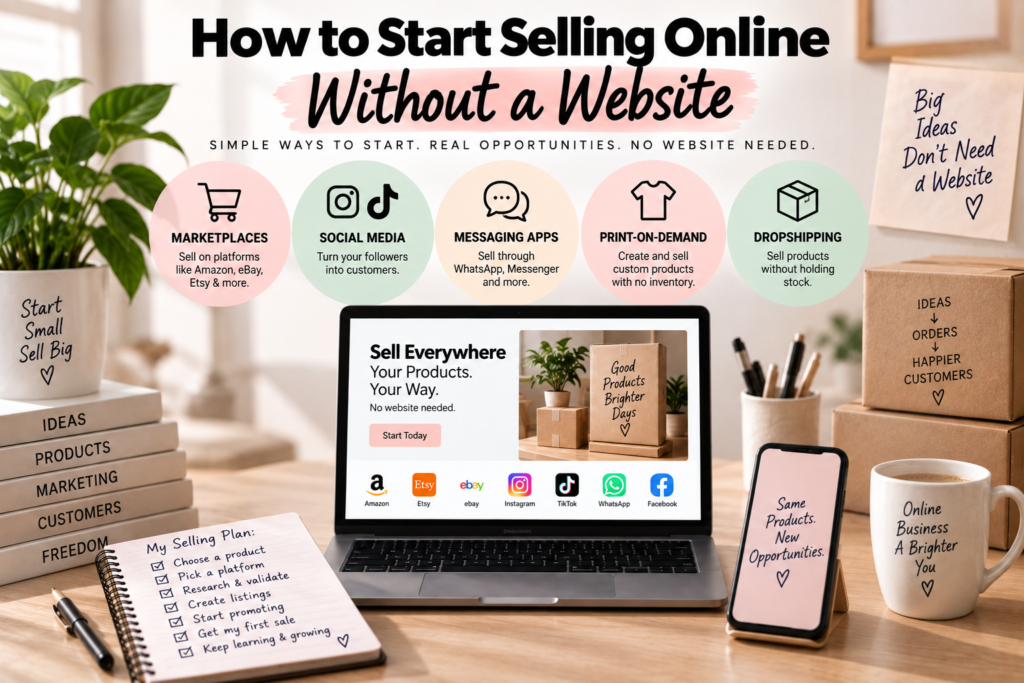
How to Start Selling Online Without a Website
Starting an online business doesn’t necessarily mean building a website first. If you’re wondering How to Start Selling Online Without a Website, there are several ways to begin with platforms that already have customers and built-in selling features.
This can be especially useful if you’re a beginner, have a limited budget, or simply want to test a product before paying for a full ecommerce website.
The important thing is to choose a selling method that fits your products, customers, and business goals.
How to Start Selling Online Without a Website
The simplest answer to How to Start Selling Online Without a Website is to use an existing platform where customers can already discover and purchase products.
Some options include:
- Online marketplaces
- Social media platforms
- Messaging apps
- Handmade and creative marketplaces
- Print-on-demand platforms
- Local selling platforms
You don’t need to use all of them. Start with one platform where your potential customers are most likely to be.
Sell Products on Online Marketplaces
Marketplaces can be one of the easiest ways to start selling because you don’t have to build an audience completely from scratch.
Depending on what you’re selling, you could consider platforms such as:
- Amazon
- eBay
- Etsy
- Vinted
- Other specialized marketplaces
Each marketplace has its own fees, rules, seller requirements, and customer base, so research the platform before committing to it.
The advantage is that people are already visiting these platforms specifically to shop.
The disadvantage is that you’ll have less control over the customer experience and may have to compete directly with many other sellers.
If you’re still deciding what product to sell, check out How to Choose Products to Sell Online: A Beginner’s Guide before investing in inventory.
Use Social Media to Sell
Social media can also help you sell products without having your own website.
You can use platforms such as Instagram, Facebook, TikTok, or Pinterest to show your products and direct interested customers toward a purchasing option.
Your content could include:
- Product demonstrations
- Before-and-after content
- Tutorials
- Customer reviews
- Unboxing videos
- Product comparisons
- Behind-the-scenes content
- Answers to common questions
The goal isn’t to post advertisements constantly.
Instead, create content that helps people understand why the product is useful.
For example, if you sell travel organizers, you could create a short video showing how much easier it is to organize a suitcase with them.
Sell Through Messaging Apps
Messaging apps can be useful for small businesses, especially when customers have questions before purchasing.
You can use messaging to:
- Answer product questions
- Send product photos
- Confirm orders
- Discuss delivery options
- Provide customer support
- Follow up after a purchase
However, keep your ordering process organized.
If you receive many orders through messages, manually tracking everything can quickly become confusing. A simple spreadsheet or order-management system can help.
Test Products Before Building a Website
One of the biggest reasons to start without a website is to test your idea.
Imagine you have found a product you think customers will love.
Instead of immediately spending money on a complete ecommerce store, you could list a small quantity on a marketplace or promote it through social media.
Then observe what happens.
Are people clicking?
Are they asking questions?
Are they actually buying?
Are they complaining about the price?
Are they asking for different colors or sizes?
This information can be extremely valuable.
If you’re unsure whether people actually want your product, read How to Validate a Product Idea Before Selling Onlinebefore making a larger investment.
Use Print-on-Demand
Print-on-demand is another option for people who want to sell products without purchasing large amounts of inventory upfront.
With this model, products are produced when customers place orders.
Depending on the provider, you can sell products such as:
- T-shirts
- Hoodies
- Bags
- Mugs
- Posters
- Phone cases
- Other customizable products
For example, Printful offers print-on-demand services that can be used to create and sell customized products.
You still need to think about product quality, pricing, shipping, customer service, and marketing. However, the model can reduce the need to purchase large quantities of inventory before you know whether customers are interested.
Research What People Are Searching For
Selling without a website doesn’t mean you should skip research.
You can use Google Trends to explore interest in different products and topics.
Try searching for the product you’re considering.
Then compare it with similar products or related categories.
You can also search Google for questions customers ask.
For example, if you’re considering selling skincare products, search for things such as:
- Best skincare for beginners
- How to build a simple skincare routine
- Products for dry skin
- How to choose skincare products
These searches can help you understand what people are interested in and what problems they are trying to solve.
Create Content That Helps You Sell
You don’t need a website to start creating content.
Short videos, posts, tutorials, and product demonstrations can all help introduce people to your products.
Good content can answer questions before the customer even asks them.
For example:
Instead of:
“Buy this travel bag.”
Try:
“Here are five things I can fit inside this small travel bag.”
The second example gives the viewer a reason to watch.
Educational and useful content can also help you build trust over time.
Make Your Product Listings Clear
Whether you’re selling through a marketplace or social media, your product listing needs to provide enough information for someone to make a decision.
Include:
- A clear product name
- High-quality photographs
- Price
- Product features
- Size or dimensions
- Materials
- Available colors or variations
- Shipping information
- Return information
- How to use the product when relevant
Avoid writing descriptions that simply repeat generic information.
Explain what makes the product useful and who it is designed for.
Choose a Simple Payment Method
When you’re learning How to Start Selling Online Without a Website, payment is another important consideration.
The payment methods available to you will depend on the platform and your location.
Marketplaces usually handle payments themselves. If you’re selling directly through social media or messaging, you’ll need to choose a payment method that works for your customers and complies with the applicable rules.
Make sure you understand any transaction fees before setting your prices.
Think About Shipping Before You Start
Shipping can have a major effect on whether an online sale is profitable.
Before listing a product, find out:
- How much it costs to ship
- How long delivery takes
- What packaging you’ll need
- Whether tracking is available
- What happens if a package is lost
- Who pays for returns
Don’t wait until you’ve received your first order to figure this out.
A simple shipping process makes your business easier to manage and gives customers clearer expectations.
Can You Start Dropshipping Without a Website?
Yes, depending on the platform and supplier setup, you may be able to start a dropshipping business without building a traditional website.
However, you still need a way to present your products, receive orders, process payments, and provide customer support.
Dropshipping can reduce the need to hold inventory yourself, but it doesn’t eliminate the responsibilities of running a business.
If you’re considering this model, read Can You Start Dropshipping With No Money? to understand what you may be able to do with a very small starting budget.
You can also learn more about the model through Shopify’s dropshipping guide.
Marketplace vs. Social Media: Which Is Better?
There isn’t one answer for every seller.
| Marketplace | Social Media |
|---|---|
| Existing shopping audience | Build your own audience |
| Easier product discovery | More control over content |
| Platform rules apply | Requires consistent content |
| Platform fees may apply | May require more customer interaction |
| Good for product searches | Good for demonstrations and branding |
A beginner could even use both.
For example, you might list your products on a marketplace while using social media to bring additional attention to them.
When Should You Build a Website?
You don’t necessarily need a website on day one.
However, building one can become useful when your business starts growing.
A website can give you:
- More control over your branding
- A central place for your products
- More control over customer experience
- A place to publish useful content
- Better opportunities to build an email list
- More independence from a single marketplace
If you start getting regular sales, a website may become a logical next step.
You can also connect your website to other sales channels rather than choosing between them.
Advantages of Selling Without a Website
Learning How to Start Selling Online Without a Website can be useful because this approach has several advantages.
Lower initial costs
You don’t necessarily need to pay for website hosting, themes, apps, and other website-related expenses immediately.
Faster setup
A marketplace or social media account can often be set up more quickly than a complete ecommerce store.
Easier testing
You can test products before investing heavily in your own website.
Existing customers
Marketplaces already have shoppers searching for products.
Less technical work
You don’t need to learn everything about website design before making your first listing.
Disadvantages of Selling Without a Website
There are also limitations.
You may have less control over:
- Branding
- Customer data
- Store design
- Platform fees
- Platform policies
- Customer experience
Your business can also become dependent on another platform.
That’s why starting without a website can be a good testing strategy, but you may eventually want to create your own online home.
A Simple Beginner Strategy
If you’re starting from zero, don’t try to build everything at once.
A simple approach could look like this:
Step 1: Choose one product category.
Step 2: Research your target customers.
Step 3: Validate the product idea.
Step 4: Choose one marketplace or social platform.
Step 5: Create a strong product listing.
Step 6: Start creating useful content.
Step 7: Track views, questions, sales, and feedback.
Step 8: Improve your offer based on what you learn.
Step 9: Add more products only when there’s a reason to.
Step 10: Consider building a website once the business has traction.
This keeps the process manageable and prevents you from spending too much money before you understand your market.
Frequently Asked Questions
Can I really sell online without a website?
Yes. Marketplaces, social media, messaging platforms, and other selling platforms can allow you to sell products without creating your own website.
What is the easiest way to start selling online?
For many beginners, using an established marketplace can be one of the simplest options because the platform already provides many of the tools needed to list and sell products.
Can I sell on social media without a website?
Yes. Depending on the platform and your location, you can promote products through social media and use available selling or messaging features to communicate with customers and process sales.
Do I need money to start selling online?
Not necessarily a large amount, but most businesses have some expenses. Your costs depend on the products, platform, shipping, payment processing, marketing, and business model you choose.
Should I create a website later?
If your business starts generating consistent sales, creating your own website can give you greater control over your brand and customer experience.
Final Thoughts
How to Start Selling Online Without a Website doesn’t have to be complicated.
You can start with an existing marketplace, social media platform, messaging app, or another selling channel. The important part is to choose a method that allows you to test your product and learn about your customers.
Don’t feel pressured to build a huge online store before you’ve made your first sale.
Start small. Learn what customers want. Improve your products and listings. Then, when your business grows, you can build a website and create a stronger brand around what you’ve already learned.
If you’re deciding what to sell next, continue with What Is a Good Ecommerce Niche? and How to Validate a Product Idea Before Selling Online.
1 thought on “How to Start Selling Online Without a Website”
Comments are closed.
[…] If you want to start selling without creating a website, read How to Start Selling Online Without a Website. […]