New to online business? Start with our free 7-day roadmap and build your foundation step by step.
Get the Free Roadmap →Ecommerce
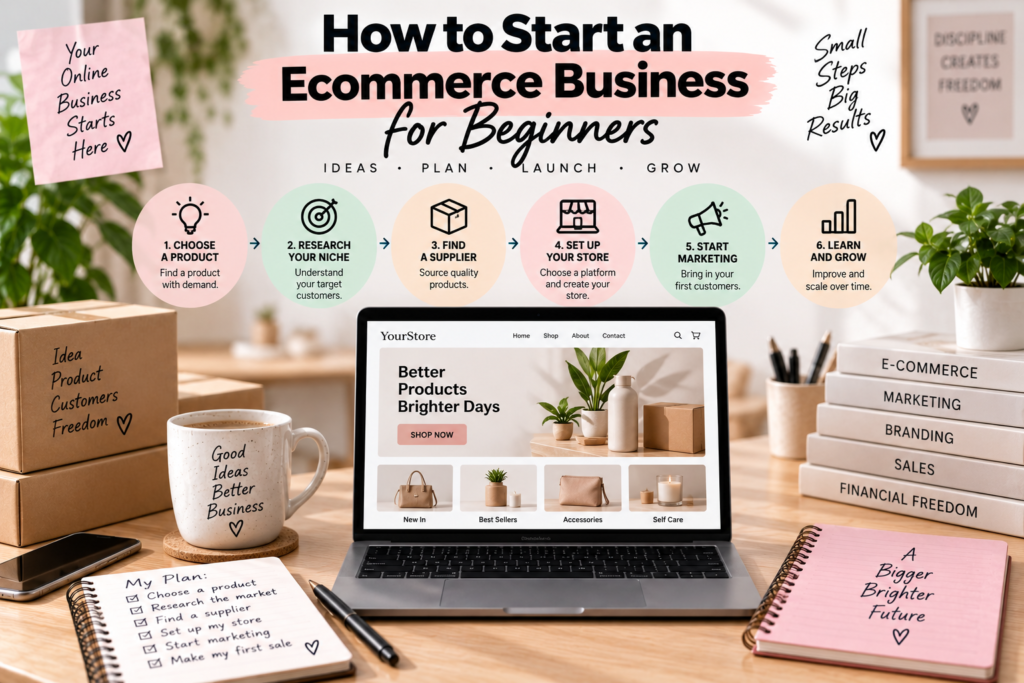
How to Start an Ecommerce Business for Beginners
How to Start an Ecommerce Business for Beginners
Starting an ecommerce business for beginners can feel overwhelming at first glance — there are platforms to choose, products to source, and marketing decisions to make before a single sale happens. But most of that complexity resolves itself once you break the process into a clear sequence of steps rather than trying to figure everything out at once. This guide walks through exactly what an ecommerce business for beginners actually involves, step by step, from the first decision to your first sale.
What Makes Ecommerce Different From Other Online Business Models
Ecommerce specifically means selling physical or digital products through an online store, as opposed to selling services (freelancing) or earning through content and advertising. That distinction matters because it shapes what you’ll actually spend your time on: sourcing or creating products, managing a storefront, handling orders, and building a system that can repeat itself reliably as volume grows.
For a beginner, this means the early decisions you make — what to sell, how to fulfill it, and which platform to build on — have a bigger impact on how smoothly things go than almost anything else. Getting these right from the start saves considerable rework later.
Step 1: Decide What You’re Going to Sell
Every ecommerce business for beginners starts with a product decision, and this is where many people get stuck longer than necessary. Rather than searching endlessly for a “perfect” idea, it helps to narrow the decision down to a few practical questions: Does this product solve a real problem or fill a genuine want? Is there existing demand I can verify, rather than demand I’m hoping exists? Can I actually source or create this reliably? Our guide on how to choose products to sell online walks through this evaluation process in more detail.
Step 2: Choose a Fulfillment Model
How you get products into customers’ hands shapes nearly every other decision that follows. The main options for a beginner are holding your own inventory, dropshipping (a supplier ships directly to the customer), or print-on-demand (a third party prints and ships custom designs on order). Each comes with different upfront costs, margins, and operational demands, so this decision deserves real thought rather than defaulting to whichever model you heard about first.
Step 3: Pick a Platform and Build Your Store
Platforms like Shopify and WooCommerce let a complete beginner build a functional store without needing custom development work. Our guide on how to start an online store covers platform selection and the essential pages every store needs — an about page, clear policies, and a straightforward checkout — before you’re ready to accept your first order.
Step 4: Price Your Products Properly
Pricing mistakes are one of the most common reasons a new ecommerce business for beginners struggles to turn a profit even while making sales. Pricing too low to seem competitive erodes margin before fees, shipping, and returns are even factored in. Our guide on how to price products for an online store breaks down a more reliable approach than simply matching whatever competitors charge.
Step 5: Set Up Basic Tracking From Day One
It’s tempting to skip analytics setup until “later,” but installing tools like Google Analytics and Google Search Console before launch means you have real data from your very first visitor rather than a gap in your history. This matters more than it seems early on, since understanding which traffic sources and pages actually convert becomes the foundation for every marketing decision you make afterward.
Step 6: Plan Your First Marketing Push
A finished store with no traffic plan won’t generate sales on its own. Our guide on marketing for beginners: how to get your first customers covers the realistic first channels — social content, SEO, and direct outreach — worth focusing on before considering paid advertising, which usually isn’t the right first move for a brand-new store with no sales history to learn from.
Step 7: Launch Before You Feel Fully Ready
Many beginners delay launching indefinitely, convinced the store needs one more fix, one more product, or one more design tweak before it’s ready. In reality, a store that’s functional but imperfect and actually live will teach you more in its first week than months of pre-launch tweaking ever could. Real customer behavior — what they click, what they abandon, what questions they ask — is data no amount of planning can substitute for.
Legal and Administrative Basics to Handle Early
It’s easy for a beginner to focus entirely on the product and marketing side of an ecommerce business while putting off the administrative basics until “later.” In practice, a few things are worth handling early: registering a business name if your area requires it, understanding whether you need to collect sales tax, and opening a separate bank account for business income and expenses. The U.S. Small Business Administration has a clear overview of registration basics that applies to most new online sellers, and checking local requirements specific to your location avoids complications once the business starts generating real revenue.
Keeping business and personal finances separate from the beginning — even before the business is making significant money — makes tax season considerably less stressful and gives you an accurate, ongoing picture of whether the business is actually profitable once every cost is properly accounted for.
Building a Simple Customer Service System
New ecommerce sellers often underestimate how much customer service matters to repeat business and reviews, even at a small scale. A beginner doesn’t need an elaborate support system, but having a clear, visible way for customers to reach you, a reasonable response time you can actually maintain, and a straightforward returns or refund policy builds the kind of trust that turns a one-time buyer into a repeat customer. Vague or hard-to-find contact information is a common reason potential customers hesitate right before checkout, even when they’re otherwise interested in the product.
A simple FAQ page addressing shipping times, return policies, and common product questions can also reduce the volume of repetitive customer messages significantly, freeing up time for the parts of the business that actually need your direct attention.
Why Patience Matters More Than Perfection
One of the hardest adjustments for anyone starting an ecommerce business for beginners is accepting that early results rarely reflect the business’s real long-term potential. The first month’s traffic and sales numbers are more a reflection of how new the store is than how good the underlying idea actually is. Search engines take time to index and rank new content, social audiences take time to build trust in a new brand, and word-of-mouth takes time to develop at all.
Rather than chasing perfection in the store’s design or endlessly tweaking product listings before launch, most successful beginners make faster progress by launching something reasonably solid, then using actual customer behavior and feedback to guide what gets improved next. Waiting for a flawless setup before going live usually costs more in lost learning time than it saves in avoided mistakes.
Common Beginner Mistakes to Avoid
Overinvesting before validating demand. Spending heavily on inventory, a custom website, or branding before confirming people actually want the product puts unnecessary risk on an unproven idea.
Choosing a saturated niche with no differentiation. Entering a crowded market with the exact same product and positioning as everyone else makes it very difficult to get noticed, let alone convert visitors into buyers.
Ignoring the numbers. Not tracking which products, pages, or marketing channels are actually working means repeating the same mistakes without realizing it.
Expecting fast results. Most ecommerce businesses for beginners take months of consistent effort before sales become predictable. Treating the first slow weeks as proof the idea doesn’t work is a common and costly overreaction.
Trying to do everything manually forever. Order confirmations, shipping notifications, and basic customer service can often be automated early on, freeing up time for the decisions that actually need a human’s judgment.
How Long It Realistically Takes to Get Going
There’s no single universal timeline, but a reasonable expectation for an ecommerce business for beginners is roughly one to three months to get a store properly set up, sourced, and launched, followed by three to six months of consistent marketing and iteration before sales become more predictable. Businesses that treat the first few months as a learning and testing period, rather than expecting immediate success, tend to make better decisions and last longer than those chasing fast results.
How Much Money You Actually Need to Start
Costs vary enormously depending on the fulfillment model you choose. Dropshipping and print-on-demand businesses can realistically start with under a few hundred dollars, since there’s no inventory to purchase upfront. Holding your own inventory requires more capital — often anywhere from a few hundred to a few thousand dollars depending on the product — but can offer better margins once you understand demand. It’s worth budgeting for platform fees, basic design or photography costs, and a buffer for early mistakes regardless of which model you choose.
Balancing a New Ecommerce Business With Other Commitments
Most beginners don’t quit a job or set aside all other responsibilities to start an ecommerce business — and they don’t need to. Treating it as a part-time project with dedicated, consistent hours each week is a realistic way to build momentum without taking on unnecessary financial risk. As the business proves itself with real sales and growing traffic, scaling up the time and investment you put into it becomes a much safer decision than committing fully from day one.
Choosing a Niche That Gives You an Edge
Beyond simply picking a product, successful beginners usually find some kind of edge within a niche rather than competing head-on with established sellers offering the exact same thing. That edge might be a specific sub-audience that’s underserved, a product variation nobody else is offering, or simply better photography, descriptions, and customer experience than existing competitors provide. A narrower, well-defined niche with a clear point of difference tends to convert better than a broad category where you’re just one of many nearly identical options.
Building Toward Your First Sale
Your first sale often comes from a different source than your hundredth. Many beginners get their very first sale through their own network, a small targeted outreach effort, or a niche community rather than broad organic search traffic, which typically takes longer to build. Treating that first sale as validation — proof the fundamentals work — rather than expecting it to be the start of an immediate flood of orders sets more realistic expectations for the months that follow.
Frequently Asked Questions
Is ecommerce still a good business for beginners to start? Yes, though it’s more competitive than it was years ago. Beginners who focus on a specific niche, genuine product quality, and consistent marketing still find real success, even in increasingly competitive categories.
What’s the easiest ecommerce business model for a complete beginner? Dropshipping and print-on-demand tend to be the most accessible starting points since they require no upfront inventory investment, though they typically carry thinner margins than holding your own stock.
Do I need technical skills to start an ecommerce business? No. Modern platforms like Shopify and WooCommerce are designed for non-technical users, and most of what you’ll need to learn is about product selection, pricing, and marketing rather than coding or design.
How much time does an ecommerce business for beginners actually require each week? This varies, but many beginners start with 10–15 hours per week alongside other commitments before increasing their time investment once the business shows real traction.
What’s the most common reason a new ecommerce business fails? Running out of motivation or budget before the business has had enough time to actually prove itself is more common than any single tactical mistake. Setting realistic expectations for how long growth takes helps beginners stay consistent through the slower early months.
Should I focus on one sales channel or sell everywhere at once? For a beginner, focusing on one well-built store and one primary marketing channel is usually more effective than spreading limited time and budget across multiple platforms before any single one is actually working.