New to online business? Start with our free 7-day roadmap and build your foundation step by step.
Get the Free Roadmap →Marketing
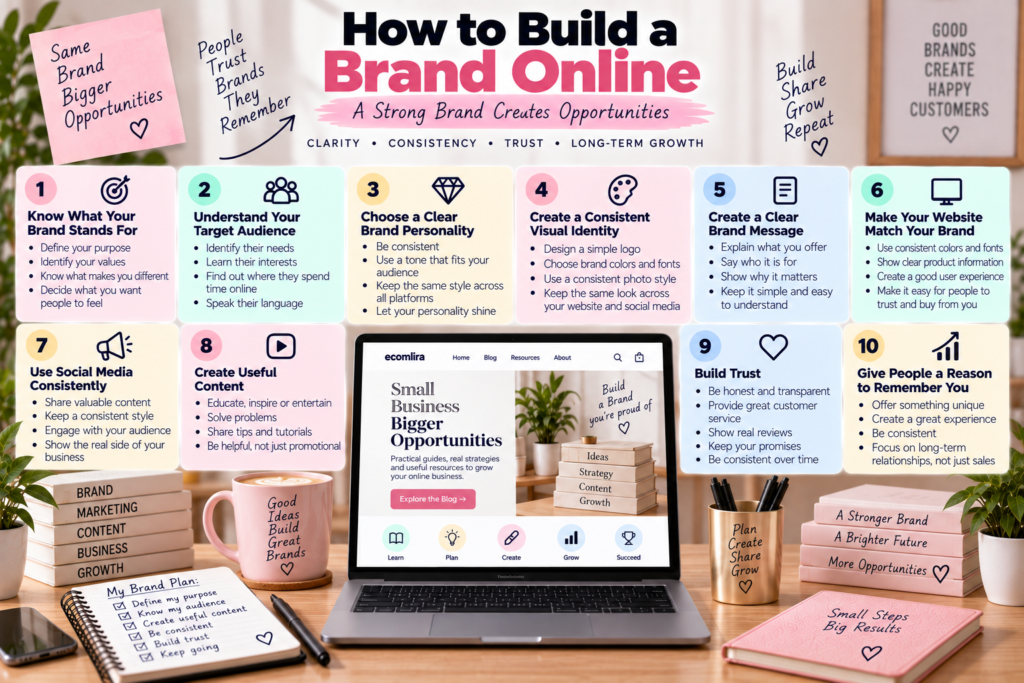
How to Build a Brand Online
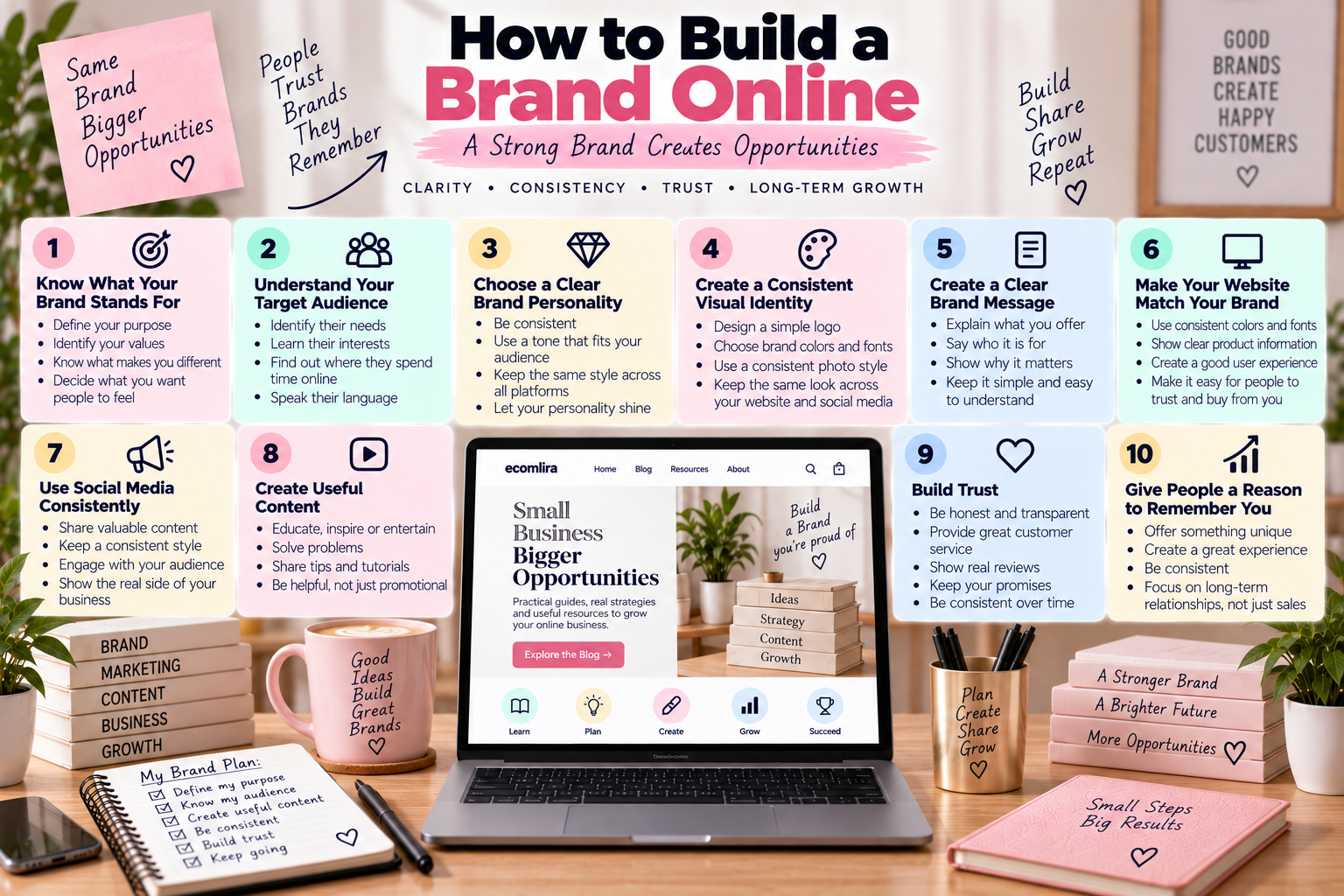
How to Build a Brand Online
Building a business online is not only about selling products or services. People also need to recognize your business, understand what it stands for, and remember it when they need what you offer.
How to Build a Brand Online starts with creating a clear identity and consistently communicating it across your website, content, social media, and customer experience.
A strong brand does not have to look expensive or complicated. Even a small business can create a recognizable presence by being consistent, useful, and clear about who it serves.
1. Know What Your Brand Stands For
Before choosing colors, fonts, or a logo, define what your business represents.
Ask yourself:
- What does my business help people do?
- Who am I trying to help?
- What problem am I solving?
- What makes my business different?
- What do I want customers to feel?
- What values are important to the business?
A business selling fitness clothing might focus on confidence, comfort, and an active lifestyle.
A business selling handmade products might focus on craftsmanship, simplicity, and individuality.
Your brand values give you a foundation for future decisions.
2. Understand Your Target Audience
Your brand should not try to appeal to everyone.
Think about the people most likely to need your product or service.
Consider:
- Their age and lifestyle
- Their interests
- Their problems
- Their goals
- Their buying habits
- Where they spend time online
- What other brands they already follow
Understanding your target audience makes your messaging much easier.
For example, a business targeting busy professionals might use different language and content from a business targeting teenagers interested in fashion.
3. Choose a Clear Brand Personality
If your brand were a person, how would it communicate?
Would it be:
- Friendly?
- Professional?
- Playful?
- Minimal?
- Inspirational?
- Educational?
- Bold?
- Calm?
Choose a few characteristics and try to maintain them throughout your communication.
Your website, social media captions, emails, product descriptions, and customer service should feel like they come from the same business.
That consistency helps create a recognizable brand personality.
4. Create a Consistent Visual Identity
A recognizable visual identity can make your business easier to remember.
When considering How to Build a Brand Online, visual consistency is one of the areas worth planning from the beginning.
Your visual identity can include:
- Logo
- Brand colors
- Fonts
- Photography style
- Graphic style
- Icons
- Image layouts
- Packaging
- Social media designs
You do not need dozens of colors or complicated graphics.
A simple system can work extremely well.
For example, you might choose:
2–3 main colors + 1–2 fonts + one photography style + a consistent graphic style.
The important thing is using the system consistently.
5. Create a Clear Brand Message
People should be able to understand what your business does without having to investigate your entire website.
Your main message should answer:
What do you offer, who is it for, and why should someone care?
For example:
“Practical skincare products for simple everyday routines.”
is clearer than:
“Helping you discover your ultimate beauty journey.”
The second statement sounds appealing but does not tell the customer much about the business.
A strong brand message should be simple enough for people to understand quickly.
6. Make Your Website Match Your Brand
Your website is one of the most important places where people experience your brand.
Make sure your:
- Logo
- Colors
- Typography
- Images
- Headlines
- Product descriptions
- Buttons
- Navigation
- About page
- Contact information
feel connected.
A visitor should not feel like they have moved to a completely different business when they go from your homepage to a product page.
Your website should also make it easy for people to understand what you offer and what they should do next.
7. Use Social Media Consistently
Social media can reinforce your brand every time someone sees your content.
Instead of changing your style with every post, create a recognizable approach.
You might use:
- Similar colors
- Consistent photography
- Repeated content themes
- A recognizable writing style
- Consistent video formats
- Similar thumbnail designs
Your social media branding does not need to be identical on every platform, but it should still feel like the same business.
For example, your TikTok content might be more casual than your website while still using the same overall personality.
8. Create Useful Content
A brand becomes stronger when people associate it with something valuable.
That could be:
- Helpful information
- Entertainment
- Inspiration
- Education
- Product expertise
- Excellent customer service
- Useful resources
This is why content marketing can be an important part of building a brand.
If your business consistently helps people solve problems, they may begin to associate your name with that particular topic.
Google’s current Search guidance emphasizes creating helpful, reliable, people-first content rather than producing large amounts of content primarily to manipulate search rankings. Google Search Central guidance
9. Tell Your Story
People often want to know more than what a business sells.
They may also be interested in:
- Why the business started
- What inspired the founder
- What problem the business wanted to solve
- How products are made
- What the company believes
- What makes the business different
Your story does not need to be dramatic.
It simply needs to be genuine.
A clear brand story can make a small business feel more personal and memorable.
10. Build Trust
A beautiful logo will not compensate for a poor customer experience.
Your brand is also shaped by what happens after someone discovers your business.
Build trust through:
- Accurate product information
- Clear pricing
- Transparent shipping information
- Easy-to-understand policies
- Responsive customer service
- Honest marketing
- Real customer feedback
- Secure website practices
Avoid making promises you cannot support.
Trust develops through repeated experiences, not just through visual design.
11. Keep Your Brand Consistent
Consistency does not mean every post has to look exactly the same.
It means your customers should recognize the same business across different touchpoints.
Your:
- Website
- TikTok
- Facebook page
- Emails
- Packaging
- Product pages
- Advertisements
should all communicate a similar identity.
A consistent brand identity makes the business easier to recognize.
12. Give Customers a Reason to Remember You
There are thousands of businesses competing for attention online.
Ask yourself:
What would make someone remember my business instead of another one?
It could be:
- A distinctive visual style
- A particular product
- A unique point of view
- Exceptional service
- Helpful educational content
- A memorable packaging experience
- A recognizable voice
- A specific niche
You do not necessarily need something completely revolutionary.
Sometimes being particularly useful to a specific audience is enough to create a strong position.
13. Avoid Copying Other Brands
It is normal to study successful businesses.
However, inspiration should not turn into imitation.
Avoid copying another company’s:
- Logo
- Brand name
- Product photography
- Website design
- Marketing messages
- Social media identity
- Packaging
Instead, study what works and ask why it works.
Then develop your own version based on your audience and business.
Google’s spam policies also warn against creating content primarily to manipulate search rankings, including large amounts of unoriginal content. Google Search spam policies
14. Start Small
You do not need a huge branding budget.
A small business can begin with:
- A clear business name
- A simple logo
- A small color palette
- Consistent fonts
- A clear message
- A defined audience
- Consistent social media content
- A professional website
You can improve the branding as the business grows.
The goal is to create a clear and consistent foundation rather than waiting until everything is perfect.
A Simple Brand-Building Plan
If you’re wondering How to Build a Brand Online without becoming overwhelmed, start with these steps.
Step 1: Define your audience
Write down exactly who you want to reach.
Step 2: Define your values
Choose three to five ideas you want your business to represent.
Step 3: Choose your personality
Decide how your business should sound when communicating with customers.
Step 4: Create your visual identity
Choose your colors, fonts, photography style, and basic graphic style.
Step 5: Write your main message
Explain what you offer, who it is for, and why it matters.
Step 6: Make your website consistent
Apply the same identity across your main website pages.
Step 7: Create useful content
Answer questions and solve problems related to your audience.
Step 8: Be consistent
Keep using the same identity across your marketing channels.
Common Branding Mistakes
Some businesses make branding unnecessarily complicated.
Avoid:
- Changing your logo constantly
- Using too many colors
- Changing your tone in every post
- Trying to appeal to everyone
- Copying competitors
- Making your message too vague
- Focusing only on appearance
- Ignoring customer experience
- Making unrealistic promises
- Changing direction every few weeks
A strong brand usually develops through consistency over time.
Final Thoughts
How to Build a Brand Online is not about creating the most impressive-looking website or having the biggest social media following.
It is about creating a recognizable identity, communicating clearly, providing value, and giving customers a consistent experience.
Start with your audience and your values. Then build your visual identity, message, content, website, and social presence around those foundations.
As your business grows, your brand can evolve too. The important thing is to give people a clear reason to remember and trust your business.
FAQ
How long does it take to build a brand online?
There is no fixed timeline. You can create the basic identity relatively quickly, but building recognition and trust usually takes consistent communication and customer experiences over time.
Do I need a logo to build a brand?
A logo can help with recognition, but a brand is much more than a logo. Your message, visual identity, content, customer experience, and reputation all contribute to your brand.
How much does it cost to build a brand?
It can cost very little if you create the basic branding yourself. Professional design, photography, copywriting, packaging, and advertising can increase the budget as the business grows.
Should my branding be the same on every social media platform?
The overall identity should remain recognizable, but you can adapt your content and communication style to fit each platform.
Can a small business build a strong brand?
Yes. A small business can build a strong brand by focusing on a specific audience, communicating clearly, providing value, and delivering a consistent customer experience.