New to online business? Start with our free 7-day roadmap and build your foundation step by step.
Get the Free Roadmap →Selling Platorms
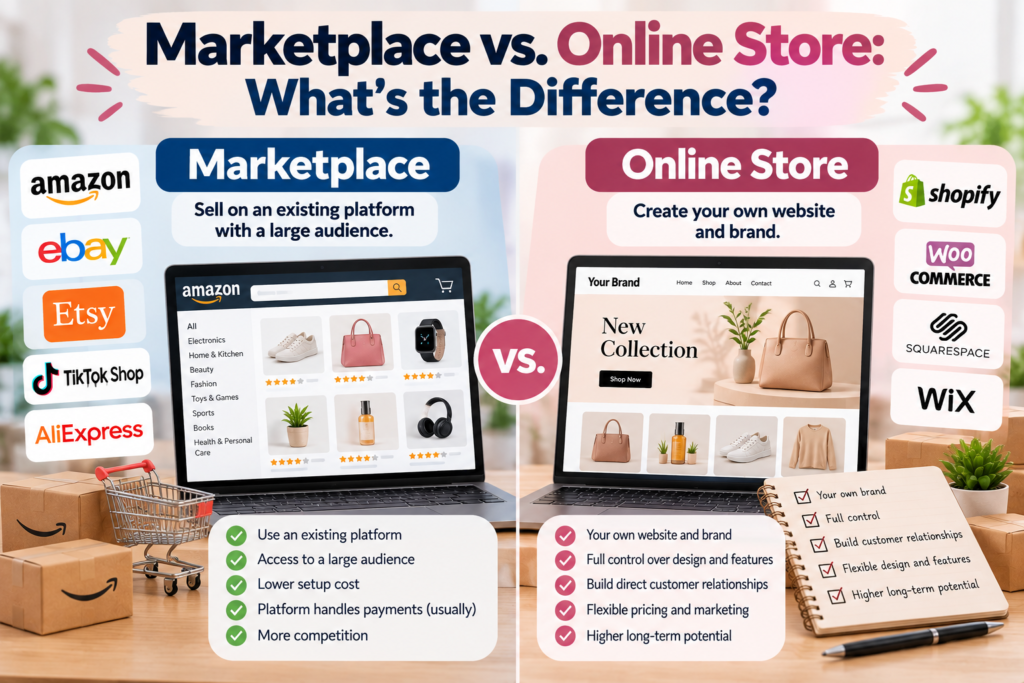
Marketplace vs. Online Store: What’s the Difference?
Marketplace vs. Online Store: What’s the Difference?
Ask five people whether you should sell on a marketplace or build your own online store, and you’ll probably get five different answers — usually delivered with a lot of confidence and not much explanation. The truth is, marketplace vs online store isn’t really a question with one right answer. It’s two genuinely different ways of selling, and which one fits depends entirely on what you’re actually trying to build.
Let’s break down what actually separates a marketplace vs online store, because once you see it clearly, the decision tends to make itself.
What Even Counts as a “Marketplace”?
A marketplace is a platform where multiple sellers list products in one shared space — think Amazon, Etsy, or eBay. You create a listing, and it sits alongside potentially thousands of similar listings from other sellers, all competing for the same shoppers browsing that platform.
The upside is obvious: those shoppers are already there, already searching, already in buying mode. You’re not building traffic from nothing — you’re plugging into traffic that already exists.
And What’s an “Online Store,” Exactly?
An online store is your own independent website, built on something like Shopify or WooCommerce, where you’re the only seller in the room. Nobody else’s listings show up next to yours. No competing “buy box.” Just your brand, your products, your rules.
The catch is right there in that last sentence — it’s your rules, which also means it’s entirely your job to get people to show up in the first place.
Marketplace vs Online Store: Who’s Actually Bringing the Traffic?
This is probably the single biggest difference, and it shapes almost everything else. On a marketplace, the platform itself is the traffic source — people come to Amazon to shop on Amazon, and your listing gets a shot at being seen simply by existing there.
On your own store, there’s no ambient foot traffic. Nobody accidentally lands on a random Shopify store the way they might stumble across a product while browsing Amazon. Every visitor has to be earned — through ads, content, social media, SEO, or some combination of all of it. If you’re weighing this trade-off more broadly across platform types, our guide on how to choose the right selling platform for your business goes deeper into that decision.
Branding: Shared Space vs. Your Own Room
On a marketplace, your branding options are limited by design. You get a product title, some photos, a description — but the overall page, navigation, and checkout experience all belong to the platform, not you. Your store, essentially, looks like everyone else’s store.
An online store flips that completely. Colors, layout, tone, the entire customer journey from homepage to checkout — it’s all yours to shape. If building a recognizable brand is the long-term goal, this is where that actually happens.
Fees: Different Costs, Different Trade-Offs
Marketplaces typically charge a mix of referral fees, transaction fees, and sometimes fulfillment costs if you use their logistics services (like Amazon’s FBA). You’re paying, in part, for the traffic and infrastructure that comes bundled in.
Independent stores usually charge a platform subscription (Shopify, for example) plus separate payment processing fees — but you avoid the marketplace’s per-sale referral cut. Depending on your margins and volume, one structure can end up meaningfully cheaper than the other, so it’s worth actually running the numbers rather than assuming.
Competition: Side-by-Side vs. Solo
Here’s something that surprises a lot of new sellers about the marketplace vs online store decision: on a marketplace, a competitor’s nearly identical, slightly cheaper product can be listed directly next to yours — sometimes literally one click away. That kind of direct, constant price comparison simply doesn’t exist on your own store, where a visitor is only looking at what you’ve chosen to show them.
Customer Relationships: Who Actually Owns Them?
This one’s easy to overlook until it matters. On most marketplaces, the platform owns the core customer relationship — you often don’t get full access to customer emails, and remarketing to past buyers directly is limited or restricted entirely.
On your own store, you own that relationship outright. Email lists, retargeting, direct communication — all fully available to you, which matters enormously if repeat business and long-term brand loyalty are part of the plan.
So… Which One Should You Actually Use?
Here’s the honest answer: it depends on what stage you’re at and what you’re optimizing for.
Lean toward a marketplace if:
- You want to start selling quickly with minimal setup
- You’re still validating whether a product has real demand
- You don’t yet have an audience or traffic source of your own
Lean toward an online store if:
- Building a recognizable, long-term brand matters to you
- You want full ownership of customer data and relationships
- You already have (or are building) a way to drive your own traffic
If you’re leaning toward testing the marketplace route first, our guide on how to start selling on Amazon walks through exactly what that setup looks like.
You Don’t Actually Have to Pick Just One
This gets missed constantly in the marketplace vs online store debate — plenty of successful sellers run both at once. A common approach is using a marketplace to generate early sales and validate demand, then building an independent store alongside it once there’s a real customer base and some breathing room to invest in a brand.
Frequently Asked Questions
Is it better to sell on a marketplace or build an online store? Neither is universally better — marketplaces offer faster access to existing traffic, while online stores offer more control and long-term brand ownership. The right choice depends on your goals and stage.
Can I use a marketplace and an online store at the same time? Yes, and many sellers do exactly that — using a marketplace for reach while building their own store for brand control and repeat customers.
Which is cheaper: a marketplace or an online store? It depends on your volume and margins. Marketplaces charge per-sale fees but require less upfront investment; online stores involve subscription costs but avoid marketplace referral fees. Running the numbers for your specific product is the only reliable way to know.
Do I own my customer data on a marketplace? Generally, no — or only in a limited way. Most marketplaces restrict direct access to customer contact information, while an independent online store gives you full ownership of that data.