New to online business? Start with our free 7-day roadmap and build your foundation step by step.
Get the Free Roadmap →Selling Platorms
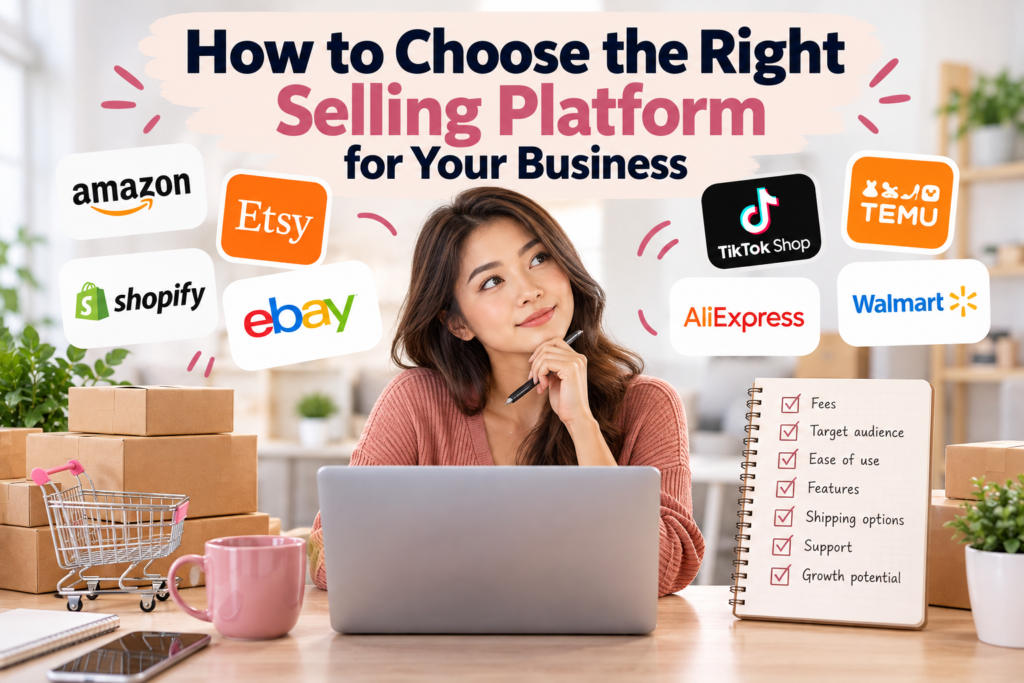
How to Choose the Right Selling Platform for Your Business
How to Choose the Right Selling Platform for Your Business
At some point, every new seller hits the same wall: you’ve got a product (or an idea for one), you’re ready to actually sell it, and then you realize there are about a dozen different places you could sell it — and no obvious answer for which one’s actually right. Amazon? Your own Shopify store? Etsy? Instagram? All of the above?
Here’s the good news: figuring out how to choose the right selling platform for your business isn’t really about finding the “best” one. There isn’t one. It’s about matching the platform to what you’re selling, who you’re selling to, and how much control versus convenience you actually want. There’s no shortcut around thinking it through — but there is a clear process. Let’s walk through it properly.
Start With What You’re Actually Selling
Before anything else, the product itself narrows the field more than people expect. A handmade ceramic mug and a downloadable PDF template don’t belong on the same type of platform, and pretending otherwise just wastes your time.
- Physical, mass-appeal products tend to do well on marketplaces like Amazon or eBay, where demand already exists
- Handmade or niche craft items fit naturally on Etsy, where buyers are specifically browsing for that
- Digital products — ebooks, templates, courses — belong on platforms built for downloads, like Gumroad or Payhip
- Anything you want full creative control over — packaging, branding, the whole experience — points toward your own ecommerce store
If you haven’t nailed down your product yet, it’s worth backing up a step. Our guide on how to validate a product idea before selling online is a good place to start before this decision even comes up.
Think About Where Your Customers Already Are
One of the most overlooked parts of choosing a selling platform is realizing you don’t have to build an audience from zero if one already exists somewhere else. Ask yourself: are the people who’d buy this already searching on Amazon? Already scrolling Instagram? Already browsing Etsy for exactly this kind of thing?
Meeting your customers where they already are is almost always easier than convincing them to go somewhere new. That’s the whole appeal of a marketplace — the traffic already exists, you’re just adding your listing to it.
Weigh Traffic Against Control
This is really the heart of how to choose the right selling platform for your business: every option sits somewhere on a spectrum between “traffic is handed to you” and “you control everything, but you’re on your own for visitors.”
Marketplaces (Amazon, eBay, Etsy) sit toward the traffic end. You get discovered faster, but you’re one listing among thousands, with limited room to build an actual brand identity. If this route appeals to you, our guide on how to start selling on Amazon covers exactly what that involves.
Independent stores (Shopify, WooCommerce) sit toward the control end. You shape the entire experience — but you’re also responsible for every visitor who shows up, which means marketing becomes non-negotiable, not optional.
Neither position is wrong. It just depends on whether you’d rather trade some independence for faster traction, or trade some traction for long-term brand ownership.
Factor In the Real Cost of Each Option
It’s easy to compare platforms on sticker price alone and miss the fuller picture. Part of learning how to choose the right selling platform is looking at the total cost, not just the headline fee:
- Listing fees (charged whether or not something sells)
- Transaction fees (a cut of every sale)
- Subscription costs (recurring, regardless of sales volume)
- Payment processing fees (usually a smaller percentage on top)
A platform that looks “free” upfront can still take a meaningful bite once transaction fees are factored in at scale — so it’s worth running the numbers against your expected margin before committing, not after your first few sales.
Consider How Much Operational Work You Want
Some platforms hand you more than just traffic — they hand you infrastructure too. Fulfillment by Amazon (FBA), for example, means Amazon stores, packs, and ships your inventory for you. That’s a very different day-to-day than running your own store, where you (or a service you hire) handle every part of the process yourself.
If you’d rather focus purely on product and marketing without becoming a logistics operator overnight, leaning toward a platform with built-in fulfillment support is worth prioritizing in your decision.
Don’t Rule Out Using More Than One
Here’s something that trips people up when you choose the right selling platform: it doesn’t have to mean picking exactly one, forever. Plenty of sellers run an independent store as their branded home base, while also listing on a marketplace to catch additional traffic they wouldn’t get otherwise. Each platform plays a different role instead of competing for the same job.
A Simple Way to Decide
If you’re still stuck, run through these questions in order:
- What am I actually selling — physical, handmade, or digital?
- Where does my audience already spend time — searching a marketplace, scrolling social media, or somewhere else?
- Do I want built-in traffic or full brand control more right now?
- What’s the real cost once fees are factored in at my expected volume?
- How much operational work am I actually willing to take on?
Answering these honestly usually narrows a dozen options down to one or two realistic choices — which is really all “choosing the right platform” comes down to.
Frequently Asked Questions
What’s the single biggest factor when you choose the right selling platform? What you’re selling and where your specific audience already shops tend to matter more than any other factor — the “best” platform is the one that matches both.
Should beginners start with a marketplace or their own store? Marketplaces are often easier for beginners since the traffic already exists. An independent store offers more control but requires you to generate your own visitors from day one.
Can I switch selling platforms later if I choose wrong? Yes. Many sellers start on one platform to test demand, then expand to or switch toward another once they understand their product and audience better.
Is it better to use one platform or multiple at once? Both approaches work. Some sellers focus entirely on one platform to keep things simple; others use multiple platforms at once to combine built-in traffic with long-term brand control.