New to online business? Start with our free 7-day roadmap and build your foundation step by step.
Get the Free Roadmap →Marketing
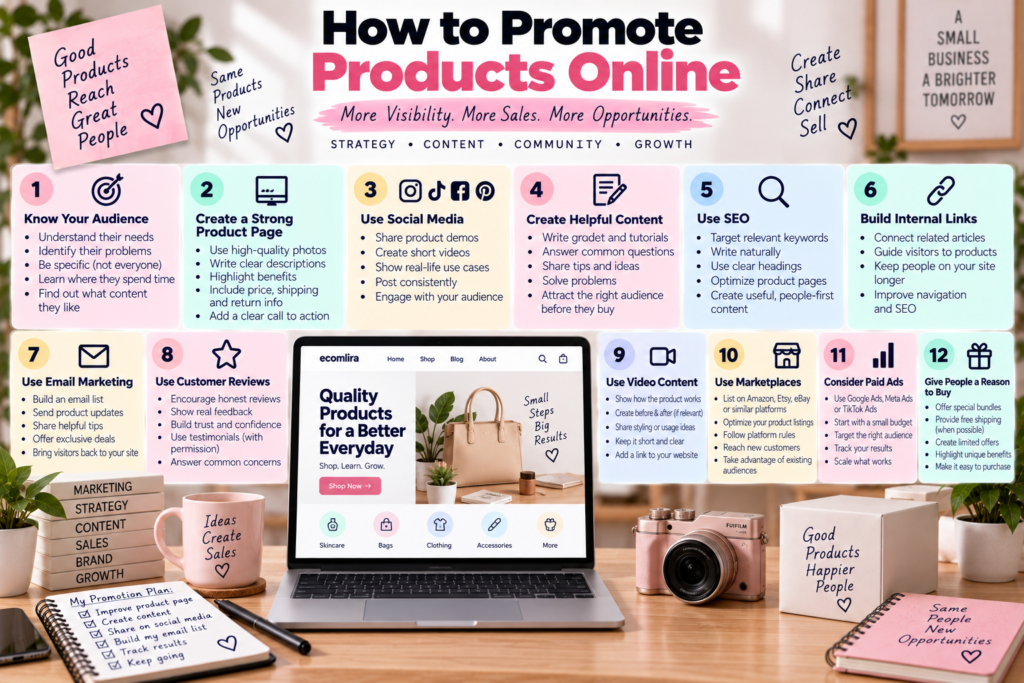
How to Promote Products Online
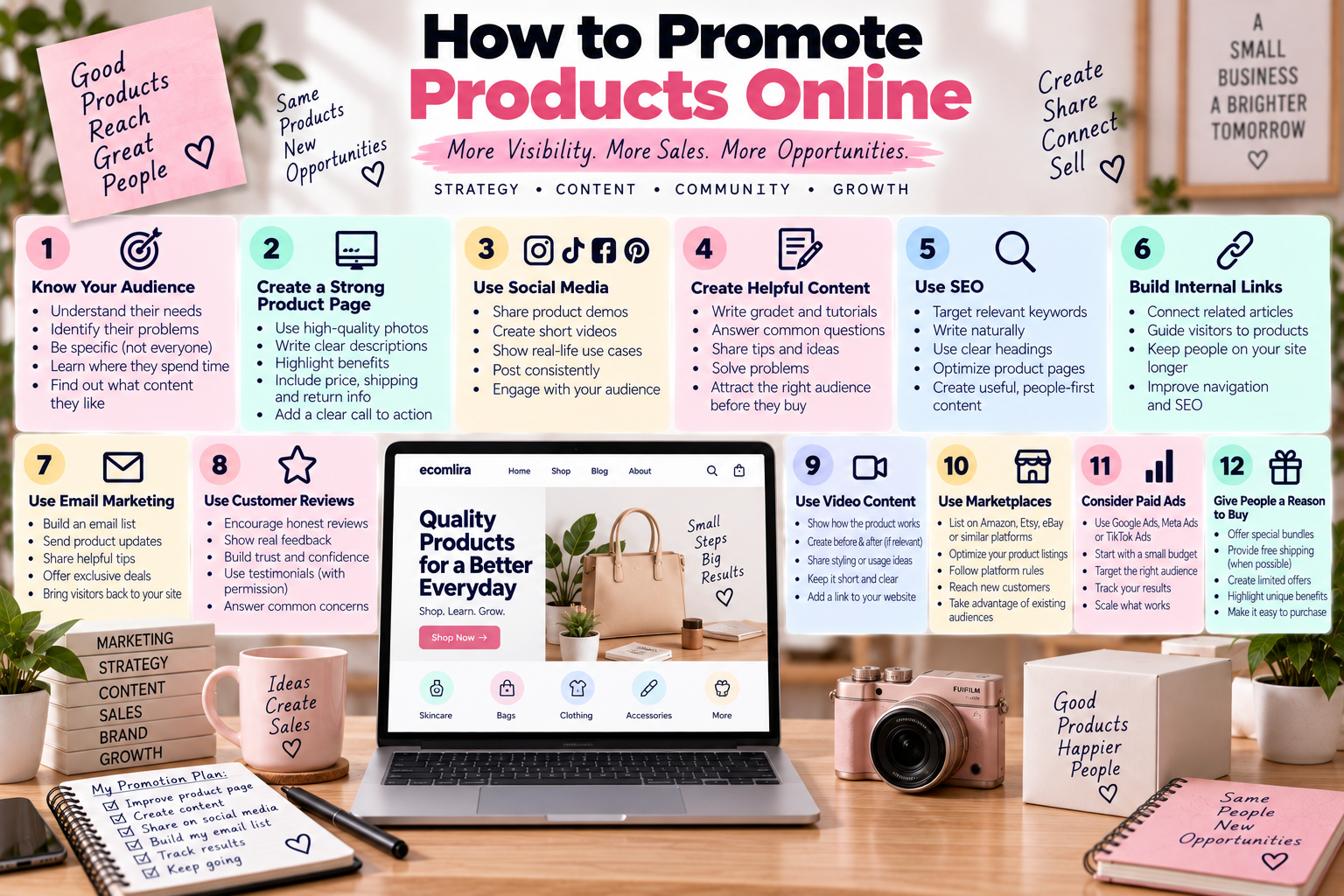
How to Promote Products Online
Selling a product online is only part of building a successful business. People also need to discover your products, understand their benefits, and have a reason to buy.
How to Promote Products Online starts with choosing the right audience and then using the channels where those potential customers already spend time.
You do not need to use every marketing channel at once. A focused strategy can be much easier to manage, especially when you’re starting with a small budget.
How to Promote Products Online
Selling a product online is only part of building a successful business. People also need to discover your products, understand their benefits, and have a reason to buy.
How to Promote Products Online starts with choosing the right audience and then using the channels where those potential customers already spend time.
You do not need to use every marketing channel at once. A focused strategy can be much easier to manage, especially when you’re starting with a small budget.
1. Know Who You Are Selling To
Before promoting anything, identify your target audience.
Think about:
- Who needs this product?
- What problem does it solve?
- What would make someone choose it?
- Where does your audience search for products?
- What questions might they have before buying?
- What type of content do they normally consume?
For example, someone selling gym clothing may target people interested in fitness, workouts, running, or active lifestyles.
Someone selling skincare products might focus on customers searching for solutions for specific skin concerns.
The clearer your audience is, the easier it becomes to create relevant marketing.
2. Create a Strong Product Page
Your product page is often where promotion turns into a potential sale.
A good product page should make it easy for visitors to understand what they are buying.
Include:
- A clear product name
- High-quality product photos
- A useful description
- Important features
- Benefits
- Size or specification information
- Price
- Shipping information
- Return information
- A clear call to action
Avoid filling the page with exaggerated claims.
Instead, explain what the product does, who it is for, and what makes it useful.
Google recommends creating useful, clear content for people rather than writing primarily to manipulate search rankings.
3. Use Social Media
Social media can put your products in front of potential customers without requiring you to pay for every person who sees your content.
Depending on your audience, you could use Instagram, TikTok, Facebook, Pinterest, YouTube, or other platforms.
Try different types of content:
- Product demonstrations
- Before-and-after content where appropriate
- Tutorials
- Product comparisons
- Frequently asked questions
- Behind-the-scenes videos
- Customer reviews
- Styling or usage ideas
- Short educational videos
Rather than posting “Buy this product” repeatedly, show people why the product is useful.
For more ideas, see How to Market Your Business on Instagram and How to Market Your Business on TikTok.
4. Create Content Around Your Products
Content marketing can help you attract people before they are ready to purchase.
Imagine that you sell running shoes.
Instead of only publishing product photos, you could create articles or videos such as:
- How to Choose Running Shoes
- What to Look for in Running Shoes
- Running Shoes for Beginners
- How Often Should You Replace Running Shoes?
- Running Shoe Mistakes to Avoid
Some of those people may eventually become customers.
The same principle works for almost any category.
A skincare business could create skincare guides. A clothing business could publish styling ideas. A home business could create organization tutorials.
Your content should provide genuine value rather than simply turning every article into an advertisement.
5. Use SEO to Reach People Searching for Products
Product SEO can help your products and supporting content become discoverable through search engines.
Think about the words potential customers might use when looking for your products.
For example:
- “black gym leggings”
- “best laptop bag for work”
- “cotton summer dress”
- “skincare routine for oily skin”
Use relevant language naturally in product titles, descriptions, headings, and supporting content.
Google explains that descriptive titles, useful content, relevant links, and clear site organization can help users and search engines understand your pages.
Avoid stuffing a product description with the same keyword repeatedly. Google specifically warns against keyword stuffing.
6. Build Internal Links
If you have a website with multiple articles and product pages, connect related content together.
For example, a clothing store could have:
Blog article → Product guide → Product page
A skincare website might have:
Skincare guide → Routine article → Recommended products
These internal links help visitors discover related information and make it easier to move around your website.
Google also explains that links help users and search engines discover other relevant pages.
You can learn more about increasing visitors in How to Get More Traffic to Your Website.
7. Use Email Marketing
An email marketing strategy can help you stay connected with people who have already shown interest in your business.
You might send:
- New product announcements
- Helpful product tips
- Special offers
- Product guides
- Seasonal recommendations
- Restock notifications
- Educational content
Not every email needs to contain a discount.
Useful information can keep your audience interested even when they are not ready to purchase immediately.
Over time, email can become a valuable way to bring previous visitors back to your website.
8. Use Customer Reviews
Reviews can help potential buyers feel more confident about a product.
After someone purchases, you can encourage them to leave an honest review.
You can also use appropriate customer feedback in your marketing, provided you have permission to use it.
Reviews can answer questions that a product description might not fully address.
For example, customers may explain how they used the product, what they liked, or what surprised them.
Just avoid creating fake reviews or misleading testimonials.
9. Promote Products Through Useful Videos
Short-form video can be particularly useful for demonstrating products.
A simple product video could show:
- The problem
- The product
- How it works
- The result or benefit
- Where to learn more
For example, a bag seller could show what fits inside the bag.
A clothing seller could demonstrate different ways to style one item.
A beauty business could show how a product is used.
The objective is to make the product easier to understand.
10. Consider Marketplaces
Depending on your product and business model, marketplaces can provide another way to reach customers.
Examples include:
- Amazon
- Etsy
- eBay
- Vinted
- Specialized marketplaces
- Social commerce platforms
The advantage is that these platforms already have audiences searching for products.
The trade-off is that you need to understand each platform’s fees, rules, competition, and customer expectations.
You can also learn more about selling through different channels in Ecomlira’s Selling Platforms section.
11. Try Paid Advertising Carefully
Free promotion methods can take time.
Once you understand which products and messages perform well, you might consider paid advertising.
Potential channels include:
- Google Ads
- Meta Ads
- TikTok Ads
- Pinterest Ads
- Marketplace advertising
Start small rather than immediately spending a large amount.
Track what happens after people click your advertisement. A high number of clicks does not automatically mean a successful campaign.
You should look at metrics such as:
- Clicks
- Conversion rate
- Cost per acquisition
- Revenue
- Return on ad spend
A product that receives many clicks but few purchases may need a better product page, clearer offer, stronger targeting, or a different audience.
12. Give People a Reason to Buy
Promotion gets attention, but the offer still needs to make sense to the customer.
Your product promotion strategy might include:
- A launch offer
- A bundle
- Free shipping above a certain amount
- A limited seasonal collection
- A loyalty benefit
- A useful bonus
- A quantity discount
You do not have to constantly offer discounts.
Sometimes better product information, stronger photography, clearer benefits, or better customer service can make a bigger difference.
A Simple Product Promotion Plan
If you are wondering How to Promote Products Online without becoming overwhelmed, start with a simple system.
Week 1
Choose one product and identify its target customer.
Improve the product page and make sure the photos, description, price, shipping information, and call to action are clear.
Week 2
Create several pieces of content around the product.
You could make a short video, an educational post, a product demonstration, and a helpful article.
Week 3
Share the content across the social platform where your audience is most active.
Connect relevant content together with internal links.
Week 4
Review the results.
Look at website visits, engagement, clicks, product views, and sales.
Then improve the approach based on what you learn.
Common Product Promotion Mistakes
Some businesses make promotion harder than it needs to be.
Common mistakes include:
- Trying to use every social platform
- Posting only advertisements
- Targeting everyone
- Using poor-quality product photos
- Making unsupported claims
- Ignoring customer questions
- Sending too many promotional emails
- Spending on ads before understanding the product
- Focusing on clicks instead of actual results
- Giving up before testing and improving
A strong strategy usually develops through testing rather than being perfect on the first attempt.
Final Thoughts
How to Promote Products Online becomes much easier when you stop thinking about promotion as simply “selling.”
Your job is to connect the right product with the right person and clearly communicate why it is useful.
Start with your audience, improve your product page, create useful content, use social media, build an email audience, and measure your results.
Once you know which channels are producing meaningful results, you can invest more time or money into the strategies that make sense for your business.
FAQ
What is the best way to promote products online?
There is no single best method for every business. SEO, social media, content marketing, email, marketplaces, reviews, and paid advertising can all work depending on the product and audience.
How can I promote products online for free?
You can use social media, SEO, useful content, email marketing, communities, referrals, and organic search to promote products without paying for every visitor.
Do I need a website to promote products online?
Not always. You can promote products through marketplaces and social platforms. However, having your own website can give you more control over your content, customer experience, and brand.
How much should I spend on product advertising?
There is no universal amount. Start with a budget you can afford to test, measure the results, and increase spending only when the numbers make sense.
Should I promote every product?
Not necessarily. Focus on products with clear demand, good customer fit, healthy margins, and a strong reason for people to choose them.