New to online business? Start with our free 7-day roadmap and build your foundation step by step.
Get the Free Roadmap →Marketing
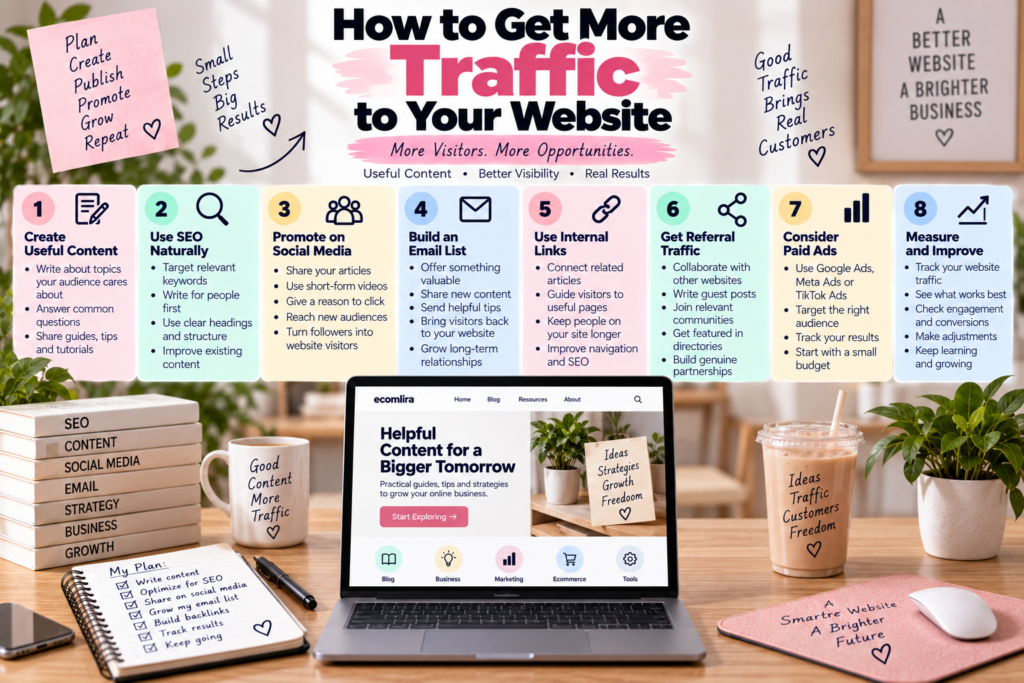
How to Get More Traffic to Your Website
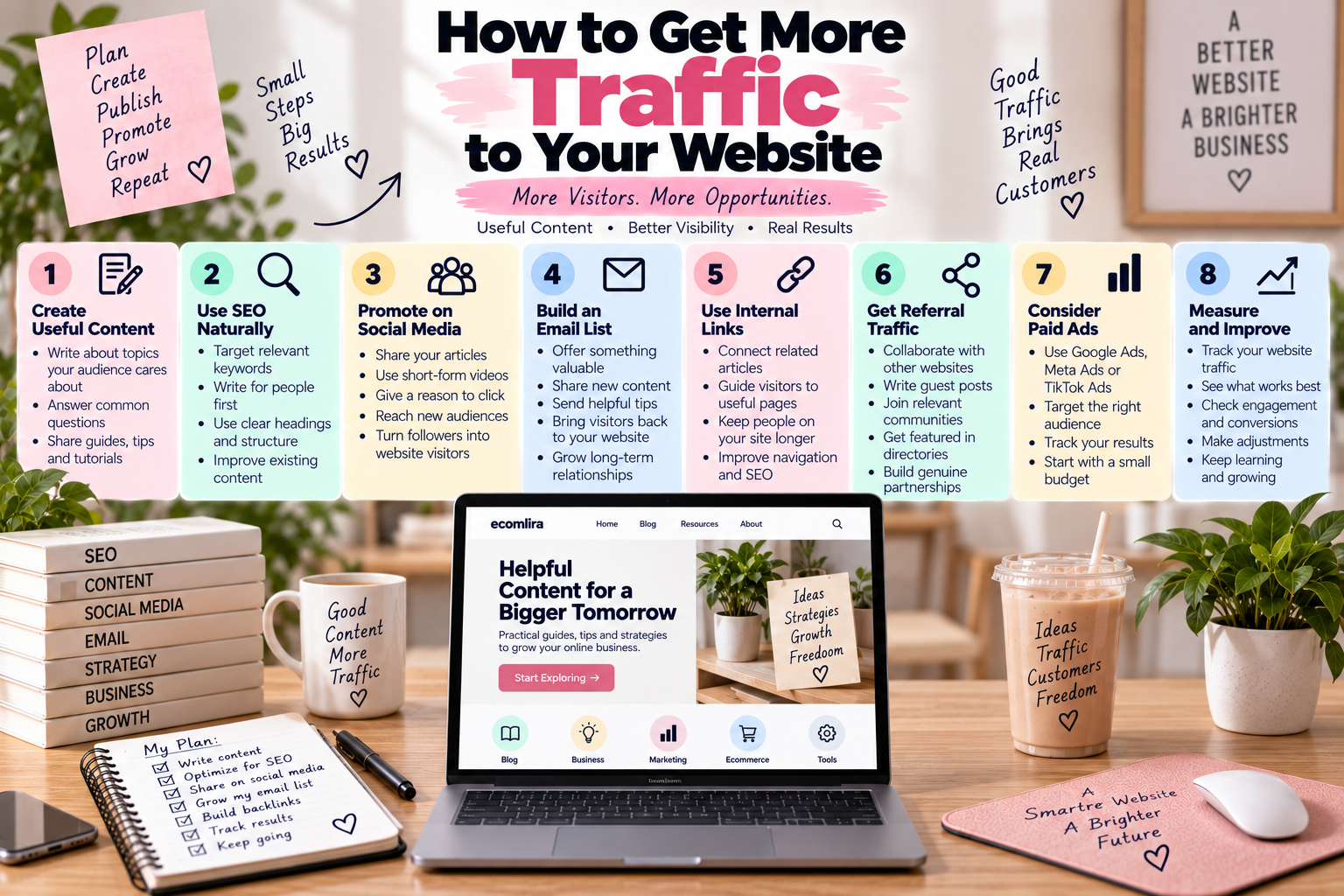
How to Get More Traffic to Your Website
Learning how to get more traffic to your website is one of the most common, ongoing challenges for any online business — without a steady stream of visitors, even the best product or the most genuinely useful content won’t convert into meaningful results. This guide covers proven, sustainable ways to get more traffic to your website, whether you’re starting from zero or trying to grow beyond a modest existing baseline.
Why “More Traffic” Isn’t Always the Right Goal in Isolation
Before diving into tactics, it’s worth a brief but important caveat: raw traffic volume matters less than the quality and relevance of that traffic. A thousand visitors with no genuine interest in what you offer will likely convert worse than a hundred visitors who are specifically searching for exactly what you provide. Keeping this in mind while pursuing more traffic helps ensure the growth you’re working toward actually translates into real business results, rather than just a bigger number on a dashboard that doesn’t meaningfully move the needle.
Start With Search Engine Optimization
SEO remains one of the most reliable long-term ways to get more traffic to your website, since it specifically targets people already actively searching for what you offer, rather than requiring you to interrupt their attention elsewhere. This includes optimizing content around specific, researched keywords, improving page load speed, and building quality backlinks over time. See our guide on how to use SEO for a small business for a deeper, practical breakdown of this specific channel.
Publish Consistent, Genuinely Useful Content
Every piece of genuinely useful content you publish is another opportunity to get more traffic to your website through search results or organic shares. Content that directly and thoroughly answers specific questions your audience is actively searching for tends to perform best over time, both in terms of initial traffic and long-term search ranking stability.
Leverage Social Media Strategically
While social media traffic tends to be less consistent and predictable than search traffic, actively sharing your content and genuinely engaging with relevant communities can meaningfully help get more traffic to your website, especially in the earlier stages before your SEO efforts have had time to build any real momentum on their own.
Build an Email List
An email list gives you a direct, repeatable way to get more traffic to your website whenever you publish something new — unlike social media or search, where visibility depends heavily on algorithms entirely outside your control. This channel becomes increasingly valuable as your subscriber base grows, since each new piece of content can be pushed directly to an audience that’s already opted in and interested.
Guest Posting and Building Backlinks
Getting other relevant, reputable websites to link back to yours — through guest posts, genuine partnerships, or simply being featured — helps get more traffic to your website both directly, through referral clicks, and indirectly, through improved search rankings that backlinks tend to produce over time. This is one of the slower channels to build but tends to compound meaningfully alongside your broader SEO efforts.
Use Free Tools to Track What’s Actually Working
Tools like Google Search Console and Google Analytics show exactly which pages and channels are currently generating traffic to your website, helping you double down deliberately on what’s already working rather than continuing to guess or spread effort evenly across channels that may not actually be producing results for your specific site.
Improve Your Site’s Technical Performance
Traffic-generation efforts can be quietly undermined by technical issues that have nothing to do with content quality or marketing effort. Slow page load times, broken links, and poor mobile responsiveness all discourage both visitors and search engines from favoring your site — meaning some of the most impactful work toward getting more traffic to your website isn’t about creating new content at all, but fixing technical friction that’s actively working against everything else you’re doing.
Optimize Existing Content, Not Just Publishing New Content
It’s easy to assume the only path to more traffic is publishing more new content, but revisiting and improving existing pages — updating outdated information, expanding thin sections, adding better internal links — can meaningfully boost traffic to content you’ve already invested time creating, often with considerably less effort than starting an entirely new piece from scratch.
Build Internal Linking Between Your Own Pages
A well-connected site, where related articles link naturally to each other, helps both visitors and search engines discover more of your content once they’ve landed on any single page. This keeps visitors engaged longer and gives search engines a clearer picture of how your content relates together as a cohesive whole, which can meaningfully support your overall SEO efforts beyond any single individual page’s own optimization.
Consider Paid Advertising Strategically
While the bulk of sustainable traffic growth tends to come from organic channels, a modest, strategically targeted ad budget can accelerate getting more traffic to your website — particularly useful for testing which messaging resonates before investing more heavily in organic content built around that same validated angle. Paid traffic works best as a complement to organic efforts, not a replacement for them, since it stops producing traffic the moment you stop actively paying for it.
Repurpose Successful Content Into Multiple Formats
Once you identify a piece of content that performs particularly well, repurposing it into other formats — a video version, a social media carousel, an email newsletter — extends its reach considerably without requiring you to generate an entirely new idea and research process from scratch. This is one of the more efficient ways to get more traffic to your website from work you’ve already invested in creating.
Engage Actively With Your Existing Audience
Traffic growth isn’t purely about reaching new people — engaging genuinely with your existing audience through comments, replies, and community participation increases the likelihood they’ll return, share your content further, and bring additional visitors along with them. A loyal, engaged core audience often becomes one of your most reliable, low-effort traffic sources over time.
Be Patient With Organic Growth Timelines
Most sustainable ways to get more traffic to your website — SEO, content, email, backlinks — take genuine time to build real momentum, typically measured in months rather than days or weeks. Paid ads can accelerate traffic in the short term, but organic channels tend to compound in a way paid traffic simply doesn’t, continuing to produce results well after the initial investment of time and effort.
Cross-Promoting Between Your Own Content and Channels
Beyond internal linking within your website itself, actively cross-promoting between your different content assets — mentioning a recent blog post in your email newsletter, sharing a video in your social captions, linking your social profiles from your site’s footer — creates multiple overlapping pathways that all funnel back toward getting more traffic to your website. Each individual channel becomes stronger when it’s actively reinforcing the others, rather than operating as a completely isolated silo with no connection to your other marketing efforts.
Understanding Traffic Seasonality in Your Niche
Depending on what you offer, traffic patterns may naturally fluctuate throughout the year — a gardening site sees different search interest in spring than winter, a tax-related business sees predictable spikes around filing deadlines. Understanding these natural patterns specific to your niche helps you plan content and promotional pushes around periods of naturally higher demand, rather than being caught off guard by seasonal dips or failing to capitalize on predictable seasonal spikes when they occur.
Common Mistakes That Quietly Limit Traffic Growth
Publishing without a distribution plan. Content that’s published but never actively shared or promoted anywhere tends to sit largely undiscovered, regardless of how genuinely good it is.
Ignoring technical site health. Slow loading times and broken navigation quietly undermine even the best content and marketing effort, often without the site owner realizing it’s happening.
Chasing every channel simultaneously. Spreading limited time and effort too thin across many channels at once often produces weaker overall results than focusing deeply on two or three that genuinely fit your specific audience and niche.
Never revisiting older content. Content published once and then completely forgotten misses meaningful opportunities for ongoing traffic that periodic updates and improvements could otherwise unlock.
Learning From Competitor Traffic Sources
Studying where competitors in your niche are getting their own traffic from — which keywords they rank for, which sites link to them, which social platforms they’re most active on — can surface channels or opportunities you hadn’t considered for your own site. Free tools offer limited competitor visibility, though even basic manual research (searching relevant terms and seeing who consistently ranks well, or checking which sites are actively backlinking to similar content) can reveal genuinely useful patterns worth incorporating into your own approach for getting more traffic to your website.
Setting Realistic Traffic Growth Goals
Rather than fixating on a single, potentially arbitrary traffic number, it helps to set specific, incremental milestones tied to actual channels and timeframes — for example, doubling organic search traffic over the next quarter, or reaching a specific number of email subscribers by a certain date. These concrete, channel-specific goals give you something genuinely actionable to work toward, rather than a vague overall target with no clear underlying strategy attached to actually achieving it.
Frequently Asked Questions
How long does it take to get more traffic to a website? This depends heavily on the channel. Paid ads can drive traffic almost immediately, while SEO and content marketing typically take several months to build meaningful, consistent traffic that continues growing over time.
Do I need to pay for ads to get more traffic to my website? No. Many websites build significant, sustainable traffic through organic SEO, content, and social sharing without any ad spend at all, though ads can meaningfully accelerate growth once your offer and messaging are already validated.
What’s the most reliable long-term source of website traffic? Search engine traffic tends to be the most reliable and sustainable long-term source, since it continues driving visitors as long as your content remains relevant, accurate, and well-optimized for the terms people are actually searching.
How do I know which traffic channel to focus on first? Consider where your specific audience already spends time and how quickly you genuinely need results — community engagement and social sharing tend to produce faster initial traction, while SEO and content build more slowly but compound more durably over a longer time horizon, often becoming your most reliable ongoing source of traffic once fully established.