New to online business? Start with our free 7-day roadmap and build your foundation step by step.
Get the Free Roadmap →Marketing
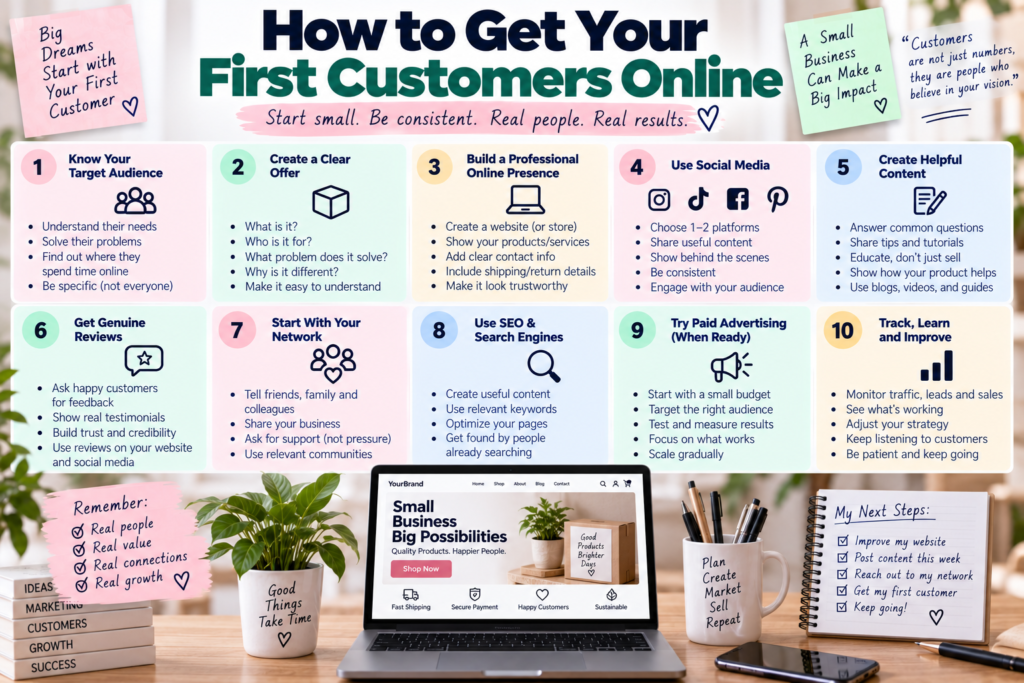
How to Get Your First Customers Online
How to Get Your First Customers Online
There’s a particular kind of quiet that follows a launch — the store is live, everything technically works, and you’re refreshing a dashboard that stubbornly shows zero. If you’re in that stage, figuring out how to get your first customers online is genuinely one of the hardest parts of starting any online business, and it’s also one of the most learnable, once you stop waiting passively for people to stumble onto you.
This guide walks through practical, realistic ways to get your first customers online — not growth-hacking theory, but the actual tactics that work when you’re starting from zero.
Why the First Customers Are the Hardest
Before diving into tactics, it’s worth understanding why this stage feels uniquely difficult. You have no reviews yet, no social proof, no existing traffic, and no data on what messaging actually resonates. Every later customer benefits from the trust signals earlier customers left behind — but those first few have to say yes with none of that reassurance in place. That’s exactly why the strategies here look different from what you’d use once the business has some momentum behind it.
Start With People Who Already Trust You
Before chasing strangers, look at who already knows you. Friends, family, former colleagues, and anyone in your existing network represent the fastest way to get your first customers online, simply because the trust-building work is already halfway done. Even a small handful of early customers can become your first reviews, referrals, and honest product feedback — all disproportionately valuable at this exact stage.
Show Up Where Your Ideal Audience Already Gathers
Rather than trying to build an audience from nothing on a brand-new platform, find where your ideal customer already spends time — a relevant Facebook group, a subreddit, a niche forum, or a local community. Genuinely helping people there, without immediately pitching your product, is one of the more underrated ways to get your first customers online without spending anything on advertising.
Lower the Risk of That First Purchase
New, unproven businesses ask a lot of trust from a complete stranger. Reducing that risk — a smaller starter offer, a clear satisfaction guarantee, transparent pricing with no hidden surprises — makes that first “yes” considerably easier to get. People are far more willing to try something new when the downside of trying it feels genuinely small.
Use Content to Build Trust Before You Ever Pitch
Publishing something genuinely useful — a blog post, a short video, a social post answering a real question your audience has — is a slower path to get your first customers online, but it compounds over time. Unlike a single ad or one-off post, well-optimized content keeps working in search results and shares long after you originally published it. Our guide on how to create content that attracts customers breaks down what actually makes content convert rather than just exist.
Don’t Be Afraid to Ask Directly
A lot of beginners hesitate to simply ask for the sale, worried it’ll come across as pushy. In practice, direct, honest outreach — messaging someone who genuinely fits your ideal customer profile and clearly explaining what you offer — is one of the most effective, and most avoided, ways to get your first customers online when you’re starting from absolute zero.
Follow Up — Most People Don’t Say Yes the First Time
Most people don’t commit to something new the very first time they hear about it. A second message, a gentle reminder, or simply answering a question they raised and never heard back on can close the sale the first attempt didn’t. Giving up after a single unanswered message is a quieter, more common reason beginners struggle longer than necessary to get their first customers online.
Turn Early Customers Into Referral Sources
Once you land a few genuine customers, ask directly whether they know anyone else who might benefit from what you offer. Referrals from actual buyers tend to convert considerably better than cold outreach, since the trust has already been transferred on your behalf. This is often the mechanism that makes the second batch of customers noticeably easier to get than the first.
Consider a Small, Targeted Ad Test
Once you have at least some initial signal about who’s actually interested — even from free channels — a small, deliberately limited ad budget can help you get your first customers online faster than waiting on organic reach alone. This isn’t necessary for everyone, but for products with a clear, specific audience, even a modest test budget can accelerate that first batch of sales meaningfully.
Using Free Tools to Track Early Progress
Even at this early stage, it’s worth setting up basic tracking so you’re not relying purely on memory or gut feeling about what’s working. Google Analytics can show where your first visitors are actually coming from, while a simple spreadsheet tracking each outreach attempt and its outcome helps you spot patterns manually — which messages get responses, which communities produce interest, which offers convert. This habit, started early, becomes increasingly valuable as your customer base grows and the patterns become harder to track purely by memory.
Make Sure Your Site Actually Converts
All the traffic and outreach in the world won’t help if visitors arrive and immediately leave. Before pushing hard on any acquisition tactic, make sure your site itself builds enough trust to convert a stranger into a buyer — clear policies, genuine information about who’s behind the business, and a straightforward checkout process. Our guide on how to get visitors to trust your website and buy covers this specific piece in much more depth.
Track Where Your First Customers Actually Come From
As you pick up your first handful of sales, pay close attention to which specific channel — your network, a community, content, direct outreach, or an ad — actually produced them. That single piece of information tells you exactly where to focus more energy next, rather than continuing to spread yourself thin across everything at once, guessing at what might eventually work.
A Simple First-Month Plan
If you’re starting from nothing right now, here’s a realistic sequence:
- Week 1 — Reach out personally to your existing network with genuine, individual messages, not mass blasts
- Week 2 — Find one or two relevant online communities and start showing up helpfully, not promotionally
- Week 3 — Publish one genuinely useful piece of content addressing a real question your audience has
- Week 4 — Follow up with everyone who showed interest but hadn’t yet said yes, and ask your first customers directly for referrals
This gives you real, usable signal within a single month, rather than months of preparation with nothing concrete to actually learn from.
Common Mistakes When Trying to Get First Customers
Waiting passively for discovery. Building something and hoping people find it organically rarely works before you have any existing traffic or reputation to lean on.
Giving up after one attempt. Most early customers require more than a single touchpoint before they’re ready to commit.
Skipping the trust-building step. Jumping straight to a hard sell without first demonstrating credibility tends to produce weaker conversion than a more patient, trust-first approach.
Spreading effort too thin. Trying every possible tactic simultaneously, rather than focusing deeply on the one or two most promising for your specific audience.
Frequently Asked Questions
How long does it typically take to get your first customers online? This varies considerably by niche and effort, but many beginners see their first sales or signups within a few weeks of consistent, direct outreach rather than waiting passively for organic discovery.
Do I need a big following to get my first customers online? No. Many businesses land their first customers through direct outreach, existing personal networks, and community engagement, long before any kind of significant audience exists.
What’s the most common mistake beginners make trying to get their first customers? Waiting for people to discover the business passively, instead of proactively reaching out, showing up in relevant spaces, and directly asking for the sale.
Should I focus on paid ads to get my first customers online? Not necessarily right away. Many beginners find more success starting with free, direct methods — personal outreach, communities, content — before investing in paid advertising once they better understand what actually resonates with their specific audience and have some initial data to guide where that ad spend should go.