New to online business? Start with our free 7-day roadmap and build your foundation step by step.
Get the Free Roadmap →Marketing
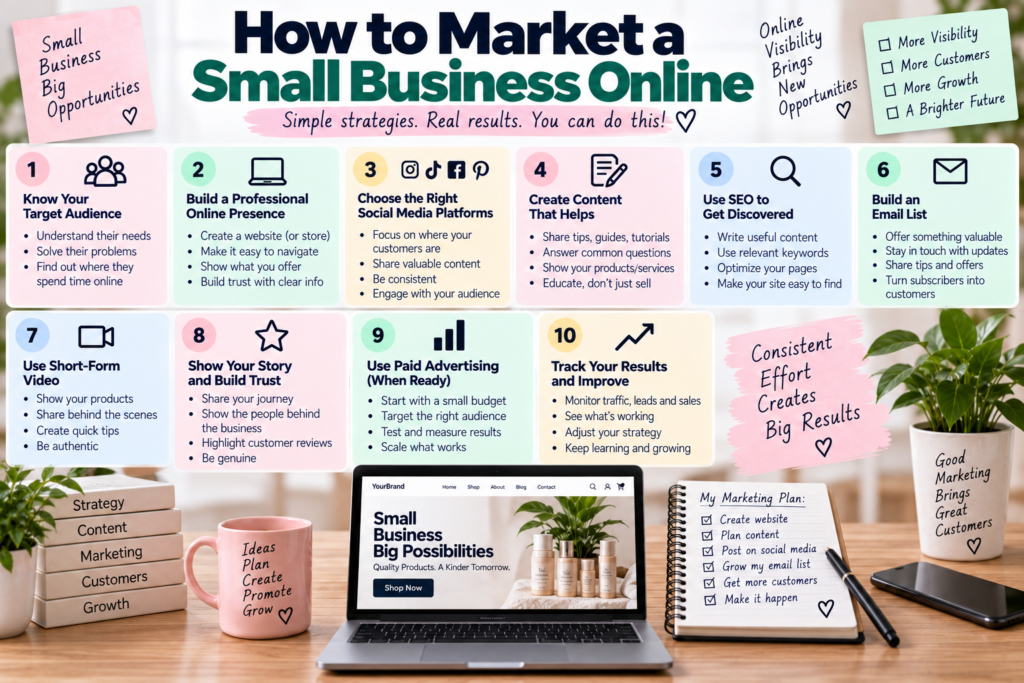
How to Market a Small Business Online
How to Market a Small Business Online
Learning how to market a small business online is one of the highest-leverage skills you can build as an entrepreneur — it doesn’t require a massive budget, just the right approach genuinely matched to your specific audience and resources. This guide covers the core tactics that actually move the needle when you market a small business online, without wasting time and money on channels that don’t fit your particular situation.
Start With a Clear Value Proposition
Before you market a small business online, be able to answer one question clearly and specifically: why should someone genuinely choose you over the alternative they’d otherwise consider? If your messaging is vague or generic, even the best marketing channel and the most polished execution won’t convert particularly well. Write this down in one or two clear sentences before creating any content, ads, or promotional materials.
Understand Your Specific Audience Deeply
Marketing a small business online works considerably better when you understand your audience beyond just basic demographics — their specific pain points, where they spend time online, what objections they typically have before buying, and what ultimately convinces them to take action. This deeper understanding shapes everything from which channels to prioritize to what messaging actually resonates once you’re there.
Claim Your Online Presence
At minimum, a small business marketing online should have:
- A simple, functional website that clearly communicates what you offer
- A Google Business Profile, especially important for local businesses
- Active social accounts on the one or two platforms your specific audience actually uses regularly
You don’t need every platform — you need the ones where your specific customers already genuinely spend time, rather than spreading effort across platforms your audience barely uses.
Use Content to Build Trust Before the Sale
One of the most effective ways to market a small business online is through content that answers real questions your potential customers already have, before you ever ask them to buy anything. This could be blog posts, short videos, or social posts — the specific format matters less than genuinely answering questions your audience is actively searching for or wondering about.
Tools like Google Trends can help you see what people are actually searching for within your niche before you invest significant time creating content built around a particular topic.
Leverage Local SEO if You Have a Physical Presence
If your small business serves a specific geographic area, local SEO is often the fastest way to market a small business online to nearby, genuinely interested customers. This includes optimizing your Google Business Profile thoroughly, actively collecting reviews, and using location-specific keywords naturally throughout your website’s content.
Build an Email List From Day One
Email remains one of the more underrated channels to market a small business online, since it gives you a direct, owned relationship with customers and prospects that doesn’t depend on any platform’s algorithm. Starting to collect email addresses early — even through something as simple as a newsletter signup or a discount offer — builds an increasingly valuable asset as your list grows over time.
Use Paid Ads to Accelerate, Not Replace, Organic Growth
Paid advertising through Google Ads or Meta Ads can be a genuinely fast way to market a small business online once you know your offer actually converts. Starting with paid ads before validating your offer organically often wastes budget on messaging that hasn’t been proven — testing your messaging with free channels first, then scaling with ads once you know what genuinely works, tends to produce considerably better returns on ad spend.
Encourage and Showcase Reviews
Genuine customer reviews are one of the more powerful, often underutilized ways to market a small business online, since potential customers consistently trust other customers’ experiences more than a business’s own marketing claims about itself. Actively asking satisfied customers for reviews, rather than passively hoping they’ll leave one unprompted, meaningfully increases how many you actually collect over time.
Partner With Complementary Local Businesses
For small businesses in particular, partnering with non-competing businesses serving a similar or overlapping audience — through co-promotions, referral arrangements, or joint events — can be a genuinely effective, low-cost way to market a small business online to an audience that’s already relevant and receptive to what you offer.
Track and Adjust Based on Real Numbers
Whatever channel you use to market a small business online, track basic numbers on a regular basis: website visits, inquiries, and actual sales. This tells you what’s genuinely working, rather than relying purely on assumptions or gut feeling about what seems to be producing results. For a full breakdown of specific individual channels, see our marketing for beginners guide.
Building a Simple Content Foundation
Once your basic online presence is in place, the most durable way to keep bringing in customers is publishing genuinely useful content on a consistent basis. Our guide on how to create content that attracts customers walks through what actually makes content convert, rather than simply existing on your site without producing any meaningful business results. Pair this with basic tracking through Google Search Console, which shows you exactly which pages are appearing in search results and which terms are bringing people to your site, so you can double down on what’s already working rather than guessing.
Creating a Customer Journey From First Contact to Purchase
Effective marketing for a small business online rarely works as a single-step process from first impression to sale. Most customers move through a rough journey: first becoming aware that a solution to their problem exists, then researching and comparing options, then finally deciding to buy. Understanding where your marketing efforts fit into that journey helps you create the right type of content or offer for each stage — educational content for people still researching, social proof and clear pricing for those close to deciding, and easy, low-friction purchasing options for those ready to buy now. Marketing that only addresses one stage often leaves significant potential customers stuck at the stages it doesn’t address.
Making Your Website Work Harder for Your Marketing
All the traffic-driving effort in the world produces limited results if your website itself doesn’t effectively convert visitors into customers or inquiries. A clear, benefit-focused headline, a straightforward path to taking the next step, genuine trust signals like reviews and a real About page, and fast, mobile-friendly performance all quietly determine what percentage of your marketing effort actually turns into business results. Investing in your website’s ability to convert existing traffic often produces better returns than simply pushing more traffic toward a site that isn’t converting well in the first place.
Balancing Multiple Channels Without Spreading Too Thin
As you market a small business online across several channels simultaneously, it’s worth being deliberate about how much genuine attention each one actually receives. A common mistake is maintaining a token presence across five or six channels, none of which get enough consistent effort to actually produce meaningful results. A more effective approach usually involves choosing one primary channel to invest most of your effort into, with one or two secondary channels receiving lighter, more sustainable ongoing attention.
The Role of Consistency Over Intensity
Small businesses marketing online often alternate between intense bursts of promotional activity and long periods of complete silence, usually driven by how busy day-to-day operations happen to be in any given week. This inconsistency tends to undermine the trust and momentum that steady, ongoing marketing efforts build over time. Even a modest but genuinely consistent marketing rhythm — a set amount of time each week dedicated specifically to marketing activities — tends to outperform sporadic, higher-intensity efforts that aren’t sustained.
Adapting Your Approach as the Business Grows
The tactics that work best for a brand-new small business with zero existing customers often need to evolve as the business matures and accumulates real customers, reviews, and market presence. Early on, direct outreach and personal network amplification tend to carry more weight; later, leveraging existing customer relationships, referrals, and accumulated social proof becomes increasingly central to how you market a small business online effectively at a more established stage.
Using Customer Feedback to Sharpen Your Marketing
Your existing customers are one of your most valuable sources of marketing insight. Pay attention to the specific language they use when describing why they chose you, what problem you solved for them, and what nearly stopped them from buying — this real, unfiltered feedback often reveals messaging angles far more effective than anything you’d come up with independently. Incorporating this genuine customer language into your website copy, ads, and social content tends to resonate more strongly with similar prospective customers, since it reflects how real buyers actually think and talk about the problem you solve.
Common Mistakes to Avoid
Trying to be everywhere at once. Spreading limited time and budget across too many channels simultaneously usually produces weak results everywhere rather than strong results in the one or two places that would genuinely matter most.
Neglecting to track what’s working. Marketing without measurement makes it nearly impossible to know whether your efforts are genuinely paying off or simply consuming time and money without meaningful return.
Copying a competitor’s strategy without adaptation. What works for a differently-positioned or differently-resourced competitor may not translate directly to your own specific business, audience, and available resources.
Inconsistent effort over time. Marketing that happens only when things feel slow, rather than as an ongoing, consistent practice, tends to produce weaker cumulative results than steady, sustained effort maintained over months.
Frequently Asked Questions
What’s the cheapest way to market a small business online? Organic content, SEO, and social media are typically the lowest-cost ways to market a small business online, since they cost time rather than direct ad spend, though they generally require more patience before producing meaningful results.
How long before online marketing shows results for a small business? This depends on the channel. Paid ads can show results within days; organic content and SEO usually take a few months to build meaningful, lasting traction, but tend to produce more durable, compounding results over time.
Should a small business focus on one platform or several? Most small businesses see considerably better results focusing deeply on one or two platforms where their audience is most genuinely active, rather than spreading effort across many platforms with minimal, inconsistent attention to each.
How much should a small business spend on marketing? This varies significantly by industry and goals, but many small businesses start with primarily organic, free channels before gradually introducing paid advertising once they understand what specifically converts for their particular offer and audience — and reinvesting a portion of early revenue into marketing tends to be more sustainable than committing a large fixed budget before you know what works.