New to online business? Start with our free 7-day roadmap and build your foundation step by step.
Get the Free Roadmap →Marketing
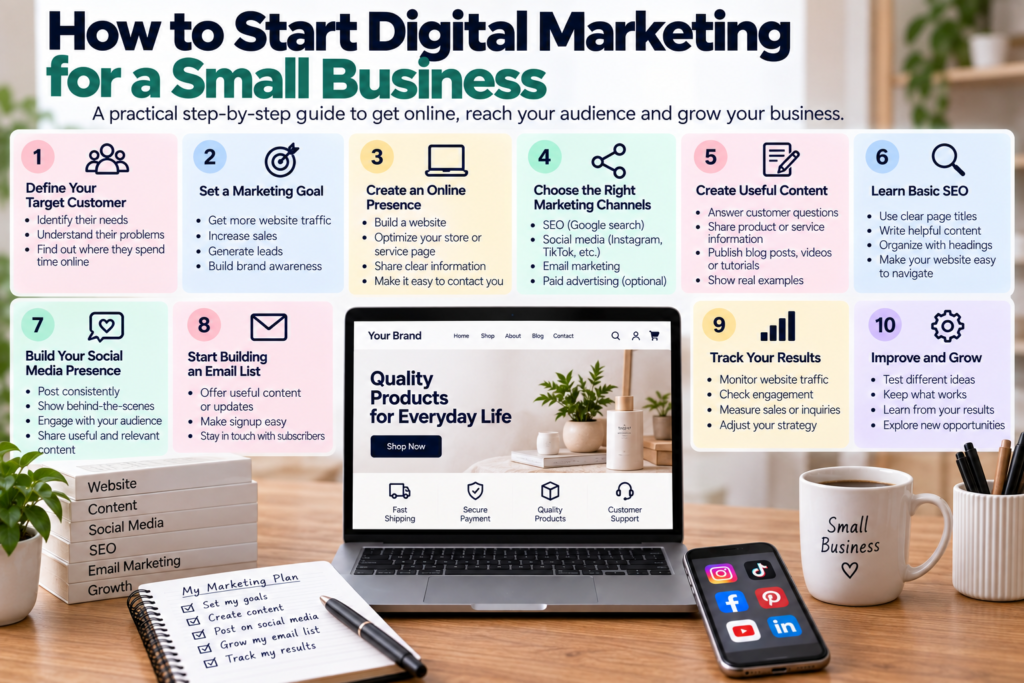
How to Start Digital Marketing for a Small Business
How to Start Digital Marketing for a Small Business
Getting started with digital marketing for a small business can feel overwhelming — there are dozens of channels, tools, and strategies all competing for your attention, and most advice online assumes you already have a team and a budget. The good news is you don’t need all of it at once. This guide walks through a realistic, step-by-step approach to digital marketing for a small business, built for owners who are doing this themselves, part-time, alongside everything else.
If you’re still setting up the business itself, our guide on how to start an online business is a good place to begin first, since everything below builds on having a clear offer and somewhere for customers to land.
How to Start Digital Marketing for a Small Business
Getting started with digital marketing for a small business can feel overwhelming — there are dozens of channels, tools, and strategies all competing for your attention, and most advice online assumes you already have a team and a budget. The good news is you don’t need all of it at once. This guide walks through a realistic, step-by-step approach to digital marketing for a small business, built for owners who are doing this themselves, part-time, alongside everything else.
If you’re still setting up the business itself, our guide on how to start an online business is a good place to begin first, since everything below builds on having a clear offer and somewhere for customers to land.
What Digital Marketing Actually Means for a Small Business
Digital marketing for a small business is simply the practice of reaching and winning customers through online channels: search engines, social media, email, your website, and paid ads. The difference between a small business and a large one isn’t the channels available — it’s the resources. A large company can run five channels with a dedicated team each. A small business has to choose, and choosing well is most of the battle. If you want the broader definition first, our guide on what is digital marketing covers the fundamentals.
Step 1: Define Your Audience Before Your Channels
Before choosing where to market, get specific about who you’re marketing to. “Everyone” isn’t an audience. Digital marketing for a small business works best when you know:
- What problem your product or service solves
- Who typically has that problem
- Where that person already spends time online
- What they search for when they’re looking for a solution
This single step prevents most of the wasted effort beginners run into, because it turns channel selection from a guessing game into a logical decision.
Step 2: Build a Simple Website or Landing Page
Even a one-page website gives your business a home base for digital marketing — somewhere to send traffic from social media, search, or ads. It doesn’t need to be elaborate at first. It needs to clearly explain what you offer, show that you’re a real business, and make it easy to buy or get in touch. A beautiful campaign that sends people to a confusing page wastes every dollar and hour behind it.
Step 3: Set Up Your Free Foundations
Several free tools form the base of almost every small business’s digital marketing:
- A Google Business Profile — essential for local businesses, and it directly affects visibility in local search and Google Maps
- Google Analytics — so you can see who visits your site and what they do there
- Google Search Console — so you can see how your site appears in search results
These take an afternoon to set up and give you the data you’ll need to make every later decision with evidence rather than guesswork.
Step 4: Pick One Primary Channel
This is where most small businesses go wrong with digital marketing — trying to be active on five platforms at once and doing none of them well. Instead, choose one primary channel based on your audience:
- If your audience searches before buying, start with content and SEO
- If your audience is visual or browsing, start with Instagram or TikTok
- If you already have contacts or past customers, start with email
One channel done consistently beats five channels done occasionally. Once the first is running smoothly, you can add a second.
Step 5: Create a Simple Content Plan
Once you’ve picked a channel, plan your content in advance rather than creating it reactively. Even a simple weekly plan — what to post, when, and why — makes digital marketing for a small business dramatically more sustainable. Content that answers real customer questions tends to outperform content that only talks about your business, because it gives people a reason to engage before they’re ready to buy.
Step 6: Start Collecting Emails Early
An email list is one of the few marketing assets you truly own. Social platforms can change their algorithms overnight; your email list can’t be taken away. Even a simple signup offer — a discount, a guide, a checklist — starts building an audience you can reach directly, at no per-message cost, whenever you have something worth sharing.
Step 7: Track What’s Actually Working
Free tools like Google Analytics and your platform’s built-in insights (Instagram Insights, TikTok Analytics) show what’s actually driving traffic or engagement, not just what feels like it’s working. Check this monthly and decide whether to keep, adjust, or drop each tactic. The goal isn’t perfect data; it’s replacing “I think” with “I can see.”
Step 8: Add Paid Advertising Only After You Know What Works
Paid ads can accelerate results, but they amplify whatever you already have, good or bad. If your offer and messaging haven’t been tested, ads just spend money faster. A better sequence is testing your message organically, noting what resonates, and then putting a small, deliberate ad budget behind the messages that already work.
Choosing the Right Channel for Your Business Type
Different business types tend to find different channels more productive:
- Local service businesses (plumbers, salons, cafes) usually get the most from a Google Business Profile, local SEO, and reviews
- Ecommerce stores often benefit from social media, email, and eventually paid ads, since products are visual and impulse-friendly
- Professional services and consultants tend to do well with content marketing and LinkedIn, where trust and expertise matter most
- Digital product sellers often combine content, email, and social to build an audience before launching
Matching the channel to how your customers actually make decisions matters far more than which channel is currently fashionable.
How Much Time Should You Spend on It?
For a small business owner doing this alone, a realistic starting commitment is a few hours per week, done consistently. That’s enough to publish regularly on one channel, respond to comments and messages, and review your numbers monthly. Trying to do more usually leads to burnout and inconsistency, which is worse than a modest but reliable rhythm.
How Long Until You See Results?
Setting realistic expectations prevents giving up too early. Paid ads can produce visible results within days, but organic channels like SEO and content typically take three to six months to build momentum. Social media falls somewhere between, often taking weeks before a pattern of what works becomes clear. Digital marketing for a small business is a compounding investment: the early months feel slow, and the later months benefit from everything built before.
Working With a Small Budget
Budget constraints shape digital marketing for a small business more than almost any other factor, and it helps to plan around them honestly rather than pretending they don’t exist. If your budget is close to zero, lean on channels that cost time rather than money: content, SEO, organic social, and email. If you have a modest budget, a sensible split is putting most of it behind whichever channel is already producing results, with a small portion reserved for testing something new. Avoid spreading a small budget evenly across many channels, since none will receive enough to generate meaningful data.
Building Trust With a Brand-New Audience
Small businesses often lack the name recognition that makes larger competitors easy to trust, so trust has to be built deliberately. Genuine customer reviews, clear contact information, a real About page, and transparent policies all help. Publishing content that demonstrates real expertise also builds credibility before a sale, since people are far more willing to buy from a business that has already helped them for free. Our guide on how to get visitors to trust your website and buy covers the specific trust signals that matter most.
Local vs. National Digital Marketing
Whether your customers are nearby or spread across the country changes your approach considerably. Local businesses benefit most from local SEO, Google Business Profile optimization, and review collection, since customers often search with phrases like “near me.” Businesses serving a national or global audience compete on broader keywords and typically rely more on content, social media, and email to reach people who’d never find them through a local search. Knowing which category you fall into prevents investing in tactics designed for the wrong kind of customer.
Common Mistakes to Avoid
Trying every channel at once. This spreads limited time and money too thin to produce results anywhere.
No consistent schedule. Sporadic activity rarely builds momentum in any digital marketing for a small business strategy.
Ignoring the data. Continuing a tactic that isn’t working, simply because it should work, wastes time better spent elsewhere.
Sending traffic to a weak website. If visitors arrive and can’t quickly understand what you offer or how to buy, more traffic won’t help.
Expecting overnight results. Most channels reward patience and consistency far more than intensity.
Learning the Skills as You Go
You don’t need formal training to start digital marketing for a small business, but a few free resources speed up the learning curve considerably. Google’s Digital Garage offers free introductory courses on marketing fundamentals, and most major platforms publish their own beginner guides for their advertising and analytics tools. Combining a little structured learning with hands-on practice, then reviewing your own results, is usually the fastest path to genuine competence.
Revisiting Your Strategy Every Quarter
Digital marketing isn’t a set-and-forget task. Platforms change, competitors adapt, and your own business evolves. A short quarterly review — what’s working, what isn’t, what to try next — keeps your approach current without requiring constant overhaul. Treat each quarter as a small experiment: pick one thing to improve, measure it, and keep what works.
A Simple 30-Day Starter Plan
If you want a concrete starting point, here’s a realistic first month:
- Week 1: Define your audience, set up your Google Business Profile, Analytics, and Search Console
- Week 2: Clean up your website so your offer and next step are unmistakable
- Week 3: Choose your one primary channel and publish your first few pieces of content
- Week 4: Set up a basic email signup, review what you’ve learned, and plan the next month
For a deeper dive into specific tactics once you have these basics in place, see our marketing for beginners guide.
Frequently Asked Questions
How much should a small business spend on digital marketing? This varies widely, but many small businesses start with organic (free) channels before adding paid advertising once they understand what converts. Your time is the main early investment.
Can I do digital marketing for my small business myself? Yes, especially in the early stages. Many successful small businesses start with the owner handling marketing directly before hiring help or an agency once the workload outgrows one person.
What’s the fastest digital marketing channel for a small business? Paid advertising tends to produce the fastest visible results, though organic channels like content and SEO typically produce more sustainable long-term traffic at lower ongoing cost.
Do I need a website for digital marketing? Almost always, yes. A website, even a simple one, is where your marketing efforts point. Social profiles alone rarely give you the same credibility, control, or ability to capture leads.
Which digital marketing skills matter most for a beginner? Clear writing, basic analytics literacy, and consistency matter more than any single technical skill. Most other skills can be learned by doing.