New to online business? Start with our free 7-day roadmap and build your foundation step by step.
Get the Free Roadmap →Marketing
What Is Digital Marketing?
What Is Digital Marketing?
If you’re starting an online business, you’ve probably heard the term everywhere — but what is digital marketing, exactly, beyond a vague catch-all for “marketing that happens on a computer”? At its core, digital marketing is any marketing that happens through digital channels: websites, search engines, social media, email, and paid ads, instead of traditional media like print, TV, or billboards.
This guide breaks down exactly what is digital marketing, the main channels every beginner should understand, and how it fits into building an online business from the ground up.
The Main Types of Digital Marketing
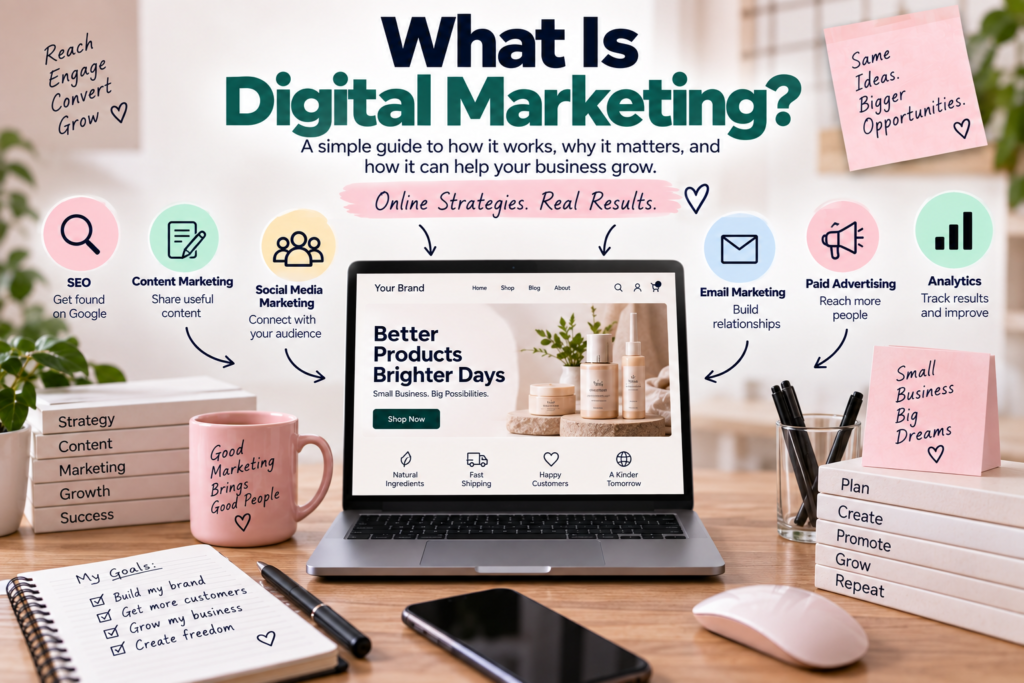
Digital marketing isn’t one single activity — it’s an umbrella term covering several genuinely distinct channels, each with its own dynamics:
- Search Engine Optimization (SEO) — improving your visibility in organic, unpaid search results over time
- Content marketing — blog posts, videos, and guides that attract and inform an audience before ever pitching them
- Social media marketing — building a presence and engaging customers on platforms like Instagram and TikTok
- Email marketing — nurturing leads and customers directly through their inbox, on a channel you fully control
- Paid advertising — running targeted ads on platforms like Google or Meta to reach a specific audience quickly
Most businesses that succeed with digital marketing don’t rely on just one channel — they combine two or three that genuinely suit their audience, budget, and available time.
Why Digital Marketing Matters for Beginners
Traditional marketing — TV, print, billboards — usually requires large budgets most beginners simply don’t have access to. Digital marketing levels the playing field considerably: a well-written blog post or a well-targeted social post can genuinely compete with much bigger competitors, because visibility increasingly depends on relevance and consistency rather than raw ad spend alone.
Businesses that prioritize content specifically tend to see meaningfully higher returns on marketing investment compared to those that rely purely on paid channels — a good example of how digital marketing rewards sustained, consistent effort over simply having the biggest budget in the room.
How Digital Marketing Differs From Traditional Marketing
The core difference isn’t just where the marketing happens — it’s measurability. Digital marketing lets you see exactly how many people saw a post, clicked a link, or completed a purchase, often in near real time. Traditional marketing rarely offers anywhere near that level of detail, which makes it considerably harder to know what’s actually working versus what merely feels like it’s working.
How to Choose Where to Start
With so many channels under the digital marketing umbrella, beginners often try to do everything simultaneously — and end up doing nothing particularly well as a result. A more effective approach:
- Identify where your specific audience already spends time
- Pick one primary channel to focus on deeply for the first few months
- Track real results before adding a second channel into the mix
If your audience tends to research before buying, SEO and content marketing are usually a strong starting point. If your audience responds well to visuals and short video, social platforms like Instagram or TikTok may produce faster initial traction. For a deeper breakdown of getting started with any specific channel, our guide on marketing for beginners: how to get your first customers walks through the practical starting steps.
Organic vs. Paid Digital Marketing
Within digital marketing, it’s worth distinguishing between organic efforts (content, SEO, unpaid social posting) and paid efforts (ads across search, social, or display networks). Organic channels typically take longer to build momentum but cost time rather than direct spend, while paid channels can produce faster results but stop the moment the budget runs out. Most sustainable digital marketing strategies eventually blend both — using organic content to build long-term assets while layering in paid campaigns for more immediate, targeted reach.
Digital Marketing and the Customer Journey
Effective digital marketing typically maps loosely to a customer’s journey from first becoming aware of a problem through to actually purchasing a solution. Content and SEO often work best at the earlier awareness stage, when someone is still researching. Email marketing and retargeting ads tend to work better further along, once someone has already shown some interest. Understanding roughly where your audience sits in this journey helps you choose which digital marketing channel is actually appropriate for a given piece of content or campaign, rather than treating every channel as interchangeable.
Measuring Digital Marketing Performance
One of digital marketing’s biggest advantages over traditional advertising is the ability to measure results in detail. Free tools like Google Analytics and Google Search Console let you track exactly which channels are driving traffic, engagement, and — ultimately — sales. Reviewing this data regularly, rather than relying on assumptions about what’s working, is what separates digital marketing efforts that genuinely improve over time from ones that stay stagnant despite continuous activity.
Common Digital Marketing Mistakes Beginners Make
Trying every channel simultaneously. Spreads limited time and budget too thin to produce strong results anywhere.
No consistent posting or publishing schedule. Sporadic activity rarely builds the momentum that most digital marketing channels depend on.
Ignoring the data. Continuing a tactic that isn’t actually producing results, simply because it “should” theoretically work, wastes time and budget better spent elsewhere.
Confusing activity with results. Being active across many channels doesn’t automatically translate into meaningful business outcomes — what matters is whether the activity is actually converting.
How Digital Marketing Connects to Broader Business Strategy
Digital marketing doesn’t exist in isolation from the rest of your business — it should directly support your actual sales process and customer relationships, not just generate abstract traffic or impressions. A digital marketing effort that drives visitors but doesn’t connect to a clear conversion path, whether that’s a checkout page or an inquiry form, ends up producing activity without meaningful business outcomes. Mapping your chosen channels back to specific, measurable business goals from the start helps avoid this disconnect.
Building a Simple Digital Marketing Foundation
For a beginner, a reasonable starting foundation for digital marketing might include a basic website, a Google Business Profile if serving a local area, one primary content or social channel, and an email list started from day one, even before it has many subscribers. This foundation can expand over time as you learn what’s actually working for your specific business, rather than attempting to build out every possible channel before you’ve validated anything.
Digital Marketing Skills Worth Developing Early
Even without hiring a dedicated marketer, a few foundational skills tend to serve small business owners well as they take on digital marketing themselves: basic copywriting for clear, persuasive messaging; enough comfort with analytics tools to read what’s actually happening rather than guessing; and enough understanding of SEO fundamentals to make content genuinely discoverable. None of these require formal training to start — most are learnable through consistent, hands-on practice over the first few months of actually running campaigns and watching what happens.
Digital Marketing Trends Worth Watching
The specific tools and platforms within digital marketing shift constantly, but a few broader patterns tend to hold steady: search engines and social platforms increasingly favor genuinely useful, original content over thin or purely promotional material; video continues gaining ground across nearly every channel; and personalization — tailoring messaging to specific audience segments rather than blasting generic content to everyone — consistently outperforms one-size-fits-all approaches. Staying broadly aware of these shifts matters more than chasing every new individual tool or platform that emerges.
Frequently Asked Questions
Is digital marketing expensive to start? No. Many digital marketing channels, like content marketing, SEO, and organic social media, cost time rather than direct money, which makes them genuinely accessible to beginners working with limited budgets.
Do I need to use every digital marketing channel? No. Most small businesses see considerably better results focusing deeply on one or two channels rather than spreading effort thin across all of them simultaneously.
How long does digital marketing take to show results? This varies significantly by channel. Paid ads can show results within days, while SEO and content marketing typically take months to build real momentum, though the results tend to compound and last longer once established — unlike paid spend, which stops producing visibility the moment the budget runs dry.
What’s the difference between digital marketing and social media marketing? Social media marketing is one specific channel within the broader digital marketing umbrella. Digital marketing encompasses SEO, email, content, and paid advertising as well, not just activity on social platforms — social media is a piece of the picture, not the whole picture.
1 thought on “What Is Digital Marketing?”
Comments are closed.
[…] choosing well is most of the battle. If you want the broader definition first, our guide on what is digital marketing covers the […]